By Panafrican.email Business Desk

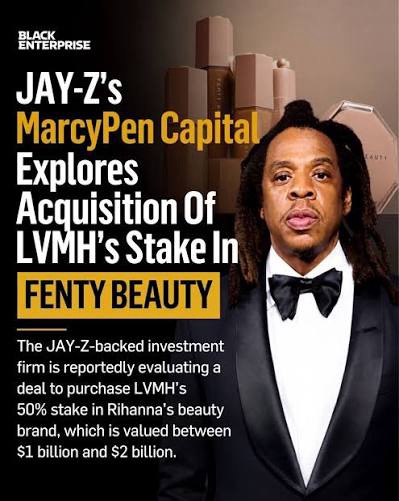
In the global beauty industry, ownership is increasingly becoming as important as influence. That reality is now on full display as reports indicate that MarcyPen Capital Partners, the investment firm backed by hip-hop entrepreneur and billionaire Jay-Z, has emerged as a leading contender to acquire luxury giant LVMH’s 50 percent stake in Fenty Beauty, the cosmetics company co-founded by Rihanna. (Billionaires.Africa)
If completed, the transaction would represent far more than another celebrity-business headline. It would mark one of the most significant transfers of ownership in a modern Black-founded global consumer brand and could reshape how African and diaspora investors think about beauty, culture, and capital.
The Asset Everyone Wants

Since launching in 2017, Fenty Beauty has become one of the most influential cosmetics brands of the 21st century. Built around inclusivity and a broad range of foundation shades, the company challenged long-standing assumptions about who luxury beauty products were designed for. The brand quickly expanded into international markets and became a commercial force within the cosmetics sector. (LVMH)

Fenty’s success transformed Rihanna from global entertainer into one of the world’s most successful entrepreneur-founders. The company operates through a joint venture structure in which Rihanna and LVMH reportedly each hold a 50 percent ownership stake. (Investing.com)

Now, amid broader portfolio restructuring at LVMH, the French luxury conglomerate has reportedly explored selling its position in the business. Analysts have estimated the value of the stake at between $1 billion and $2.5 billion depending on valuation methodology and market conditions. (Billionaires.Africa)
Why MarcyPen Matters
For MarcyPen Capital, acquiring the stake would provide immediate exposure to a globally recognized beauty platform with proven consumer demand.
More importantly, it would represent a shift from celebrity endorsement economics toward ownership economics.
For decades, Black entertainers generated billions of dollars in value for multinational corporations through advertising campaigns, licensing deals, and cultural influence. Yet ownership of the underlying businesses often remained concentrated elsewhere.
A MarcyPen-Fenty transaction would place one of the most valuable beauty brands associated with Black culture under an ownership structure led by two of the most successful Black entrepreneurs of their generation: Rihanna and Jay-Z.
That possibility carries symbolic weight far beyond Wall Street.
The Rise of Cultural Infrastructure
The beauty industry has entered a new phase.
Brands are no longer simply selling products. They are building ecosystems around identity, community, and cultural influence.

Fenty Beauty demonstrated that inclusivity could be commercially powerful. The company’s launch pushed competitors throughout the industry to expand shade ranges and rethink product development strategies. What became known as the “Fenty Effect” fundamentally altered the cosmetics landscape. (YouTube)
MarcyPen’s reported interest suggests investors increasingly see cultural brands as long-term infrastructure assets rather than short-term celebrity ventures.
In that framework, Fenty Beauty is not merely a makeup company. It is a platform with intellectual property, distribution relationships, consumer loyalty, and global cultural relevance.
What It Means for Africa
For African entrepreneurs and investors, the significance extends beyond cosmetics.
The transaction highlights a larger trend: the growing importance of ownership in industries where Black consumers and creators drive demand.
African markets are among the fastest-growing beauty markets globally, supported by expanding middle classes, digital commerce, and increasing demand for products designed for diverse skin tones.
A stronger connection between diaspora-owned investment firms and globally recognized beauty brands could eventually create new pathways for manufacturing, distribution, retail partnerships, and talent development across the continent.
Whether through supply chains, partnerships, or future expansion strategies, Africa represents an increasingly important growth frontier for global beauty companies.
The Bigger Question
The central question is not whether Fenty Beauty can continue to grow.
The brand has already proven its staying power.
The real question is who will own the next chapter of that growth.
If MarcyPen succeeds in acquiring LVMH’s stake, the deal could become a landmark case study in the evolution of Black capital—one in which cultural influence is no longer merely monetized by outside institutions but increasingly controlled by those who created it.
For investors across Africa and the diaspora, that may be the most important beauty story of all.
Leave a Reply