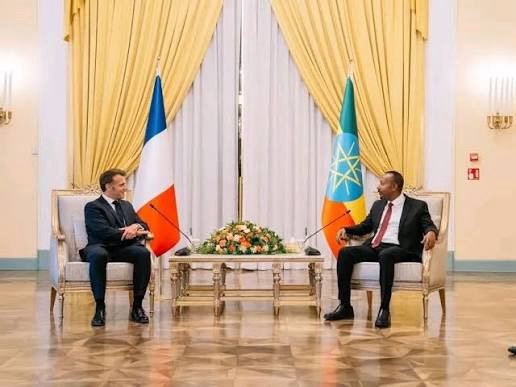
A new €54.6 million ($60+ million) concessional loan agreement between France and Ethiopia is reshaping political conversations across Africa about sovereignty, infrastructure, and the future direction of Pan-African alliances. The deal, signed during French President Emmanuel Macron’s visit to Addis Ababa, focuses on energy modernization, digitalization of Ethiopia’s national grid, and renewable energy expansion.
Under the agreement, Ethiopia will use the financing to modernize electricity transmission infrastructure, automate substations, improve grid management, and strengthen technical training systems. French-backed firms including GE Vernova France and RTE International are expected to participate in implementation. The wider RISED initiative connected to the agreement reportedly forms part of a broader €270 million European-supported energy and digital infrastructure strategy in Ethiopia.
For many Africans, however, the significance of the deal goes far beyond electricity.
Ethiopia’s Balancing Act Between East and West
Abiy Ahmed has increasingly positioned Ethiopia as a state willing to cooperate with multiple global power centers simultaneously — China, the Gulf states, Russia, Europe, the United States, and African institutions. Rather than fully aligning with one bloc, Addis Ababa appears to be pursuing a multi-vector strategy designed to maximize investment while preserving national leverage.
The French loan arrives at a moment when Ethiopia is aggressively pursuing industrial expansion, digital infrastructure, renewable energy, and geopolitical influence in the Horn of Africa. The country has also secured major investment commitments from several countries in recent months.
Unlike the anti-French rhetoric now dominant in parts of the Sahel, Ethiopia’s leadership appears willing to engage France pragmatically if the relationship produces infrastructure financing and technological transfer.
That distinction is politically important.
What This Means for the AES Alliance
The emergence of the Alliance of Sahel States — led by Mali, Burkina Faso, and Niger — has dramatically changed African political discourse. The AES governments built much of their legitimacy around resisting French military and economic influence after years of frustration with counterterrorism operations and post-colonial dependency structures.
Because of that, some Pan-African observers may interpret Ethiopia’s acceptance of French financing as contradictory to the anti-neocolonial position promoted by AES leaders.
Yet the situation is more complicated.
The AES project is largely rooted in security sovereignty and monetary independence in the Sahel. Ethiopia’s priorities are different: energy security, industrial modernization, regional influence, and economic recovery after years of internal conflict.
This creates two competing schools of thought inside Pan-African political circles:
- The Sovereignty-First Position
Critics argue that European financing often comes with long-term geopolitical influence, tied contracts, and strategic dependency. Across social media and online forums, some Africans view renewed French engagement in Ethiopia as Paris attempting to regain influence on the continent after setbacks in West Africa. - The Strategic Engagement Position
Others argue African nations should not reject investment simply because it originates from Europe. From this perspective, the key issue is whether African governments maintain control over their resources, infrastructure, and policy direction.
For the AES bloc, Ethiopia’s approach may serve as both a challenge and a lesson. Addis Ababa is demonstrating that African states can negotiate with Western powers without necessarily adopting a subordinate political posture. Whether that balance can be maintained long term remains uncertain.
South Africa’s Perspective
South Africa is likely watching developments carefully.
Pretoria has increasingly promoted a foreign policy rooted in strategic non-alignment through platforms like BRICS while still maintaining economic ties with Europe and the United States. Ethiopia’s deal with France reflects a similar diplomatic philosophy: engage globally, avoid isolation, and pursue infrastructure wherever capital is available.
South Africa may also see Ethiopia as an emerging competitor for continental leadership.
Both countries aspire to shape Africa’s economic future. Ethiopia represents East Africa’s demographic and infrastructure powerhouse, while South Africa remains Africa’s most industrialized economy and a major financial center. As Ethiopia modernizes its energy and digital sectors, its influence within continental institutions could grow substantially.
At the same time, South Africa has historically supported stronger African self-reliance and regional integration. The Ethiopian-French agreement therefore raises broader questions:
- Can Africa industrialize without external financing?
- Should African nations prioritize ideological purity or economic pragmatism?
- Is Pan-African solidarity compatible with selective partnerships with former colonial powers?
These questions increasingly define Africa’s geopolitical future.
The Bigger Pan-African Debate
The Ethiopia-France agreement reveals an emerging divide inside modern Pan-Africanism itself.
One vision emphasizes complete disengagement from former colonial powers and the creation of fully independent African financial, military, and technological systems.
Another vision argues Africa should engage all global powers strategically while building internal capacity gradually.
Neither side completely dominates the continent today.
The AES alliance has become the strongest symbol of anti-Western sovereignty politics in Africa, while countries like Ethiopia, Rwanda, Kenya, Morocco, and South Africa continue pursuing hybrid diplomatic models that combine African nationalism with global partnerships.
The real issue may not be whether African countries cooperate with Europe, China, Russia, or America — but whether those relationships ultimately strengthen African production, energy independence, and technological sovereignty.
If Ethiopia uses this financing to expand local technical expertise, modernize infrastructure, and improve energy access for millions of citizens, supporters will call the deal a strategic victory. If dependency deepens or control shifts outward, critics will see it as another chapter in Africa’s long struggle with external influence.
For now, the agreement stands as a symbol of a continent still debating how true independence should look in the 21st century.
Leave a Reply