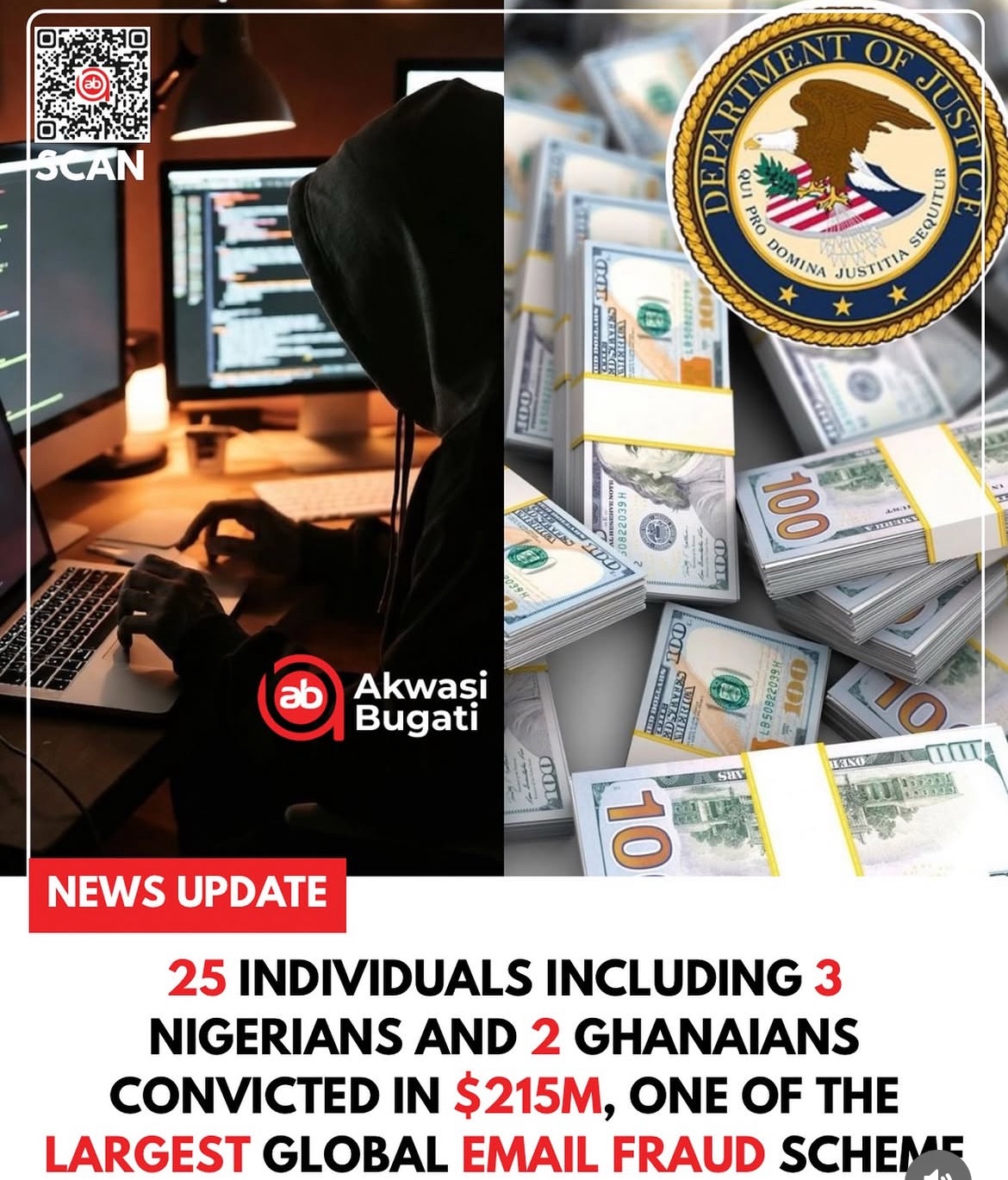
A United States federal court has convicted 25 individuals, including several Nigerians and at least one Ghanaian national, in what American authorities describe as one of the largest international business email compromise and money laundering schemes ever prosecuted by the United States Department of Justice.
According to prosecutors, the criminal network orchestrated a sophisticated cyber-enabled fraud operation that stole approximately $215 million from more than 1,000 victims spread across 47 U.S. states and at least 19 countries. The case was prosecuted in Ohio following years of investigations involving multiple American and international law enforcement agencies.
The scheme centered on what investigators call “business email compromise” scams, a form of cyber fraud in which criminals infiltrate or imitate legitimate corporate email accounts in order to trick businesses, nonprofits, and individuals into transferring large sums of money into fraudulent bank accounts controlled by criminal syndicates. Authorities say the network used hacked email systems, fake invoices, identity theft, shell companies, and international money laundering channels to move stolen funds across borders.
Among the individuals named in court proceedings were several Nigerian nationals and Nigerian-linked suspects, including Emmanuel Okereke, Olalekan Bashiru, Jeremiah Agina, Ademola Balogun, Ayobami Osas Christopher, Ayorinde Emmanuel Adebayo, Olabode Bankole, Chukwuemeka Evulukwu, and Kingsley Owusu. Reports indicate that the criminal operation maintained links across Africa, the United States, and other parts of the world.
American prosecutors stated that the syndicate targeted companies, government institutions, and private individuals through highly coordinated cyber intrusions and deceptive financial communications. Victims reportedly included businesses expecting legitimate wire payments, organizations processing vendor invoices, and individuals manipulated into transferring funds under false pretenses. Investigators say stolen money was quickly distributed through networks of money mules and international bank transfers to conceal the origins of the funds.
The convictions follow a four-day federal trial in Toledo, Ohio, where jurors found multiple defendants guilty of conspiracy to commit wire fraud and money laundering offenses. U.S. authorities described the case as part of a broader crackdown on transnational cybercrime networks operating across several continents.

The case has once again drawn global attention to the growing sophistication of cyber fraud operations linked to organized criminal groups. In recent years, law enforcement agencies have increasingly focused on “business email compromise” scams, which the Federal Bureau of Investigation says have caused billions of dollars in global losses annually. Unlike traditional internet scams, modern BEC operations often involve advanced hacking methods, fake corporate identities, social engineering tactics, and coordinated money laundering structures.
The convictions are also likely to intensify conversations across Africa regarding youth unemployment, cybercrime, digital ethics, and economic opportunities. While the overwhelming majority of African technology professionals are engaged in legitimate innovation and entrepreneurship, cyber fraud cases involving African nationals continue to attract international scrutiny and damage the global reputation of emerging African digital sectors.
Experts note that economic hardship, unemployment, weak financial oversight, and the glamorization of internet fraud on social media have contributed to the rise of cybercrime networks in parts of West Africa. However, analysts also warn against stereotyping entire nations based on the actions of criminal groups, emphasizing that African governments and law enforcement agencies have increasingly collaborated with international partners to combat cyber-enabled financial crimes.
The case also echoes previous high-profile prosecutions involving international fraud syndicates connected to business email compromise scams. Over the last decade, American authorities have pursued several large cybercrime investigations involving suspects operating from Nigeria, Ghana, South Africa, Kenya, and other countries.
With cybercrime evolving into a multi-billion-dollar global industry, experts say governments across Africa and the diaspora will face growing pressure to strengthen cybersecurity education, financial monitoring systems, digital literacy programs, and international law enforcement cooperation.
Leave a Reply