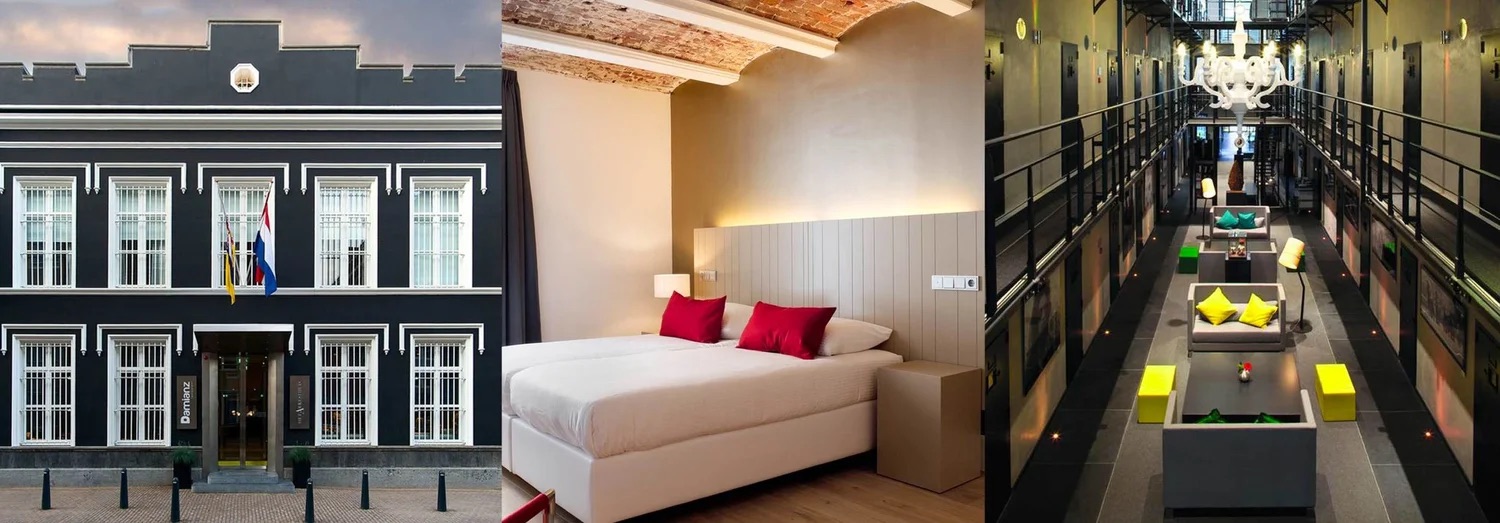
In a development that has sparked conversations across social media and policy circles, a former prison in the city of Roermond in the Netherlands has been transformed into a luxury five-star hotel, highlighting the country’s dramatic decline in crime rates over the past decade.
The story gained renewed attention after former Labour Party governorship candidate for Bayelsa State, Udengs Eradiri, shared his experience visiting the repurposed facility in Roermond. In a video circulating online, Eradiri described his amazement at seeing a once-active correctional facility converted into a high-end hospitality destination because authorities reportedly no longer needed the prison due to extremely low incarceration levels.
The former prison, now operating as a luxury accommodation venue, represents a broader trend in the Netherlands where declining crime and prison populations have led to the closure of several detention centers. Over the years, Dutch authorities have shut down multiple prisons as incarceration rates dropped significantly, driven by criminal justice reforms, rehabilitation-focused policies, lower violent crime levels, and social welfare investments.
Rather than allowing the abandoned structures to decay, many former prisons across the country have been repurposed into community centers, student housing, cultural venues, and upscale hotels. The Roermond conversion has become one of the most symbolic examples of how urban redevelopment can emerge from social progress.
The transformation also raises important questions for African nations grappling with overcrowded prisons, unemployment, and strained justice systems. Across many parts of Africa, correctional facilities remain congested, underfunded, and plagued by human rights concerns. Analysts say the Dutch example demonstrates the long-term economic and social benefits of investing in education, rehabilitation, mental health support, and economic stability rather than relying solely on punitive incarceration systems.
Some commentators have pointed out that while the Netherlands enjoys lower crime rates today, the achievement came after decades of institutional reforms, public investment, and social planning. Experts caution against simplistic comparisons, noting that every country faces unique economic and social realities. However, the symbolic image of prison bars replaced by luxury suites continues to resonate globally.
The story has also sparked debate online about governance, youth opportunities, and the relationship between economic stability and crime prevention. Many Africans on social media contrasted the Dutch experience with rising concerns over insecurity, unemployment, and prison overcrowding in parts of the continent.
As nations around the world search for solutions to crime and social instability, the former prison hotel in Roermond stands as an unusual but powerful symbol of what societies can become when incarceration rates decline and rehabilitation succeeds.
Leave a Reply