
September 27, 2026 | panafrican.email — Africa Intelligence
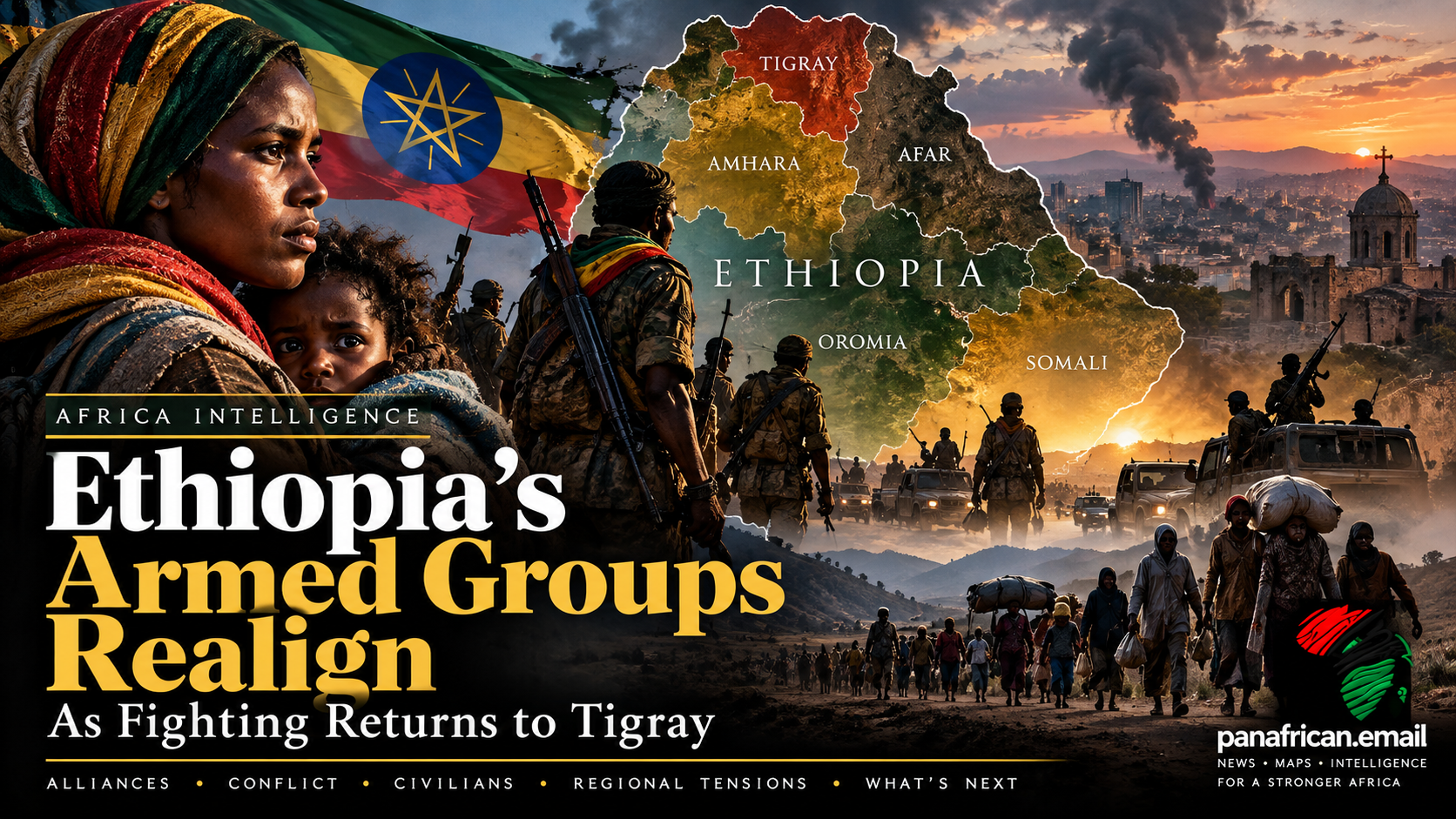
A new coalition of armed movements, renewed fighting in Tigray and widening regional tensions are reshaping Ethiopia’s security landscape.
Ethiopia is entering another period of acute instability as fighting between federal forces and Tigrayan forces has intensified, while a newly announced coalition brings together seven armed movements from across the country—including groups that were previously on opposite sides of the 2020–2022 Tigray war.
The developments mark the most serious deterioration in Ethiopia’s northern security situation since the African Union-mediated cessation of hostilities agreement of November 2022. The United Nations has warned of the growing impact on civilians and called for immediate de-escalation. (OHCHR)
Seven armed movements form a new alliance

On September 20, seven Ethiopian armed and opposition movements announced the formation of what has been described as the Ethiopian Peoples’ Forces Alliance for Survival.
The groups named in the alliance are:
- Amhara Fano National Movement
- Tigray People’s Liberation Front (TPLF)
- Oromo Liberation Army (OLA)
- Ogaden National Liberation Front (ONLF)
- Afar Revolutionary Democratic Unity Front
- Benishangul Peoples’ Liberation Movement
- Gumuz Peoples’ Democratic Movement
According to Reuters, the alliance says its objective is to remove Prime Minister Abiy Ahmed’s government. The coalition brings together movements with very different political histories, territorial interests and relationships with one another. (Reuters)
The significance of the announcement lies partly in the fact that some of its members were previously adversaries.
Fano forces fought alongside federal forces during much of the 2020–2022 Tigray war, while the TPLF was fighting the federal government. Fano itself later became involved in an armed conflict with the federal government in Amhara beginning in 2023. (Reuters)
The emerging alliance therefore represents a major realignment of Ethiopia’s armed opposition landscape.
But the announcement does not mean that the participating organizations have resolved their longstanding disagreements.
The groups retain different territorial claims, political objectives and local rivalries. Analysts cited by Reuters have questioned how effectively geographically dispersed forces with different political agendas could operate as a unified military structure. (Reuters)
Fighting returns to Tigray
The alliance announcement came as tensions between the federal government and Tigrayan forces were already escalating.
Fighting intensified on September 23 in Tigray and subsequently spread toward parts of neighboring Amhara and Afar regions.
Tigrayan forces took control of airports in Mekelle, Axum and Shire, prompting Ethiopian Airlines to suspend flights to the three airports. Reports have also described clashes around areas linking Tigray with Amhara and Afar. (Al Jazeera)
The two sides disagree sharply over who initiated the latest escalation.
Tigrayan officials have described their military activity as a response to what they characterize as federal aggression, including drone strikes and the movement of government forces.
Federal officials have accused the TPLF of launching a major offensive.
Because access to conflict areas remains restricted and communications have been disrupted, independent verification of individual battlefield claims remains difficult. (Al Jazeera)
The civilian cost is already becoming visible
The immediate concern is not simply the military balance. It is the effect of renewed fighting on civilians who are still living with the consequences of the previous war.
Reuters reported residents in Mekelle and other parts of Tigray stocking up on food, withdrawing cash and attempting to obtain medicine as fears of another prolonged conflict grew.
The interruption of air and road transportation has also complicated movement of people and goods. Ethiopian Airlines has suspended flights to three airports, while reports from the region describe disruptions to overland transportation and shortages of basic commodities. (Internazionale)
The United Nations’ human rights chief, Volker Türk, has expressed alarm about the civilian impact of the renewed fighting and urged the Ethiopian government, the TPLF and their respective allies to immediately reduce tensions. (OHCHR)
The humanitarian concerns are particularly serious because Tigray has not fully recovered from the 2020–2022 war.

Allegations surrounding airstrikes
Human Rights Watch has also documented concerns about attacks affecting civilian areas.
The organization reported that an August 20 airstrike in Mekelle’s Daero neighborhood wounded 13 civilians, including seven children. Human Rights Watch said its investigation found no evident military target at the residential compound and called for the incident to be investigated as a possible war crime.
Ethiopian authorities had not responded to the organization’s questions at the time of publication. (Human Rights Watch)
The report illustrates a broader concern: as armed confrontations intensify, civilians may once again become exposed to airstrikes, artillery, forced displacement and interruptions to essential services.
Eritrea enters the strategic conversation
Another major factor is Ethiopia’s relationship with neighboring Eritrea.
Ethiopian government officials have accused Eritrea of financially supporting elements of the new armed coalition. Eritrea has repeatedly denied those allegations.
The accusation is particularly significant because Eritrean forces participated alongside Ethiopian federal forces during the earlier Tigray war. Relations between Addis Ababa and Asmara have subsequently deteriorated, including over Ethiopia’s ambitions for access to the Red Sea. (Reuters)
At this stage, claims concerning external support should be treated as allegations rather than established fact.
Nevertheless, the possibility of regional involvement adds another layer to an already complicated security environment involving Ethiopia, Eritrea and Sudan.
Why the new alliance matters
The new coalition changes the political geography of Ethiopia’s armed conflicts.
For years, insurgencies in Ethiopia have largely been treated as separate regional conflicts:
Tigray — TPLF and Tigrayan forces versus federal authorities.
Amhara — Fano forces versus the federal government.
Oromia — OLA and other armed actors versus federal and regional security forces.
Other regions — smaller armed organizations pursuing regional or ethnic political objectives.
The new alliance attempts to connect these conflicts within a single national political framework.
That does not necessarily create a unified army.
Indeed, analysts have highlighted major obstacles: geographical separation, different command structures, competing political goals and unresolved territorial disputes. (Al Jazeera)
The alliance is therefore best understood, at least for now, as an attempt at coordination among several armed and political movements rather than proof of a single integrated military command.
The unresolved question of Western Tigray
Territory remains one of the most difficult issues.
Western Tigray was a major source of contention during the previous war and remains deeply connected to competing Amhara and Tigrayan political claims.
The fact that groups that previously fought one another are now discussing cooperation does not automatically resolve those territorial disputes.
Indeed, the emerging alignment could be tested precisely when military cooperation encounters questions about territory, local administration and control.
What happens next?
Several indicators will be important to watch.
First: whether the seven-group alliance develops a functioning joint command structure or remains primarily political.
Second: whether fighting remains concentrated in northern Ethiopia or expands further into Amhara, Afar and other regions.
Third: whether the federal government and Tigrayan leadership reopen a political channel.
Fourth: whether Eritrea becomes more directly involved—or whether accusations of external support remain contested claims.
Fifth: whether humanitarian access, communications and transportation can be maintained as the conflict develops.
The African Union, United Nations and regional actors have already urged restraint and a return to dialogue. (Internazionale)
Ethiopia at another crossroads
Ethiopia’s current crisis is not simply a story about one armed group confronting another.
It is the convergence of several unresolved questions: federalism, regional autonomy, territorial control, political representation, security-sector reform and the relationship between Ethiopia’s national government and its diverse regions.
The emergence of a seven-group alliance demonstrates that several armed movements increasingly see their individual conflicts as connected to a wider national struggle.
But whether that alignment produces sustained military cooperation—or exposes deeper divisions among its participants—remains uncertain.
For civilians, the immediate priority is more straightforward: preventing another prolonged war and maintaining access to food, medicine, communications and safe passage.
The events unfolding in Tigray, Amhara and Afar will therefore be closely watched not only inside Ethiopia, but throughout the Horn of Africa.
panafrican.email will continue tracking the movement of armed groups, regional security developments, humanitarian conditions and the wider geopolitical consequences for the Horn of Africa.
Leave a Reply