
A factual profile of the principal governments, political leaders,
diplomats, international institutions and technology actors involved
in the current Israel–Iran diplomatic confrontation at the United Nations.
Governments and political leaders shaping the wider confrontation.
Israel is a principal state actor in the confrontation
with Iran. Its government has used military and diplomatic
channels to present its position to the international
community.
Iran is the principal state actor opposing Israel and
the United States in the current confrontation. Tehran
has used the UN General Assembly to present its position.
Washington is a major external actor in the confrontation,
combining military pressure with diplomatic engagement
concerning Iran, regional security and the Strait of Hormuz.
The United Nations provides the principal international
forum where opposing governments present their positions
and conduct diplomatic exchanges.
Political and diplomatic figures directly connected with the UN episode.
Netanyahu represents Israel’s political leadership.
His UN appearance placed Iran and the wider regional
confrontation at the center of his international message.
Pezeshkian represents Iran’s presidential government
internationally and used the General Assembly to present
Tehran’s position during the confrontation.
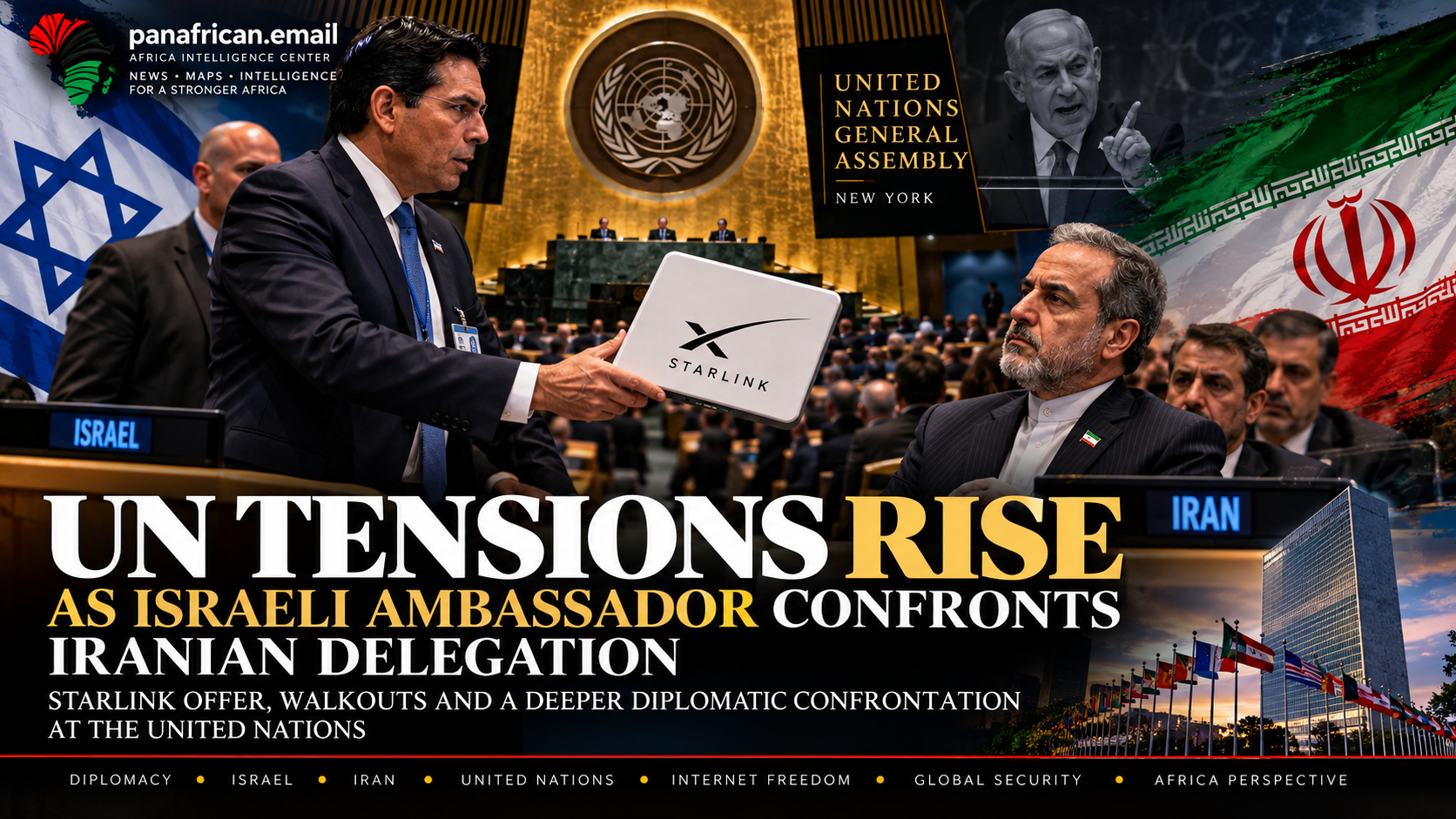
Danon is Israel’s principal diplomatic representative
at the United Nations. He became the central figure in
the widely circulated Starlink exchange with an Iranian
representative.
Asadi was identified in current reporting as a third
counsellor at Iran’s Permanent Mission to the United Nations.
He was the Iranian representative involved in the
September 24 Starlink exchange with Danny Danon.
The communications technology that became part of the diplomatic exchange.
Starlink became part of the diplomatic story after an
internet terminal was offered to an Iranian representative.
The episode highlighted the geopolitical significance
of communications infrastructure.
Who’s Who
State & Political Actors
Israel
Iran
United States
United Nations
Key People

Benjamin Netanyahu

Masoud Pezeshkian

Danny Danon
Nasser Asadi
Technology in the Story
Starlink
The Bigger Picture
September 27, 2026 | panafrican.email — Global Affairs
A tense exchange involving Israel’s ambassador to the United Nations and an Iranian representative has drawn widespread attention online during the latest United Nations General Assembly in New York.
Video circulating on social media has been accompanied by claims that Israel’s UN ambassador, Danny Danon, was expelled from the General Assembly after approaching the Iranian delegation during proceedings.
However, available reporting does not substantiate that claim. A fact-check published September 27 found that the footage being circulated as evidence of an Israeli ambassador being expelled from the General Assembly was actually old and unrelated to the recent incident. (مصراوي.كوم)
The actual recent encounter involved Danon approaching an Iranian representative during the General Assembly and offering a Starlink satellite-internet terminal.
Danon’s Starlink gesture
The incident occurred after Israeli Prime Minister Benjamin Netanyahu displayed a Starlink terminal during his September 24 address to the General Assembly.
Danon subsequently approached an Iranian representative, identified in reporting as Nasser Asadi, carrying a Starlink device.
In a video posted by Danon, he offered the terminal to the Iranian representative and argued that satellite internet could help Iranians access information despite restrictions on internet connectivity.
The Iranian representative did not engage with Danon and declined the device. Danon subsequently published the encounter on X. (The Business Standard)
The episode quickly became a social-media story in its own right, competing for attention with the much larger diplomatic confrontation taking place at the General Assembly.
A highly charged UN gathering
The encounter occurred during an unusually tense General Assembly session.
Iranian President Masoud Pezeshkian addressed the assembly on September 23, defending Iran’s position amid its conflict with the United States and Israel.
Two days later, Iran’s delegation walked out when Netanyahu began his address. A photograph of the late Iranian military commander Qassem Soleimani was left at the Iranian delegation’s seat after the walkout, becoming another widely circulated image from the session. (Roya News)
Netanyahu’s address focused heavily on Israel’s confrontation with Iran and the wider regional conflict. Several delegations also walked out during his speech. (Reuters)
The diplomatic theater reflected the broader confrontation between Washington, Jerusalem and Tehran, with the United Nations providing a rare venue where opposing governments could present their positions before an international audience.
What the viral claim gets wrong
The distinction between an ambassador being removed from the building and an ambassador approaching another delegation during a diplomatic event matters.
The viral post shown in the circulating screenshot states that Israel’s ambassador was expelled from the General Assembly after walking down the central aisle to disrupt an Iranian speaker.
Current fact-checking does not support that description.
The video used to substantiate the “expelled” claim has been identified as older footage unrelated to the recent General Assembly encounter. The recent Danon-Iranian delegation episode instead concerns the Starlink offer. (مصراوي.كوم)
This is an important distinction for readers because short videos can be detached from their original context and paired with captions that change their apparent meaning.
Why Starlink became part of the confrontation
Internet access has become a significant political issue in Iran.
Reporting has documented major internet restrictions and shutdowns during periods of unrest and conflict. The Starlink terminal therefore carried significance beyond being a technology product: it was presented by Israeli officials as a potential means of bypassing government-controlled communications restrictions.
Danon’s video explicitly connected the device with what he described as helping the Iranian people obtain greater access to information and freedom. (The Business Standard)
Iranian officials, meanwhile, have continued to present their own account of the conflict and accuse the United States and Israel of aggression.
The competing narratives demonstrate how communications technology has become intertwined with modern geopolitical conflict.
The larger diplomatic confrontation
The incident cannot be separated from the broader crisis involving Iran, Israel and the United States.
During the General Assembly, Washington indicated that it remained open to contact with Tehran, although no meeting between the two sides had been scheduled at the time of reporting. (Iran International | Iran International)
At the same time, President Donald Trump publicly pressed for negotiations while maintaining a confrontational position toward Iran. Iran has also indicated that discussions involving the Strait of Hormuz are central to any future negotiations. (Reuters)
The Strait is one of the world’s most important energy corridors, meaning that the diplomatic confrontation extends well beyond the Middle East.
Any prolonged disruption could have consequences for energy prices, shipping, insurance and economies across Africa and the wider Global South.
Africa is watching
For African governments and businesses, the significance of the confrontation extends beyond diplomacy.
Africa’s economies are exposed to changes in global fuel prices, shipping costs, food prices and international investment flows.
A prolonged confrontation involving the United States, Israel and Iran could also affect maritime trade through the Red Sea and surrounding waterways—routes that are strategically important to East Africa, the Horn of Africa and the wider continent.
The diplomatic developments at the United Nations therefore deserve attention not simply as political theater in New York, but as part of a wider global economic and security environment.
The information war
Perhaps the most important lesson from the episode is the speed at which misleading descriptions can transform a diplomatic incident into a purported breaking-news event.
The screenshot circulating online presents a simple narrative: an Israeli ambassador disrupted an Iranian speaker and was expelled.
The available evidence tells a more complicated story.
There was a real confrontation between Israeli and Iranian representatives. There was a widely publicized Starlink exchange. Iranian and Israeli delegations engaged in highly visible diplomatic signaling. But the specific claim that Danon was expelled from the General Assembly is not supported by the fact-checking currently available. (مصراوي.كوم)
For readers, the distinction between what happened, what was claimed, and what has been independently verified is increasingly important.
At a time when conflicts are being fought simultaneously on battlefields, television screens and social-media feeds, information itself has become part of the geopolitical contest.
panafrican.email will continue monitoring developments at the United Nations, the Iran-Israel conflict and their implications for Africa and the Global South.
Leave a Reply