
Panafrican.email | Mining & Resources
A Danish documentary that takes viewers deep into the world of African mineral trading, diplomacy and undercover journalism is once again relevant to conversations about how Africa’s natural resources are accessed, negotiated and exported.
The Ambassador, directed by Danish journalist and filmmaker Mads Brügger, was released in 2011 and follows Brügger as he adopts the identity of a wealthy businessman and purported Liberian diplomat operating in the Central African Republic (CAR). The film uses hidden-camera techniques to investigate diplomatic credential brokerage, political networks and the illicit diamond trade. (MIFF 2026)
Not the DRC — but a story with wider African mining relevance
The distinction matters.
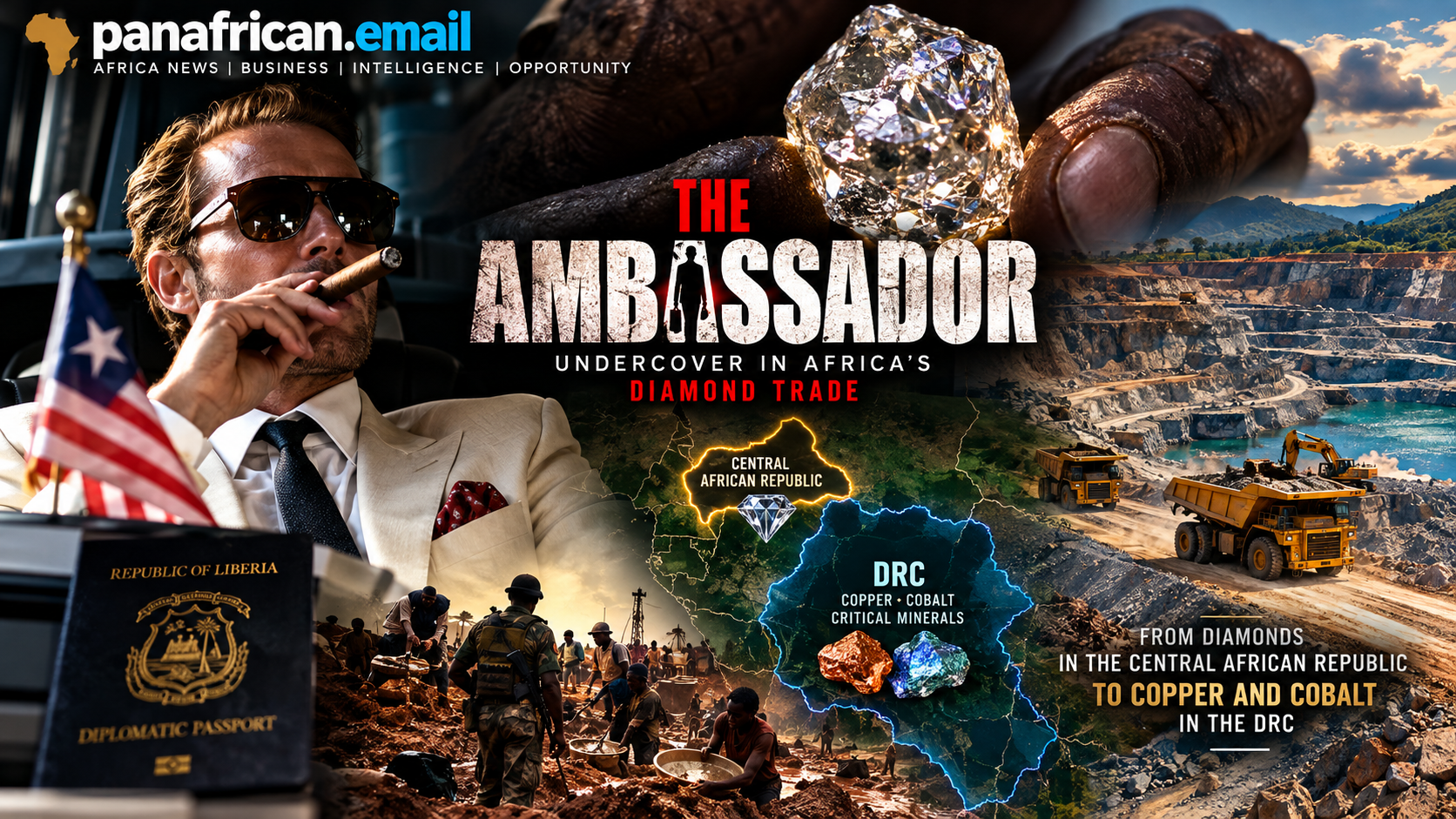
The mining activity documented in the film concerns diamonds in the Central African Republic, rather than copper, cobalt or other mineral operations in the Democratic Republic of Congo.
According to the Melbourne International Film Festival’s archive, Brügger’s fictional business persona claims to be establishing a factory while seeking access to diamond reserves. The documentary subsequently follows his encounters with businessmen, officials and people involved in the diamond economy. (MIFF 2026)
The film therefore provides a case study of one particular mineral economy rather than a documentary investigation of the DRC’s mining sector.
That distinction is especially important today as the DRC occupies a central position in global discussions about copper, cobalt, critical minerals, batteries and industrial supply chains.
Entering the mineral economy
Brügger’s approach was deliberately unconventional.
Rather than presenting himself as a conventional journalist, he constructed a fictional persona and sought access to networks surrounding diplomatic and commercial activity. According to contemporary reporting on the film, the documentary uses concealed recording equipment and follows Brügger’s attempts to establish relationships with people connected to the diamond trade. (Screen Daily)
The result is part documentary, part undercover investigation and part performance.
That unusual format became one of the film’s defining characteristics—and also generated questions about the ethics of undercover documentary filmmaking. The Melbourne International Film Festival describes the film as raising questions about both Western exploitation of African natural resources and the ethics of documentary filmmaking. (MIFF 2026)
From diamonds to the DRC’s copper frontier
For viewers following the DRC’s contemporary mineral economy, The Ambassador offers a historical lens rather than direct reporting on today’s Congolese mines.
The DRC’s resource story is substantially different from the CAR diamond trade depicted in the film. The DRC is a major producer of copper and cobalt, with its mineral sector increasingly connected to global electric-vehicle, electronics, energy and industrial supply chains.
That makes the film’s broader question relevant:
Who controls access to African mineral resources, who finances extraction, who processes the minerals, and where is the greatest value created?
Those questions extend beyond any single country.
The business behind the minerals
One of the striking features of The Ambassador is the way commercial interests intersect with diplomatic relationships.

The film’s central character presents himself as a businessman seeking opportunities in a resource-rich environment. Contemporary coverage describes his efforts to establish a commercial front while pursuing access to diamonds. (International Documentary Association)
For today’s African mining industry, the commercial landscape is considerably more sophisticated.
Governments, multinational mining companies, domestic operators, commodity traders, development-finance institutions, infrastructure companies and technology providers all participate in mineral value chains.
The strategic competition is no longer only about extracting ore.
It increasingly concerns:
- Geological data
- Exploration technology
- Mineral processing
- Refining
- Logistics
- Energy infrastructure
- Financing
- Local content
- Industrial manufacturing
- Battery supply chains
- Digital intelligence
Why this matters for the DRC
The DRC has become increasingly important to international discussions about critical-mineral supply chains.
Copper, cobalt and other minerals connect Congolese production to industries far beyond Central Africa.
For African governments and businesses, the central economic question is increasingly how mineral wealth can generate greater domestic and regional value rather than simply leaving the continent as raw or minimally processed material.
That means looking at the entire chain—from geological exploration through extraction, processing, transportation and manufacturing.
A different kind of mining documentary
The Ambassador is therefore worth revisiting not because it is a documentary about the DRC—it isn’t—but because it raises questions that remain relevant across Africa’s resource economies.
The film shows one filmmaker entering a complex mineral economy by adopting a fictional identity and pursuing access to the diamond trade.
Its methods are deliberately provocative, and contemporary critics have disagreed about the ethics and effectiveness of its approach. (Seattle Weekly)
For audiences interested in African mining today, the documentary can be viewed alongside a much larger conversation about resource governance, transparency, foreign investment, mineral processing and African ownership of value chains.
From the Central African Republic to the Congo
The geographic distinction is ultimately part of the story.
Central African Republic: diamonds and the networks investigated by The Ambassador.
Democratic Republic of Congo: copper, cobalt and a much larger contemporary industrial-mineral economy.
Both countries sit within Central Africa’s broader resource landscape, but their mining sectors, commodities, institutions and geopolitical circumstances are different.
For Panafrican.email, that distinction is important because African mineral intelligence requires looking beyond headlines and identifying where a resource actually comes from, who controls it, where it goes and what value remains in Africa.
Watch The Ambassador
The English-subtitled version embedded with this article is hosted by Wingman Media on Vimeo. (Vimeo)
Watch The Ambassador — English subtitles on Vimeo
Panafrican.email perspective:
The next generation of African mineral reporting must go beyond the mine itself. The real story is the network connecting geology, capital, technology, diplomacy, logistics, processing and markets.
Leave a Reply