
By panafrican.email
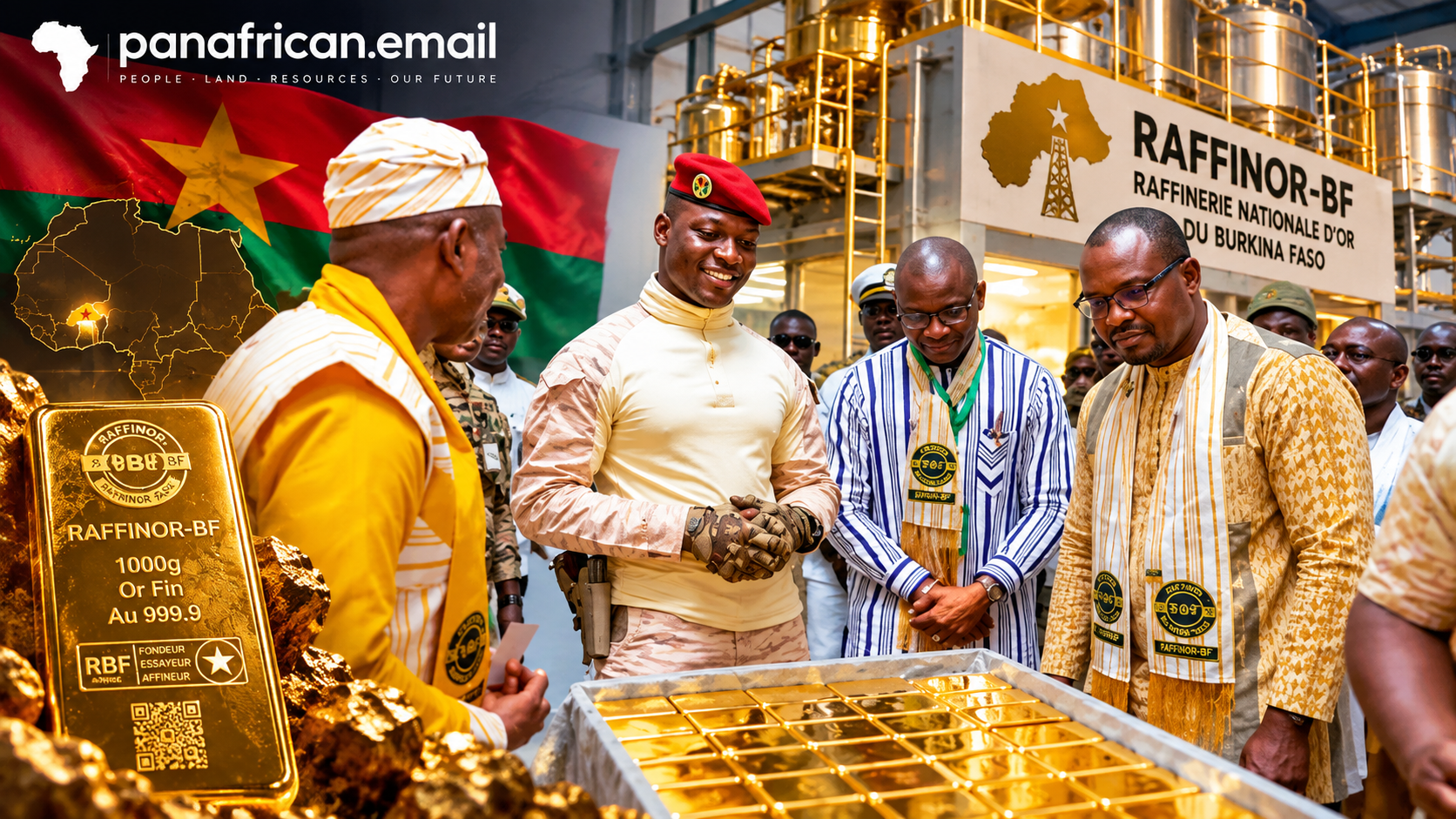
Burkina Faso has opened its first national gold refinery, placing mineral processing at the center of its broader effort to retain more economic value inside the country.
The National Gold Refinery of Burkina Faso, known as RAFFINOR-BF, was inaugurated on September 28, 2026, in Ouagadougou. The facility represents a shift from simply extracting and exporting gold toward processing, testing, storing and certifying the metal domestically. (Energy and Mines Ministry)
The Burkinabè government has described the project as an important step toward economic independence and greater control over the country’s natural resources.
From extraction to the full value chain
Burkina Faso is one of Africa’s major gold producers. Authorities and industry sources put the country’s gold production at more than 94 tonnes in 2025. Yet producing large quantities of gold does not necessarily mean that the country captures all of the economic value associated with the metal.
Refining is one part of that value chain.
RAFFINOR-BF has been designed to transform gold doré into refined gold with a purity of up to 99.99%, according to Burkina Faso’s Ministry of Energy, Mines and Quarries. The complex includes a foundry, analytical laboratory, secure gold-storage facilities, a jewelry unit and administrative infrastructure. (Energy and Mines Ministry)
The first phase has a theoretical refining capacity of 164 tonnes per year, while a planned second phase could raise capacity to approximately 515 tonnes annually. (Energy and Mines Ministry)
The project reportedly required an investment of more than 11 billion CFA francs, or roughly US$19 million, with financing involving the state through the National Precious Metals Company, SONASP, alongside private-sector participation. (Burkina Faso Government)
Why refining matters
For resource-producing African economies, the question is increasingly moving beyond how much mineral wealth is extracted.
It is also about where the value is created.
When raw or semi-processed minerals leave a country, additional stages of the value chain—including refining, certification, manufacturing, trading and financial services—can occur elsewhere.
Burkina Faso’s new refinery gives the country infrastructure to perform a larger portion of those activities domestically.
The government’s stated ambition extends beyond gold. President Ibrahim Traoré has said the country wants to develop domestic refining and processing capabilities for other minerals, including manganese, copper and zinc. (Energy and Mines Ministry)
That approach reflects a wider debate across Africa over whether mineral-rich countries should remain primarily exporters of raw materials or develop industrial systems capable of transforming those resources into higher-value products.
The challenge of securing the gold
The refinery’s headline capacity is substantial, but capacity alone does not guarantee that a refinery will operate at full utilisation.
Burkina Faso will need reliable supplies of gold from industrial, artisanal and small-scale mining operations. An industry analysis has highlighted the importance of ensuring sufficient feedstock for the refinery, particularly given the difference between national production and the quantity that can actually be channelled through formal domestic purchasing and refining systems. (Africa Business Insight)
This is particularly important in Burkina Faso’s artisanal mining sector, where informal trading and smuggling have historically complicated government oversight.
The government suspended gold exports from informal mining operations in 2024 as part of an effort to reorganise the sector and increase control over the movement of gold. (Africanews)
The refinery therefore forms only one part of a much larger system involving mining regulation, gold purchasing, traceability, security, taxation and international certification.

A regional movement toward mineral sovereignty
Burkina Faso is not acting in isolation.
Across West Africa, governments are pursuing policies designed to increase domestic participation in mineral value chains.
Ghana has tightened controls around gold exports, Guinea is developing additional refining capacity, Mali is pursuing a refinery project, and Côte d’Ivoire has announced plans for a refinery. (AP News)
The trend reflects an emerging regional question: Can Africa’s mineral wealth become the foundation for African industrialisation rather than primarily supplying external processing and manufacturing economies?
Gold is particularly important because it is already a globally traded and financially significant commodity. Establishing domestic refining capacity can potentially strengthen a country’s position in the formal gold market while creating opportunities in assaying, certification, jewelry manufacturing, finance, logistics and related industries.
Beyond the refinery
The significance of RAFFINOR-BF will ultimately depend on what develops around it.
A refinery can become the center of a broader industrial ecosystem if it is connected to transparent purchasing systems, reliable mining production, skilled technical workers, financial infrastructure and manufacturing.
For Burkina Faso, that could mean moving progressively from mine → refinery → certified bullion → jewelry and industrial products → financial markets, rather than stopping at extraction.
The government has also emphasized the need for young Burkinabè to develop technical skills capable of supporting the entire mineral value chain. (Burkina Faso Government)
This makes the refinery more than a piece of industrial infrastructure. It is part of a broader experiment in whether a mineral-producing African state can retain a greater share of the economic activity generated by its own resources.
The African resource question
Burkina Faso’s refinery arrives at a moment when resource sovereignty is becoming an increasingly important economic issue across the continent.
The central question is not simply whether Africa has gold, lithium, copper, uranium, manganese or other strategic minerals.
The question is how much of the economic chain surrounding those resources can be built on African soil.
RAFFINOR-BF provides Burkina Faso with new physical infrastructure for answering that question.
Its initial capacity of 164 tonnes—and potential expansion to 515 tonnes—gives the country room to develop a larger domestic refining industry. But the longer-term impact will depend on whether the refinery can secure adequate supplies, operate efficiently, strengthen formalisation and contribute to industries beyond the refinery gates. (Energy and Mines Ministry)
For Burkina Faso, the opening is therefore both an industrial milestone and the beginning of a much larger challenge: turning mineral extraction into a broader system of African-owned value creation.
Leave a Reply