
OUAGADOUGOU, Burkina Faso — Burkina Faso is undertaking a broad transformation of its education system, with reforms reaching beyond classrooms and examinations into the way the country teaches its history, languages, culture, citizenship and relationship with the wider world.
At the center of the transformation is an effort to make education more closely reflect Burkina Faso’s own historical experience, cultural traditions and national priorities. The government is revising curricula, producing more textbooks domestically, expanding bilingual education, introducing indigenous knowledge into schools and strengthening civic and patriotic education.
One of the most visible elements of the debate is the planned rewriting of history, geography and civic-education materials.
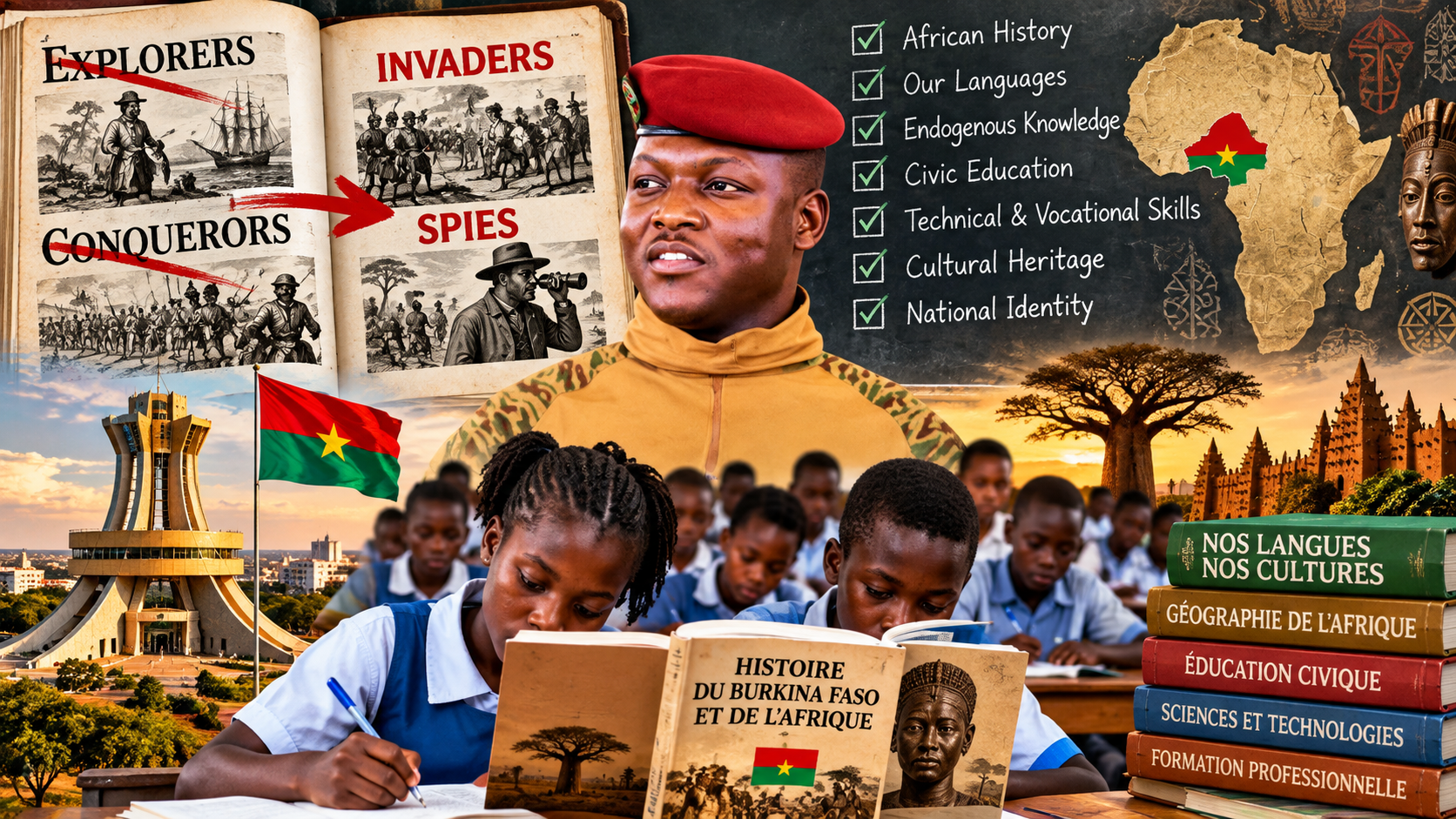
In September 2026, Minister of Secondary Education, Vocational and Technical Training Professor Moumouni Zoungrana said the government intended to review the language used in school curricula to describe Africa’s colonial experience. He criticized terminology that, in the government’s view, presents European actors in Africa through categories inherited from colonial-era narratives.
Among the examples cited by the minister were the words “explorers” and “conquerors.” He argued that some Europeans who entered Africa during the period of exploration and colonial expansion should instead be described using terms such as “invaders” and “spies.”
The remarks are part of a larger announced revision of history, geography and civic-education curricula. According to reporting on the minister’s announcement, the government intends not only to alter terminology but also to introduce additional chapters emphasizing African and Burkinabè history, values and social realities.
The changes are significant because school textbooks do more than provide dates and definitions. They determine which historical figures are remembered, which events receive attention, how colonialism is explained and how young people understand their own societies.
From imported textbooks to “made in Burkina Faso”
The curriculum debate is occurring alongside a long-running effort to increase domestic production of school textbooks.
Burkina Faso’s National Center for School Textbooks and Supplies, known as CENAMAFS, has been developing textbooks designed and produced within the country.
The government describes the project as part of a broader effort to reduce dependence on educational materials produced elsewhere and to ensure that teaching materials incorporate Burkina Faso’s own history, languages, culture and social environment.
In March 2025, CENAMAFS announced the production of ten additional textbooks and teacher guides covering subjects including history, geography, mathematics, French, English, life and earth sciences and physical sciences.
The effort followed the introduction of new curricula at the post-primary and secondary levels.
By November 2025, the Ministry of Secondary Education reported that seventeen textbooks and accompanying teaching guides had been produced during the year, contributing to a broader program intended to provide domestically produced materials for the post-primary system.
The government’s stated objective is therefore larger than simply changing a handful of words in history textbooks. It is attempting to create an educational system in which the content, examples, references and learning materials are increasingly generated within Burkina Faso.
Languages move closer to the center of education
Another major part of the reform is the expansion of national languages in schools.
Burkina Faso has been experimenting with bilingual education in which national languages are introduced alongside French at the beginning of a child’s education.
Government reporting in 2025 indicated that approximately 750 classes were participating in experiments involving national-language instruction from the first year of primary school. A later 2026 government assessment reported that the pilot had expanded to roughly 900 first-grade classes.
The government has also reported plans for hundreds of additional bilingual schools.
The significance goes beyond language instruction.
For many African countries, the language used in the classroom determines which cultural references are considered academically legitimate. Teaching children in languages spoken within their communities can make it possible to incorporate oral traditions, local history, agricultural knowledge, environmental knowledge and community practices into formal education.
Burkina Faso is explicitly linking its language policy to that broader concept of “endogenous knowledge.”
Teaching endogenous knowledge

During the 2025-2026 school year, Burkina Faso experimented with the teaching of endogenous knowledge.
The Ministry of Education reported that a directory of endogenous knowledge had been developed for each region of the country. The intention is to provide teachers with educational content connected to the cultural, social and historical realities of the communities in which schools operate.
Teachers can use the material directly or work with knowledgeable members of the community.
This creates a different relationship between the school and its surrounding society.
Instead of treating knowledge as something that enters the classroom exclusively through a national textbook, university or foreign educational system, the reform recognizes communities themselves as potential sources of knowledge.
That can include cultural practices, local history, traditional arts, environmental understanding and other forms of knowledge transmitted between generations.
Culture becomes part of the school calendar
The government has also begun connecting education more directly with cultural activity.
In 2026, the Ministry of Education conducted a pilot “Mois Artistique et Culturel,” or Artistic and Cultural Month, in schools.
The program was designed to reconnect children with artistic and cultural practices while promoting cultural transmission and creativity.
The pilot was formally concluded in July 2026 after activities involving children and educational authorities.
The initiative reflects the same philosophy underlying the curriculum reforms: education is being treated not only as preparation for examinations but also as a means of transmitting culture and developing a sense of national identity.
Civic education returns
Civic education is another major component of the transformation.
Beginning with the 2024-2025 school year, Burkina Faso reintroduced civic education into general post-primary and secondary education as well as technical and vocational education.
The reform was presented as part of the broader curriculum changes.
The government has subsequently expanded the civic and patriotic dimension of education beyond the classroom.
In 2025, approximately 60,000 new baccalaureate graduates were selected for a compulsory patriotic immersion program. The program included instruction on Burkina Faso’s political history and state-building, geopolitical and development issues, civic engagement, social responsibility, digital security and entrepreneurship.
The objective, according to the government, is to prepare young people not simply as examination candidates but as citizens who understand their responsibilities toward the country.
From memorization to practical skills
The educational reforms are not confined to history and citizenship.
Burkina Faso is also attempting to alter the relationship between general education and vocational training.
A decree adopted in May 2026 reorganized post-primary and secondary education and created a framework allowing educational structures to combine general education with technical and vocational training.
The government has emphasized the development of polyvalent schools and the introduction of vocational orientation and initiation to trades.
The stated goal is to reduce the separation between academic education and practical skills.
The reform is particularly important in a country where young people enter an economy that requires technical, agricultural, entrepreneurial and vocational capabilities alongside traditional academic qualifications.
The education system is therefore being asked to prepare students not only to pass examinations but also to participate directly in economic production.
A new philosophy of the classroom
At the opening of the 2026-2027 school year, Minister Moumouni Zoungrana described the educational transformation in terms that went beyond textbooks.
He argued that innovation in education should not simply mean placing digital equipment in classrooms. Instead, teaching should move away from an excessive emphasis on memorization and toward reflection, creativity, activity and problem-solving.
That distinction is important.
Technology can change the tools available to teachers without changing the underlying educational philosophy. Burkina Faso’s reform agenda is attempting to address both.
The government is simultaneously discussing curriculum content, teaching methods, national languages, vocational education, civic education, cultural knowledge and school governance.
Schools as community institutions
The reform also gives communities a greater role in school governance.
During the 2025-2026 school year, Burkina Faso introduced school councils as a new mechanism for participatory governance.
The councils are intended to create a different relationship between schools and their communities than the older parent associations and school management structures.
At the opening of the 2026-2027 school year, the government again emphasized community participation, calling on parents, local leaders, associations and social partners to become more involved in school life.
The philosophy is straightforward: education cannot be separated completely from the communities in which children grow up.
What changes in the history classroom?
The most politically and intellectually consequential part of the reform may ultimately be the rewriting of historical narratives.
Changing a word in a textbook may appear insignificant. But historical vocabulary determines perspective.
Calling someone an “explorer” emphasizes discovery.
Calling someone a “conqueror” emphasizes military expansion.
Calling the same person an “invader” emphasizes the experience of the people whose territory was entered.
Calling an individual an “agent,” “interpreter,” “soldier,” “administrator,” “missionary,” “trader,” “explorer,” “conqueror” or “spy” can place the same historical episode into very different interpretive frameworks.
Burkina Faso’s authorities are now openly debating that vocabulary.
The stated objective is to remove terminology that the government believes reproduces colonial perspectives and to replace it with descriptions that place African societies and their historical experiences more centrally in the narrative.
That does not mean the historical record itself changes.
Rather, the reform concerns the selection, organization and interpretation of historical material presented to students.
A wider West African movement
Burkina Faso’s reforms are also occurring within a broader regional discussion about sovereignty, education and historical memory.
The country, Mali and Niger have increasingly emphasized national and regional approaches to education, culture and political identity.
In Burkina Faso, the government has described education as part of national sovereignty and development.
The curriculum is consequently being treated as more than a technical document prepared by education specialists. It is being treated as part of the country’s wider project of defining what knowledge should serve the nation.
This explains why questions about textbooks, language and historical terminology have become matters of public policy.
The challenge of implementation

The ambition of the reform is substantial, but changing a curriculum is considerably easier than implementing it across an entire education system.
Teachers need new materials and training.
Textbooks have to be written, reviewed, printed and distributed.
National-language education requires teachers capable of teaching effectively in those languages.
Local knowledge has to be documented without reducing complex traditions to simplistic textbook summaries.
History requires particular care because educational reform can correct inherited biases while also creating the risk of replacing one oversimplified narrative with another.
For that reason, the quality of research, teacher preparation and scholarly review will be important to the success of the project.
The government’s own education-sector reviews have recognized the need for continued curriculum harmonization, improved documentation and stronger teacher development.
An education system being rebuilt from the inside
Burkina Faso’s educational transformation is therefore much broader than the viral claim that the country is replacing the words “explorers” and “conquerors” in its textbooks.
That controversy is one visible expression of a much larger project.
The country is:
- expanding national-language instruction;
- incorporating endogenous knowledge into education;
- producing more textbooks domestically;
- revising history, geography and civic-education curricula;
- strengthening civic and patriotic education;
- expanding technical and vocational training;
- encouraging practical skills and problem-solving;
- increasing the role of cultural education;
- experimenting with new school-governance structures; and
- attempting to connect education more closely to national development.
The historical vocabulary debate has nevertheless become a powerful symbol of the change.
For decades, many African education systems inherited textbooks, curricula and intellectual frameworks developed during colonial rule or influenced by former colonial powers. Burkina Faso is now attempting to assert greater control over the knowledge presented to its children.
The central question is not simply whether one historical word is changed for another.
It is who gets to tell the story of Africa, from whose perspective, and for what purpose.
For Burkina Faso’s government, the answer is increasingly clear: the country’s schools should teach children to understand their own history, languages, cultures and communities while acquiring the scientific, technical and practical skills necessary to shape the country’s future.
The coming school years will determine how successfully that ambition moves from government policy and official announcements into classrooms across Burkina Faso.
Editorial note: I deliberately described the “explorers/conquerors → invaders/spies” point as a proposed curriculum/textbook revision, rather than claiming that every Burkinabè textbook has already been changed. That distinction is supported by the current reporting, while the broader curriculum reforms are documented directly by Burkina Faso’s education authorities.
Leave a Reply