
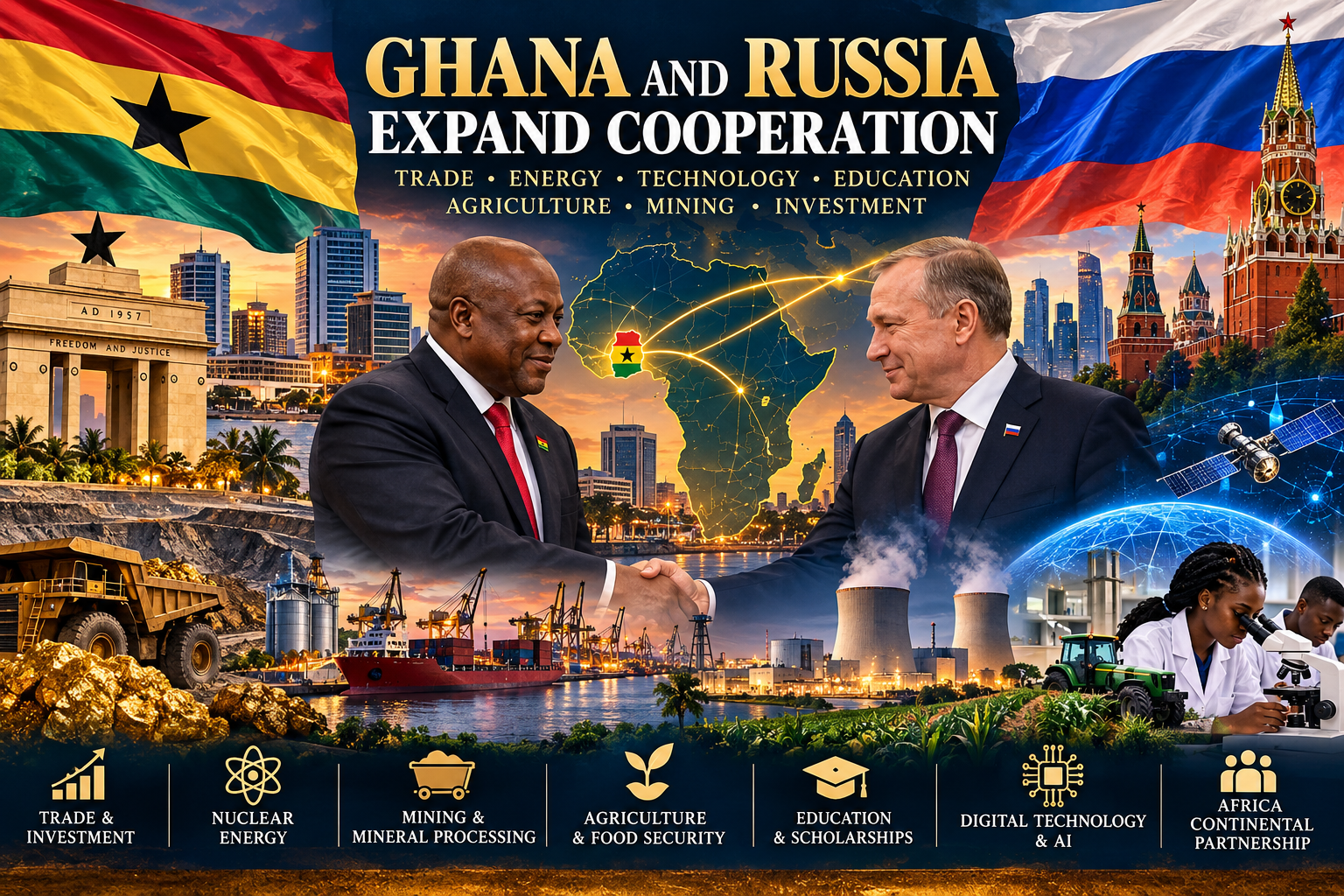
ACCRA, GHANA — Ghana and Russia are seeking to broaden their bilateral relationship beyond traditional diplomatic ties, with trade, investment, education, energy, agriculture, mining and digital technology emerging as major areas of discussion.
Russian Ambassador to Ghana Andrei Ordash said in a September 17, 2026 interview that Moscow wants its relationship with Accra to produce practical economic opportunities rather than remain focused primarily on political engagement.
The ambassador pointed to Ghana’s position within the African Continental Free Trade Area (AfCFTA), whose secretariat is located in Accra, as one of the factors making the country attractive to Russian businesses seeking wider access to African markets.
From trade to investment and local production
According to Ordash, Russia-Ghana trade has expanded substantially in recent years. He said bilateral trade turnover increased more than threefold between 2022 and 2024 and that trade in the first half of 2026 was 2.1 percent higher than during the same period in 2025.
Russian exports to Ghana increased by 11.5 percent during that period, with petroleum products, fertilisers and grain among the principal commodities.
The ambassador said Moscow would like to see the relationship develop beyond the exchange of goods toward joint investment, local production and technology transfer.
For Ghana, that could potentially mean greater emphasis on processing and manufacturing rather than simply exporting raw materials. Ordash identified minerals, agriculture, industrial production and logistics as areas where the two countries could explore deeper cooperation.
Ghana’s position as an AfCFTA member also creates a potential platform for companies operating in the country to reach other African markets.
Nuclear energy remains a major area of interest

Energy is another significant component of the developing relationship.
Ghana and Russia have maintained a framework for cooperation on the peaceful use of nuclear energy since an intergovernmental agreement was signed in 2015. Russia’s state nuclear corporation Rosatom has been involved in discussions surrounding Ghana’s plans for its first nuclear power facility.
Ordash said Russia is prepared to offer a broader package that could include technical design, construction, maintenance and training for Ghanaian personnel.
The issue has gained additional attention following recent Ghana-Russia discussions on the country’s nuclear-energy ambitions. Ghanaian officials have said nuclear power is being considered as part of efforts to diversify the country’s electricity generation mix.
In August, Foreign Affairs Minister Samuel Okudzeto Ablakwa said Ghana and Russia had agreed to deepen cooperation in peaceful nuclear energy and that Ghana was working toward adding nuclear generation to its future energy mix. Graphic reported that Rosatom was among five companies shortlisted for Ghana’s first nuclear power project. (Graphic Online)
Agriculture and mineral processing
Agriculture is another area where Moscow is seeking a larger role.
Russia already supplies Ghana with commodities including fertiliser and grain, but Ordash said future cooperation could include agricultural machinery, processing equipment, technology transfer and local production.
The ambassador also highlighted cooperation involving Ghana’s shea industry. In May 2026, Russian company Golden Forest and Ghana’s Tree Crops Development Authority signed an agreement concerning development of the shea-butter industry, according to the interview.
Mining is another potential area of cooperation. Ghana is one of Africa’s major gold producers and also possesses significant deposits of bauxite and other minerals.
Ordash said Russian companies and research organisations could potentially participate in geological exploration, mining and mineral processing.
The emphasis on processing is significant because it corresponds with Ghana’s broader interest in increasing domestic value addition rather than relying exclusively on exports of unprocessed resources.
Education and scholarships expand
Education remains one of the longest-standing links between Ghana and Russia.
Thousands of Ghanaians have studied in the Soviet Union and Russia, creating an established network of professionals with educational and institutional connections to the country.
For the 2026/27 academic year, Russia initially allocated 120 government scholarships to Ghanaian students. According to Ordash, an additional 117 places were subsequently added, bringing the reported allocation to 237.
He said 97 of the additional scholarships were directed toward agriculture, reflecting Ghana’s stated development priorities.
The scholarship programme is part of a wider expansion of educational cooperation. Russian universities are developing relationships with Ghanaian institutions in agriculture, engineering, technical education and language studies.
Takoradi Technical University has become the first Ghanaian member of the Russian-African Network University, while cooperation is also developing between Russian universities and institutions including the University of Ghana.
Ghanaian students are also participating in research, exchange programmes and summer schools.
Ghana News Agency reported earlier in July that Russia was seeking to expand educational cooperation with Ghana, particularly in engineering, agriculture and other technical fields. (Ghana News Agency)
Digital technology and artificial intelligence
The emerging partnership is also moving into technology.
Ordash identified artificial intelligence, cybersecurity, digital government, financial technology and digital payments as possible areas for cooperation.
Russia has offered to share experience in large-scale digital government systems and other technologies, while Ghana’s growing digital economy could provide opportunities for collaboration between companies, universities and government institutions.
The ambassador also pointed to cybersecurity as an area where Russia could provide technical expertise and training.
These proposals come as Ghana continues to pursue digital transformation across public services, financial technology and other sectors. Ghana News Agency reported in July that Russia had expressed interest in cooperation involving artificial intelligence, cybersecurity, healthcare, scientific research and technology transfer. (Ghana News Agency)
The challenge of payments and sanctions

Despite the potential for expanded commerce, the ambassador acknowledged that financial transactions represent one of the major obstacles to deeper Russia-Ghana trade.
Ordash said businesses dealing with Russian counterparts can face difficulties involving international payment channels and the risk of secondary sanctions.
He argued that alternative payment arrangements could help facilitate bilateral commerce, although any such arrangements would still have to comply with the laws and regulations applicable to Ghanaian and international businesses.
The issue illustrates one of the central challenges facing the proposed expansion of trade: increasing commercial activity requires not only buyers and sellers, but dependable banking, payments, insurance, logistics and compliance mechanisms.
Ghana’s African role
The relationship also has a broader continental dimension.
Ghana is scheduled to chair the African Union in 2027, giving Accra an important diplomatic role in continental discussions.
Ordash said Moscow views Ghana as an important partner in discussions involving African representation in global institutions, reform of international financial institutions, continental security and the AfCFTA.
He also discussed Ghana’s role in regional diplomacy, particularly regarding relations between ECOWAS and the Sahel states of Burkina Faso, Mali and Niger.
Ghana’s long-standing participation in United Nations peacekeeping operations was identified as another area in which Moscow sees potential for professional exchange.
Russia has also indicated that it intends to strengthen its institutional relationship with ECOWAS.
Reparations and African cultural heritage
Historical issues are another point of discussion.
Ghana has placed reparations for slavery and colonialism among the issues it intends to emphasize during its 2027 African Union chairmanship.
Ordash said Russia supports Ghana’s efforts on historical justice and expressed support for African initiatives concerning the return of cultural artefacts removed from the continent during the colonial period.
He also said Russian academic institutions were prepared to provide research and legal expertise concerning reparations claims.
These positions form part of a wider diplomatic conversation between African states and international partners over slavery, colonialism, cultural restitution and the reform of global institutions.
A relationship still being defined
The latest Russian statements point toward an effort to transform Ghana-Russia relations from a predominantly diplomatic relationship into one involving more commercial, technological and educational activity.
The proposed areas are broad: nuclear energy, agriculture, mining, mineral processing, manufacturing, logistics, digital technology, education and financial infrastructure.
But translating diplomatic announcements into projects will depend on financing, regulatory approvals, commercial viability, technology transfer, local participation and the ability of companies on both sides to conduct transactions within applicable international rules.
For Ghana, the relationship therefore represents another avenue through which the country can pursue investment, technology and market access while maintaining its broader network of international partners.
For Russia, Ghana’s economy, AfCFTA membership, educational links and position in West Africa make Accra a potential platform for deeper engagement with the wider African market.
The coming months will show how much of the proposed cooperation moves from diplomatic discussions into concrete projects, contracts, training programmes and investment.
For now, the message from Moscow is clear: Russia wants its relationship with Ghana to become more economically and technologically substantive, while Ghana continues to pursue a broad network of international partnerships based on its own national interests.
Leave a Reply