
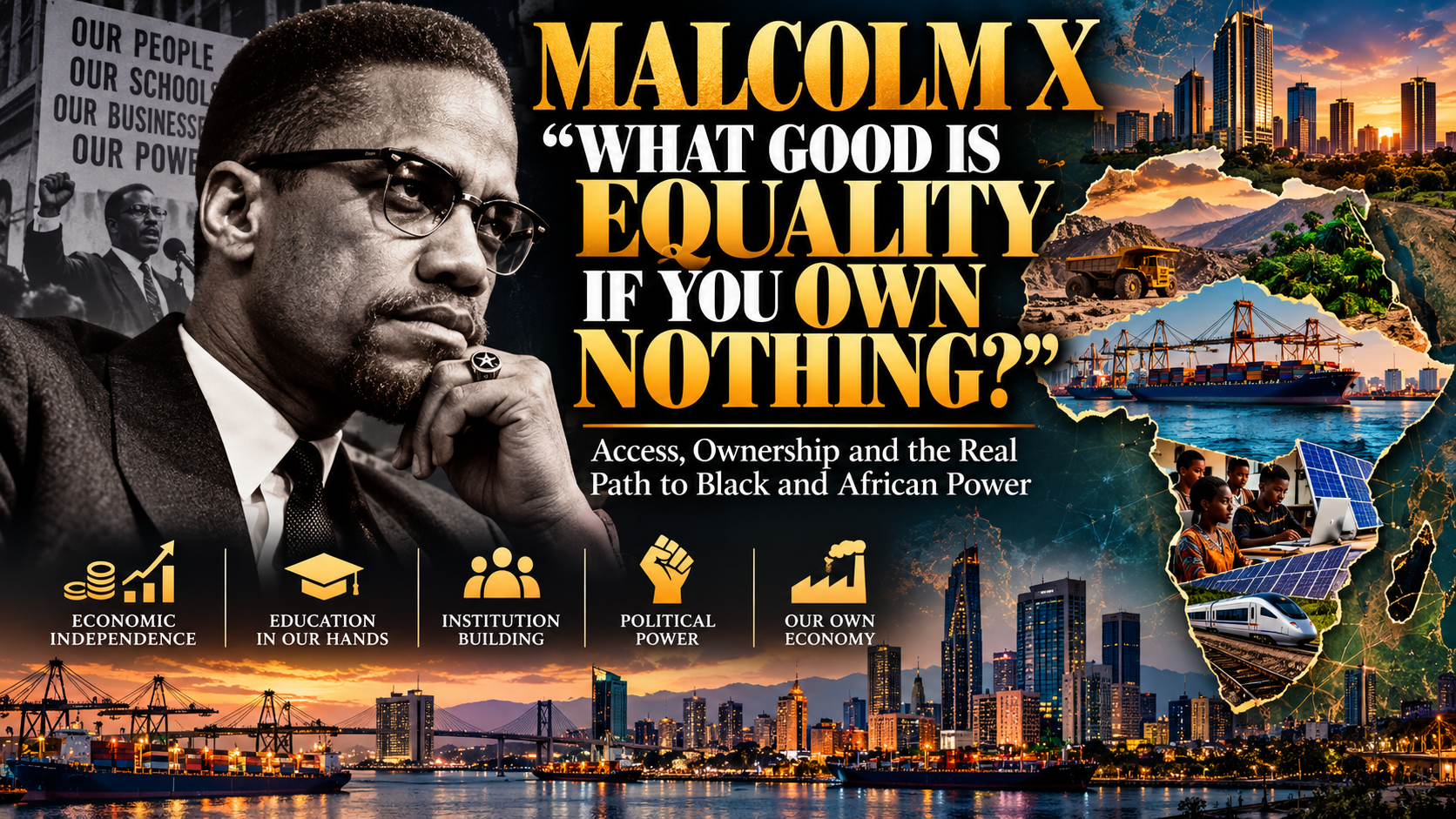
Beyond Access: The Difference Between Participation and Power
One of the most enduring questions associated with Malcolm X is deceptively simple: What does equality mean if people have access to a system but possess little power within it?
For Malcolm X, the struggle for Black freedom could not be reduced to gaining admission into institutions that already existed. Integration, employment opportunities, voting rights and equal treatment were important battles, but they did not necessarily answer the deeper question of economic and political power.
The distinction was between access and ownership.
A person may be permitted to enter an institution without having the ability to control it. A community may be allowed to work within an economy without owning significant portions of that economy. A population may have the right to vote while remaining economically dependent on institutions over which it has limited influence.
Malcolm X repeatedly pushed his audiences to examine that distinction.
His larger argument was that political freedom without economic power could remain fragile. If communities did not develop their own businesses, schools, media organizations, financial institutions and political structures, their ability to determine their own future would always be constrained by decisions made elsewhere.
That idea remains relevant far beyond the period in which Malcolm X lived.
Integration Was a Method, Not the Final Destination
Malcolm X’s position was frequently presented as being fundamentally opposed to integration. The reality was more complicated.
His criticism was directed at the assumption that integration itself represented the final measure of liberation.
For Malcolm X, entering another person’s institution was not necessarily the same thing as building an institution of your own.
The distinction matters.
If a community’s only economic strategy is to seek employment from businesses it does not own, its economic security ultimately depends upon the decisions of those businesses.
If its educational institutions are controlled entirely from outside the community, its ability to determine the direction of education can be limited.
If its media organizations are owned elsewhere, its ability to define its own narrative can be constrained.
If its financial institutions do not control capital within the community, entrepreneurs may struggle to obtain the resources necessary to build businesses capable of competing at scale.
In that sense, Malcolm X’s question was not simply whether Black people should participate in American society.
It was whether they would have the capacity to build, own and control institutions within it.
Economic Independence as a Foundation of Freedom
Economic independence was central to Malcolm X’s political thinking.
A community that possesses political rights but lacks economic resources can find those rights difficult to translate into material power.
Voting can influence political leadership, but economic ownership influences employment, investment, housing, education, infrastructure and the development of businesses.
Ownership creates another form of leverage.
A business owner makes decisions about capital.
A school owner or educational institution can establish priorities.
A media organization can determine which stories receive attention.
A transportation company can determine how people and goods move.
A financial institution can influence which entrepreneurs receive capital.
These institutions collectively create an ecosystem of power.
This is why the question of ownership remains larger than individual wealth.
The issue is institutional capacity.
“How Do We Build Our Own Economic Power?”
One of the most important questions emerging from Malcolm X’s economic philosophy was:
How do we build our own economic power?
That question changes the conversation.
Instead of asking only how people can obtain jobs, it asks how communities can create companies that employ people.
Instead of asking only how people can gain admission to universities, it asks how communities can establish and control educational institutions.
Instead of asking only how people can consume media, it asks who owns the platforms producing and distributing that media.
Instead of asking only how people can participate in financial markets, it asks who controls the capital flowing through those markets.
The difference is between being primarily a consumer of institutions and becoming a builder of institutions.
That distinction remains particularly important in an era when technology has dramatically lowered the barriers to creating businesses, media platforms, educational networks and financial services.
Ownership Creates Options
Ownership does not automatically produce justice or prosperity. Businesses can fail. Institutions can become corrupt. Wealth can become concentrated within a small group.
But ownership creates something that dependence cannot easily provide: options.
A community with multiple businesses can create employment.
A community with schools can educate according to its priorities.
A community with media organizations can tell its own stories.
A community with financial institutions can develop mechanisms for circulating capital.
A community with technology companies can build platforms rather than simply using platforms created elsewhere.
The ability to create alternatives is itself a form of power.
This is particularly relevant across Africa and the African diaspora.
The continent possesses enormous natural resources, youthful populations, expanding cities and increasingly sophisticated technology sectors. Yet ownership of critical infrastructure, capital, intellectual property, supply chains and major distribution networks remains an important question.
The challenge is therefore not simply participation in the global economy.
It is determining what position African people occupy within that economy.
From Consumers to Producers
The modern economy rewards control over production and distribution.
A country can export minerals while importing finished products made from those minerals.
It can produce agricultural commodities while importing processed food.
It can provide talented engineers while foreign companies capture the intellectual property created by their work.
It can have millions of consumers while foreign corporations control the platforms through which those consumers communicate, shop and entertain themselves.
Participation exists in each of these examples.
But ownership may remain elsewhere.
That is the problem Malcolm X’s framework helps expose.
The objective is not isolation from the global economy. It is greater control over the terms of participation.
Africa does not need to withdraw from global markets.
It needs to become more powerful within them.
Building Institutions Instead of Waiting for Permission
The most powerful implication of this philosophy is psychological as much as economic.
People accustomed to seeking admission into existing institutions can begin to think differently when they start asking:
What can we build?
That question moves the conversation from permission to creation.
Instead of waiting for someone to establish a company, establish one.
Instead of waiting for someone to create a media platform, create one.
Instead of waiting for someone else to document African history, build archives and publishing institutions.
Instead of waiting for foreign companies to determine which African resources are valuable, develop African scientific, geological and technological institutions capable of making those assessments.
Instead of simply exporting raw materials, build processing industries.
Instead of importing every technological solution, invest in local engineering and software development.
The goal is not to reject cooperation.
The goal is to ensure that cooperation does not become permanent dependence.
The African Question: Who Owns the Future?
This question is particularly significant in the twenty-first century.
Africa is entering an era of competition over critical minerals, energy, telecommunications, artificial intelligence, agriculture, shipping, manufacturing and digital infrastructure.
The countries and companies capable of controlling these systems will have enormous influence over the future.
The question therefore becomes:
Who owns the infrastructure of Africa’s future?
Who owns the mines?
Who processes the minerals?
Who owns the shipping and logistics companies?
Who controls the data?
Who develops the software?
Who owns the telecommunications infrastructure?
Who finances African businesses?
Who controls intellectual property?
Who owns the media platforms through which Africans understand themselves and the world?
These questions move the conversation beyond symbolism.
They bring the discussion into the territory of measurable economic power.
Dignity and the Ability to Build
Malcolm X connected economic independence with dignity because ownership changes the relationship between individuals and institutions.
A person who owns a business has a different relationship with the economy than someone who can only seek employment.
A community that owns schools has a different relationship with education than a community that can only petition others for educational opportunities.
A country that controls critical infrastructure has a different relationship with foreign powers than one that depends entirely upon external infrastructure.
This does not mean that every individual must become an entrepreneur or that collective ownership is the only legitimate economic model.
Rather, the broader principle is that communities require institutions capable of defending their interests.
Dignity, in this sense, is not merely a feeling.
It is institutional capacity.
The Difference Between Equality and Power
The debate over Malcolm X’s ideas remains relevant because equality and power are not necessarily identical.
A society can provide formal equality while economic inequality remains enormous.
A person can possess the legal right to compete while lacking access to capital.
A community can have political representation while having little control over the economic resources that shape its future.
A country can be formally sovereign while remaining dependent upon foreign capital, technology or infrastructure.
These contradictions force a deeper question:
Is equality primarily about being allowed into the room, or is it also about having the power to shape what happens inside the room?
Malcolm X’s legacy invites us to consider the second possibility.
Building Rather Than Merely Entering
The enduring lesson is not that participation has no value.
Access matters.
Equal rights matter.
Integration can matter.
Representation matters.
But none of these automatically guarantees ownership.
The deeper challenge is to build institutions capable of converting political freedom into economic power.
That means developing businesses, schools, financial systems, media organizations, technology companies, research institutions and cultural institutions that can survive beyond individual leaders.
It means creating systems in which wealth circulates, knowledge accumulates and institutions become stronger across generations.
The ultimate question is therefore not simply:
“Are we allowed to participate?”
It is:
“Do we possess the capacity to build, own and control institutions that determine our future?”
That is the question that transforms the conversation from access to power.
And it remains one of the most consequential questions facing communities across Africa and the African diaspora today.
Leave a Reply