
By Panafrican.email News Desk
Ghana is entering a new phase of its long-running gold story.
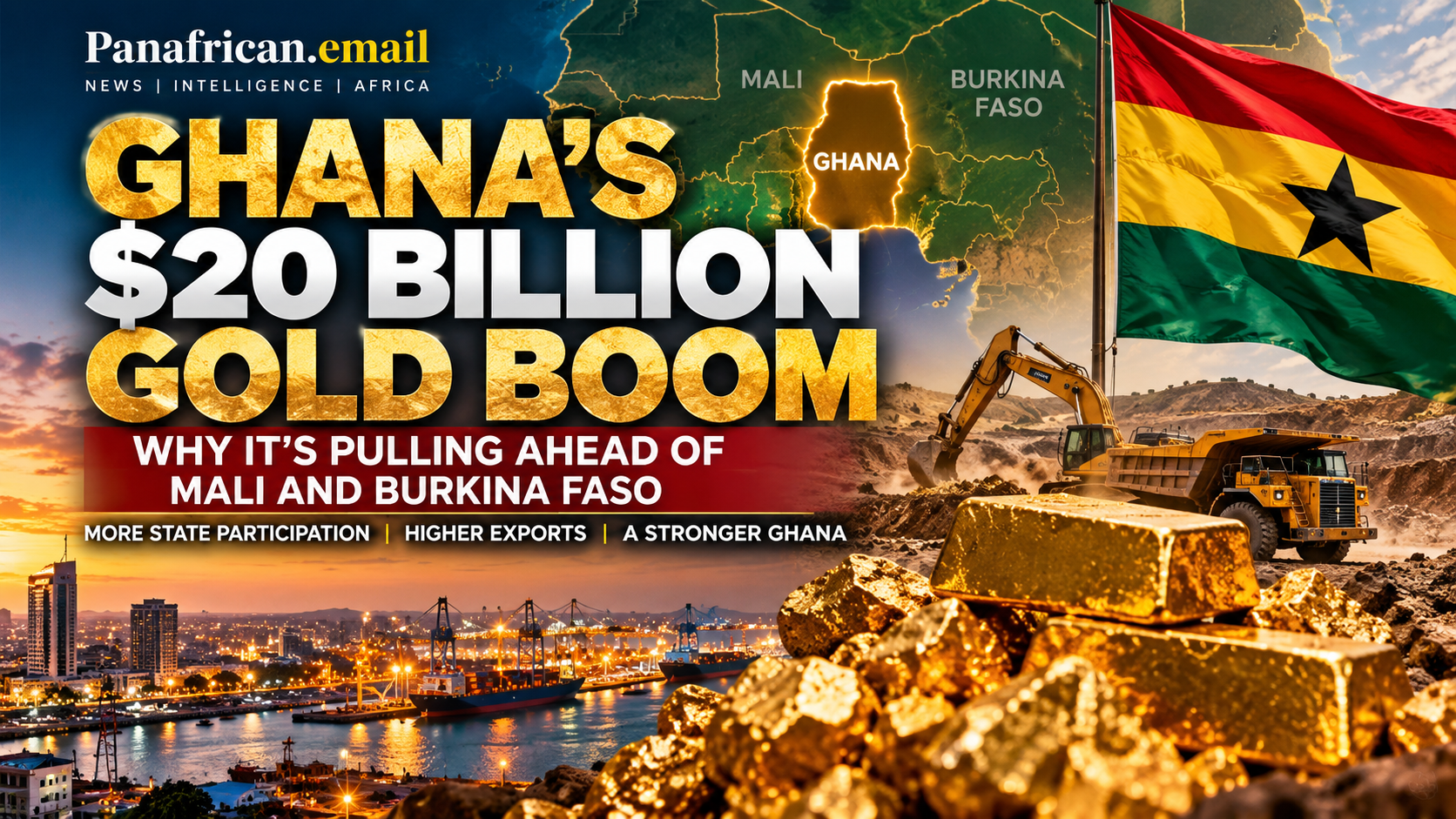
The country has long been one of Africa’s most important gold producers, but the scale of its latest expansion is changing the economic and political significance of the sector. In 2025, Ghana produced nearly six million ounces of gold, while gold export earnings climbed to approximately $20.2 billion.
The numbers are striking. They also point to something larger than a commodity boom.
Ghana is attempting to transform gold from a resource extracted largely for international markets into a more strategically managed national asset — one capable of generating foreign exchange, supporting the national currency, strengthening reserves, formalising artisanal mining and retaining more value inside Ghana.
That puts Accra in an increasingly important regional competition with gold-producing neighbours including Mali and Burkina Faso, where governments are also seeking greater control over mineral wealth.
The question is no longer simply who produces the most gold.
The bigger question is: Which African state can capture the greatest economic value from its gold?
Ghana’s extraordinary gold surge
Ghana’s 2025 performance represents a major acceleration in its gold industry.
Production reached approximately six million ounces, while export earnings approached $20.2 billion. Gold has therefore become one of the most important pillars of Ghana’s external economy.
The significance of the export figure goes beyond the mining industry itself.
Gold generates foreign exchange. Foreign exchange supports imports, reserves, debt management and currency stability. For a country such as Ghana, where access to hard currency can have a direct impact on the cost of fuel, machinery, food, medicine and industrial inputs, a dramatic increase in gold receipts can have consequences across the wider economy.
But Ghana’s strategy is not based solely on producing more gold.
The country is increasingly focused on controlling how gold moves from the mine to the international market.
That is where the Ghana Gold Board — commonly known as GoldBod — becomes central to the story.
GoldBod changes the equation
For decades, Ghana’s gold economy has included a large network of artisanal and small-scale miners, licensed buyers, traders, exporters, processors and international companies.
That system generated substantial economic activity, but it also created opportunities for smuggling, under-reporting and value leakage.
Ghana’s new approach is to bring a much larger portion of that trade into a centralised and formally regulated system.
GoldBod was established in 2025 with a broad mandate covering the buying, selling, assaying, refining and exporting of gold and other precious minerals. Its creation represented one of the country’s most significant changes to gold-trade governance in decades.
Under the new system, GoldBod became the central state-backed institution responsible for gold originating from Ghana’s artisanal and small-scale mining sector.
The objective is straightforward:
Capture more of Ghana’s gold inside the formal economy.
Instead of allowing gold to disappear through informal channels before it reaches official export statistics, the government wants more of the production to pass through regulated purchasing, pricing, weighing, assaying and export systems.
That has potentially enormous consequences.
The small-scale mining revolution
One of the most important parts of Ghana’s gold story is the performance of artisanal and small-scale mining.
Small-scale miners have often been portrayed primarily through the lens of illegal mining and environmental damage. The reality is more complicated.
Millions of people across Africa depend directly or indirectly on artisanal and small-scale mining.
The sector provides employment, supports trading communities and generates enormous quantities of mineral wealth. The challenge for governments is to formalise the activity without destroying the livelihoods that depend on it.
Ghana is attempting to do exactly that.
GoldBod’s centralised purchasing model is designed to bring more small-scale production into the official economy. In 2025, more than 100 tonnes of artisanal and small-scale gold were channelled through official export pathways.
That is a remarkable development.
It demonstrates that small-scale mining is not a marginal part of Ghana’s gold industry. It is becoming one of its central engines.
The strategic opportunity is enormous if Ghana can combine formalisation with better technology, environmental standards, traceability, access to finance and local processing.
From extraction to value retention
Africa’s mineral problem has never simply been a lack of resources.
The continent possesses enormous deposits of gold, copper, cobalt, lithium, manganese, bauxite, iron ore, uranium and other strategic minerals.
The problem has historically been where the value is captured.
A country can export billions of dollars of raw minerals while importing finished products made from those same resources at considerably higher prices.
Gold is somewhat different because it is already a globally traded financial asset. Nevertheless, enormous value can still leave a producing country through trading margins, refining, financial services and international supply chains.
Ghana’s emerging strategy is therefore increasingly about value retention.
That means asking:
- Who buys the gold?
- Who determines its price?
- Where is it assayed?
- Where is it refined?
- Where are the financial transactions conducted?
- Where does the foreign exchange ultimately enter the economy?
- How much of the mining equipment is produced locally?
- How many jobs remain in Ghana after extraction?
- Can Ghana develop a domestic jewellery and manufacturing industry around its gold?
Those questions could ultimately be more important than production statistics.
Mali is pursuing a different model
Ghana’s strategy comes at a time when Mali is also demanding a greater national share of its mineral wealth.

Mali’s gold sector has become a major focus of state economic policy, with authorities seeking increased participation and stronger government control over mining operations.
The central principle is similar to Ghana’s:
African countries want a larger share of the wealth generated by African minerals.
But the approaches are not identical.
Ghana is building a centralised gold trading institution around the formalisation of the small-scale sector and foreign-exchange management.
Mali has placed greater emphasis on increasing state participation in mining projects and renegotiating the economic relationship between the government and international mining companies.
The difference is important.
Ghana’s approach focuses heavily on the trade and financial side of the gold value chain.
Mali’s strategy has focused more heavily on ownership, state participation and the fiscal relationship between the state and mining companies.
Both approaches reflect the same continental shift: African governments are becoming increasingly unwilling to accept a model in which mineral extraction produces enormous wealth while the producing country captures only a fraction of the overall value.
Burkina Faso is also challenging the old mining model
Burkina Faso has similarly moved toward greater state involvement in its mining industry.
The country’s gold sector is strategically important to its economy, and authorities have increasingly emphasised national control, local participation and the role of the state.
This creates an emerging West African laboratory.
Three major gold-producing countries — Ghana, Mali and Burkina Faso — are experimenting with different ways of increasing national control over mineral wealth.
Their political systems and economic structures differ, but their underlying question is remarkably similar:
How can gold become a foundation for national development rather than simply an export commodity?
Ghana’s biggest advantage
Ghana’s advantage may be its established mining infrastructure.
The country already possesses decades of experience with large-scale commercial mining, an established financial system, ports, international trading relationships, geological expertise and a large network of small-scale miners.
It also has the institutional foundation needed to connect production to international markets.
GoldBod potentially gives Ghana another advantage: greater visibility over the domestic gold supply chain.
If the government knows where gold is produced, who buys it, how much is produced and where it is exported, it becomes easier to collect revenue and reduce leakage.
But centralisation alone does not guarantee success.
The system must maintain competitive prices for miners, operate transparently and provide incentives strong enough to convince producers and traders to remain within the formal market.
If informal buyers offer faster payments or better prices, smuggling can continue.
That makes enforcement only one part of the equation.
The formal system must also be attractive.
The danger of becoming too dependent on gold
Ghana’s gold success comes with a warning.
The stronger gold becomes as a source of export revenue, the more dependent Ghana becomes on the international gold market.
Gold prices can rise dramatically, but they can also fall.
A heavily gold-dependent economy therefore remains vulnerable to external shocks.
Recent trade data has highlighted just how concentrated Ghana’s export earnings have become around gold. The mineral accounted for more than 60 percent of Ghana’s exports in 2025.
That is both an extraordinary strength and a potential weakness.
Gold can provide the foreign exchange necessary to finance economic transformation.
But gold should not become an excuse to postpone economic diversification.
The ultimate goal should be to use mineral wealth to build manufacturing, agriculture, technology, infrastructure, education, energy and financial services.
The gold should finance the transformation.
It should not become the transformation itself.
The next battle: refining Africa’s gold
One of the most important questions for Ghana is what happens after the gold leaves the mine.
Africa produces enormous quantities of gold, yet much of the downstream value associated with refining, jewellery manufacturing, investment products and international financial services remains outside the continent.
Ghana therefore has an opportunity to move further downstream.
Imagine a Ghana in which gold is:
mined in Ghana → assayed in Ghana → refined in Ghana → manufactured in Ghana → financed through Ghanaian institutions → exported as higher-value products.
That would represent a fundamentally different economic model.
Instead of simply exporting gold bars, Ghana could develop a regional precious-metals ecosystem.
Accra could potentially become a major West African centre for gold trading, refining, jewellery, bullion services and mineral finance.
That is the bigger prize.
A West African gold corridor?
The competition between Ghana, Mali and Burkina Faso should not necessarily be viewed as a zero-sum game.
West Africa could ultimately benefit from a regional gold economy connecting mining regions to refining centres, financial markets, transport networks and manufacturing hubs.
Ghana’s ports and financial infrastructure could complement mineral production elsewhere in the region.
Regional cooperation could create opportunities for:
- gold refining;
- geological services;
- mining equipment manufacturing;
- mineral transportation;
- responsible sourcing;
- financial services;
- jewellery manufacturing;
- geological research;
- mining technology;
- artisanal-mining training.
The challenge is building the political and economic infrastructure necessary to make that possible.
The real measure of Ghana’s gold boom
The headline figure is $20.2 billion.
But that should not be the final measure of Ghana’s success.
The real test will be what happens to that money after it enters the country.
Does it strengthen Ghana’s reserves?
Does it improve the stability of the cedi?
Does it finance infrastructure?
Does it create industrial jobs?
Does it improve mining communities?
Does it reduce illegal mining?
Does it expand domestic refining?
Does it create Ghanaian-owned mining companies?
Does it produce a new generation of engineers, geologists, metallurgists and entrepreneurs?
And, most importantly, does Ghana retain more of the value created by its own natural resources?
Those are the questions that will determine whether the current gold boom becomes a temporary commodity windfall or the foundation of a new economic model.
Africa’s mineral moment
Ghana’s gold boom is part of a much larger African story.
Across the continent, governments are reconsidering decades-old arrangements governing natural resources.
The era of simply digging minerals out of the ground and shipping them abroad is increasingly being challenged.
The emerging model is based on sovereignty, participation, value addition, industrialisation and strategic control.
Ghana is pursuing that agenda through GoldBod and greater control over the gold trade.
Mali is seeking greater state participation in its mining sector.
Burkina Faso is also challenging traditional mining arrangements.
The details differ, but the direction is clear.
Africa is beginning to ask a different question about its mineral wealth.
Not simply:
“How much gold do we produce?”
But:
“How much of the gold economy do we control?”
For Ghana, the answer could determine whether $20 billion in annual gold exports becomes another chapter in Africa’s long history of resource extraction — or the beginning of a new era of African mineral sovereignty.
Panafrican.email Analysis
Ghana’s gold strategy deserves attention beyond the mining sector. The country’s experiment with GoldBod is effectively a test of whether an African state can use control over mineral trading, foreign exchange and formalisation to capture a greater share of resource wealth without discouraging production.
If Ghana succeeds, the model could influence mineral policy across West Africa — from gold in Mali and Burkina Faso to bauxite in Guinea, lithium in Zimbabwe and copper and cobalt in the Democratic Republic of Congo.
The next phase of Africa’s mineral revolution may therefore not be about discovering more resources.
It may be about who controls the value chain.
Source context: Firstpost Africa report featured in the supplied screenshot; Ghanaian official and statistical sources were also consulted for factual verification.
Leave a Reply