
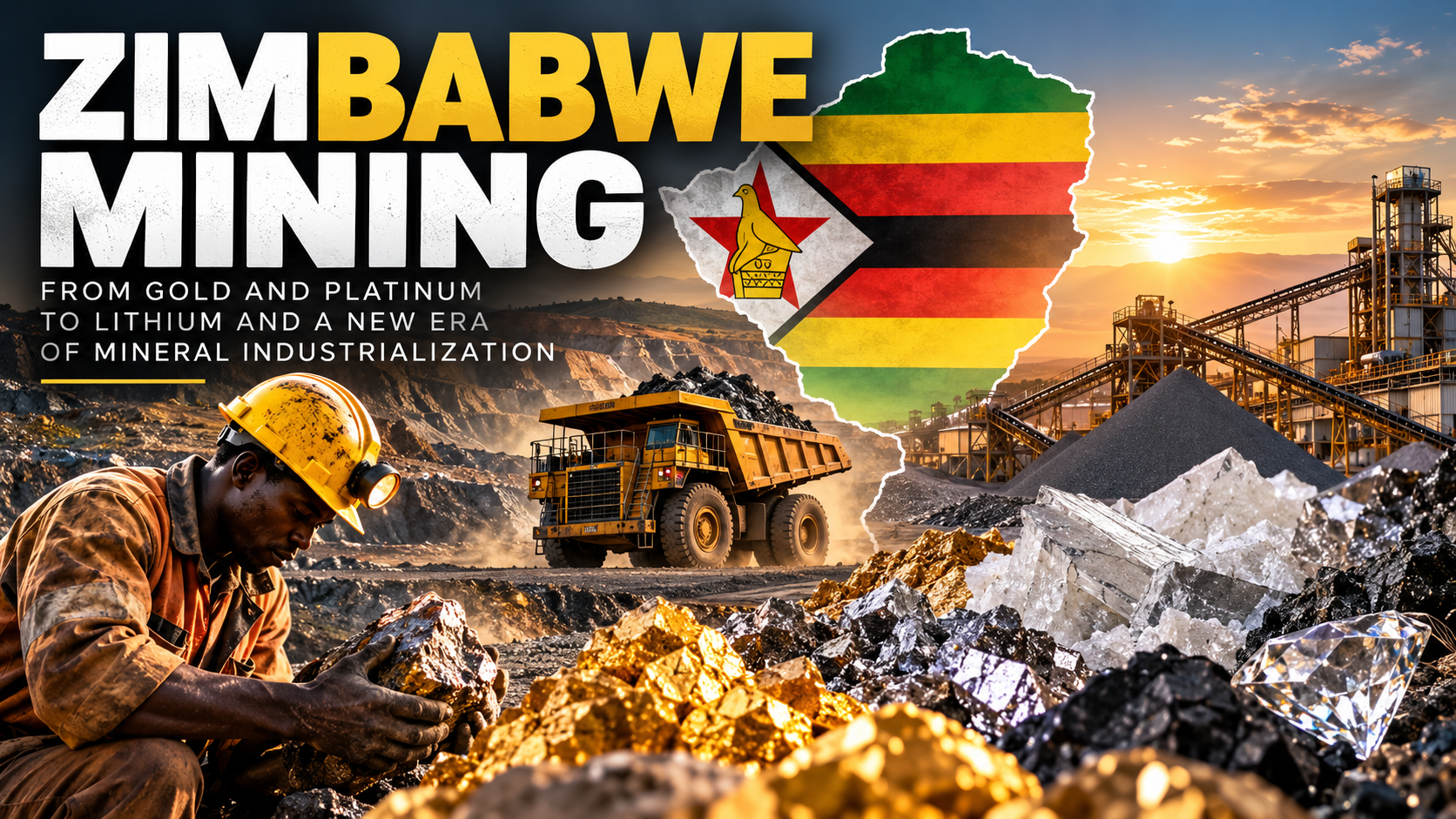
Zimbabwe is entering a decisive period in its mining history. For decades, the country’s mineral economy has been anchored by gold, platinum-group metals, chrome, coal and diamonds. But the rapid rise of lithium has added a new strategic dimension, placing Zimbabwe at the center of the global competition for minerals needed for batteries, energy storage and advanced manufacturing.
The opportunity is enormous—but so are the questions surrounding ownership, beneficiation, environmental protection, infrastructure, mineral governance and how much value Zimbabwe ultimately captures from the resources extracted from its soil.
Today, mining remains one of Zimbabwe’s most important economic sectors. The U.S. Geological Survey estimates that mining and quarrying contributed about 15.4% of real GDP in 2024, while gold, platinum-group metals and ferroalloys were among the country’s most important sources of export earnings. Zimbabwe was also the world’s third-largest platinum producer in 2024 and a major producer of lithium, palladium, chromium, vermiculite and diamonds.
A Mineral Economy Built on Diversity
Zimbabwe is unusual in Africa because of the breadth of its mineral resources. More than 60 commercially important minerals have been identified, according to Zimbabwe’s Ministry of Foreign Affairs and International Trade.
The country’s major mineral belts include the Great Dyke, which contains extensive platinum-group metals and chromium deposits, the Hwange coalfields, the Marange diamond fields and numerous gold-bearing geological formations.
The result is an economy in which different minerals play different strategic roles:
- Gold provides major foreign-currency earnings.
- Platinum-group metals (PGMs) connect Zimbabwe to the global automotive, chemical and clean-technology industries.
- Lithium has emerged as a strategic battery mineral.
- Chrome and ferrochrome support the stainless-steel industry.
- Coal remains important to electricity and industrial production.
- Diamonds provide another major export commodity.
- Iron and steel are increasingly becoming part of the country’s mineral-industrial strategy.
This diversity gives Zimbabwe a stronger foundation than an economy dependent on a single commodity.
But it also creates a complicated policy challenge: the country must simultaneously manage traditional mining industries while building new value chains around minerals that have become strategically important only in recent years.
Gold: Zimbabwe’s Traditional Economic Engine
Gold remains the backbone of Zimbabwe’s mineral economy.
The country has a long history of gold production stretching from pre-colonial mining through the colonial period and into the modern era. Today, production comes from large-scale mining companies as well as thousands of small-scale and artisanal miners.
The importance of small-scale production is particularly significant. Zimbabwe’s 2026 mid-year economic data indicated that small-scale producers accounted for the majority of national gold output, with production from that segment continuing to increase despite difficult weather conditions.
Gold has also become Zimbabwe’s largest foreign-currency earner.
According to Reuters, Zimbabwe produced a record 46.7 metric tons of gold in 2025, while gold exports generated approximately $4.61 billion, almost half of the country’s total exports that year. The government has targeted production of 50 metric tons in 2026.
That makes gold more than simply a mining commodity. It is an important pillar of Zimbabwe’s external finances.
The rise of state-backed gold production
Zimbabwe is also attempting to expand production through Mutapa Gold Resources, the state-owned gold mining company.
Mutapa has announced plans to more than double annual production to approximately 220,000 ounces by 2029. One of its major projects is the expansion of Shamva Hill, where a planned investment is expected to increase annual production substantially. Expansion plans also include Jena and Freda Rebecca.
If these projects succeed, Zimbabwe could increase its ability to capture a larger share of gold production through locally controlled mining assets.
But the gold industry also faces longstanding challenges involving illegal mining, smuggling, mercury use, environmental damage and the formalization of artisanal miners.
The policy challenge is therefore not simply producing more gold.
It is ensuring that more of the gold enters the formal economy.
Platinum: The Great Dyke’s Strategic Advantage
Zimbabwe’s second major mineral story is platinum.
The Great Dyke is one of the world’s most important geological formations for platinum-group metals. Zimbabwe was the world’s third-largest platinum producer in 2024, accounting for approximately 10.3% of global production.
Major producers include:
- Zimplats
- Mimosa
- Unki
These operations make Zimbabwe a critical participant in the global PGM market.
Platinum, palladium and rhodium have applications extending well beyond traditional jewelry. They are used in catalytic converters, chemical processes, electronics and other industrial applications.
The challenge for Zimbabwe is that mining PGMs is only the beginning of the value chain.
The real economic prize lies in processing, refining, manufacturing and developing industrial capabilities around these metals.
Zimbabwe has already begun moving in that direction.
The Minerals Marketing Corporation of Zimbabwe reported that PGM matte sales increased sharply in 2025, while direct concentrate exports declined as more material moved into downstream processing arrangements.
That transition is strategically important.
Instead of exporting increasingly raw mineral material, Zimbabwe wants to capture more value before the commodity leaves the country.
Lithium Changes the Game
If gold represents Zimbabwe’s traditional mining economy, lithium represents its future-facing opportunity.
Zimbabwe rapidly emerged as one of Africa’s leading lithium producers following major investments by Chinese companies.
The country became the world’s fourth-largest lithium producer outside the United States in 2024, accounting for approximately 9% of global production, according to the U.S. Geological Survey.
Companies including Zhejiang Huayou Cobalt, Sinomine, Chengxin Lithium and Yahua have invested heavily in Zimbabwe’s lithium industry.
Major operations include:
- Arcadia
- Bikita
- Sabi Star
- Kamativi
- Gwanda
- Prospect Lithium Zimbabwe
The scale of the transformation is remarkable.
Zimbabwe’s spodumene exports increased to approximately 1.128 million metric tons in 2025, up from 1.014 million tons in 2024. Yet export revenue remained almost unchanged at roughly $514 million because lithium prices fell sharply during the period.
That experience exposes one of the central problems of commodity economies:
Producing more does not necessarily mean earning more.
A country can increase its physical exports while receiving little additional revenue if global prices collapse.
From Lithium Mining to Lithium Processing
Zimbabwe increasingly wants to avoid that trap.
The government has pursued restrictions on exports of unprocessed minerals and lithium concentrates in an attempt to force greater domestic beneficiation.
The objective is straightforward:
Do not simply export the rock. Build the industry around the rock.
That means moving progressively from:
Mining → Concentrate → Chemical processing → Battery materials → Battery manufacturing
The first stages are already developing.
For example, Huayou has invested approximately $400 million in a processing plant intended to move lithium production further downstream toward lithium sulphate and other battery-material products.
Zimbabwe’s policy direction therefore reflects a broader African debate over the future of critical minerals.
Africa possesses enormous mineral resources required for the energy transition, but historically much of the continent has exported raw or minimally processed materials while importing finished products.
Zimbabwe is attempting to change that equation.
The 2026 Lithium Policy Turning Point
Zimbabwe’s lithium policy has become increasingly interventionist.
A 2026 analysis from Boston University’s Global Development Policy Center described the government’s move toward banning exports of raw mineral ore and lithium concentrates as a major attempt to capture more value domestically.
But the policy also carries risks.
A sudden restriction on exports can encourage investment in processing—but it can also create uncertainty for mining companies if the country lacks sufficient processing capacity, reliable electricity, transportation infrastructure and predictable regulations.
That is the central dilemma.
Zimbabwe can tell investors:
Process minerals locally.
But investors will then ask:
Where is the infrastructure needed to process them?
That includes:
- reliable electricity;
- railways;
- roads;
- water;
- chemical-processing facilities;
- skilled workers;
- engineering services;
- laboratories;
- financing;
- export infrastructure.
Without those systems, beneficiation policies can become bottlenecks rather than industrial catalysts.
China and Zimbabwe’s Mining Relationship
China has become one of the most important external partners in Zimbabwe’s mining industry.
Chinese companies have invested heavily in lithium, ferrochrome and other mineral industries.
The lithium sector is the clearest example.
Chinese companies have supplied capital, mining technology, processing infrastructure and access to China’s enormous battery supply chain. Most Zimbabwean lithium exports have historically gone to China for further processing.
This relationship provides Zimbabwe with something it urgently needs: capital.
But it also raises a strategic question.
Will Zimbabwe remain primarily a supplier of minerals to Chinese industrial networks—or become an industrial partner capable of manufacturing higher-value products itself?
That question will shape Zimbabwe’s mining economy for decades.
Chrome and Ferrochrome
Chrome is another important pillar.
Zimbabwe possesses enormous chromium resources, particularly along the Great Dyke.
The U.S. Geological Survey ranked Zimbabwe sixth globally for chromium production in 2024, accounting for approximately 3.2% of global output.
Chrome becomes especially valuable when processed into ferrochrome, a critical input for stainless steel.
This makes the chrome industry another example of the difference between extraction and industrialization.
Exporting chrome ore generates income.
Producing ferrochrome generates greater value.
Producing stainless steel creates an even larger industrial ecosystem.
That ecosystem can include:
- mining;
- smelting;
- steelmaking;
- engineering;
- fabrication;
- construction;
- transport;
- machinery;
- industrial services.
Zimbabwe’s Manhize steel project represents an important attempt to move in this direction.
The Manhize steel plant, developed by Dinson Iron and Steel Company, began producing pig iron and billets in 2024.
If Zimbabwe can connect its iron, chrome, coal and energy resources with domestic steel manufacturing, mining could become the foundation of a much broader industrial economy.
Coal and Energy
Mining and energy are deeply connected in Zimbabwe.
Coal remains important for electricity generation and industrial production, particularly around Hwange.
That creates a complicated transition.
Zimbabwe wants to participate in the global clean-energy economy through lithium, platinum and other strategic minerals. At the same time, coal remains part of the country’s current energy system.
This means Zimbabwe’s mining future is likely to contain two seemingly contradictory realities:
Coal supports today’s industrial system.
Lithium and other critical minerals could help build tomorrow’s energy system.
The challenge is managing the transition without creating electricity shortages that undermine mining and manufacturing.
Diamonds: Marange and the Question of Resource Governance
Zimbabwe’s diamond sector is another major component of its mining history.
The Marange diamond fields became one of the country’s most internationally recognized mining regions.
Zimbabwe remains a significant producer of gem-quality diamonds. The U.S. Geological Survey ranked Zimbabwe ninth globally in 2024, accounting for about 0.8% of world production.
But diamonds also illustrate the governance problems that can accompany mineral wealth.
Questions surrounding ownership, transparency, state participation, revenue management and international certification have shaped Zimbabwe’s diamond sector for years.
The broader lesson is relevant to every mineral Zimbabwe is developing today:
Resource wealth without transparent governance does not automatically translate into broad-based development.
The Informal Mining Economy
One of Zimbabwe’s most important mining stories is taking place outside the largest mines.
Thousands of people participate in artisanal and small-scale mining.
Gold is particularly important.
For rural communities, small-scale mining can provide income when agricultural opportunities are limited.
But informal mining can also produce severe environmental and social consequences.
These include:
- land degradation;
- unsafe shafts;
- mercury contamination;
- river pollution;
- child labor risks;
- mineral smuggling;
- conflicts over mining claims.
The answer cannot simply be to eliminate artisanal mining.
For many communities, mining is an economic survival strategy.
The more sustainable approach is formalization.
That means giving legitimate small-scale miners:
- legal claims;
- technical training;
- geological information;
- access to equipment;
- financing;
- environmental guidance;
- formal markets;
- fair prices.
Bringing these miners into the formal economy could increase government revenue while improving safety and environmental performance.
Mining Governance and the Mines and Minerals Bill
Zimbabwe’s mining laws are also undergoing change.
The country’s historic mining framework has been centered on the Mines and Minerals Act of 1961.
A new Mines and Minerals Bill was gazetted in 2025 and proposes substantial changes, including a mining cadastre system designed to modernize the administration of mining rights.
A transparent electronic cadastre could become one of the most important reforms in Zimbabwe’s mining industry.
A modern cadastre can help answer fundamental questions:
Who owns a mining claim?
Where exactly is it located?
Is another company claiming the same ground?
Has the license expired?
What exploration rights exist?
Which areas remain available for investment?
For investors, that information reduces uncertainty.
For government, it can improve oversight.
For citizens, it can improve transparency.
Infrastructure Is the Hidden Mining Story
Zimbabwe has mineral resources.
But mineral wealth alone is not enough.
The next phase of mining development will depend heavily on infrastructure.
A lithium mine without reliable transportation cannot efficiently export.
A processing plant without electricity cannot operate.
A steel mill without sufficient coal, power and rail capacity cannot reach its potential.
A gold mine without modern geological data may leave deposits undeveloped.
This means Zimbabwe’s mining strategy should not be viewed as a mining strategy alone.
It is an industrial infrastructure strategy.
Railways connecting mining districts to ports could become as important as the mines themselves.
The Beira corridor, linking Zimbabwe to Mozambique’s port infrastructure, is particularly significant for mineral exports.
The Environmental Question
The expansion of mining also brings an unavoidable environmental challenge.
Zimbabwe cannot repeat the historical model in which mineral extraction leaves communities with degraded land and polluted water while the economic benefits move elsewhere.
Lithium, gold, chrome, platinum and coal each carry different environmental risks.
Responsible mining requires:
- environmental impact assessments;
- water management;
- mine rehabilitation;
- tailings management;
- air-quality monitoring;
- land restoration;
- community consultation;
- transparent reporting.
This becomes particularly important as Zimbabwe seeks to position itself as a supplier of minerals for the global energy transition.
There is a growing contradiction in global mineral markets:
The world wants “green” technologies.
But producing the minerals required for those technologies still requires mines, roads, energy, water and industrial infrastructure.
Zimbabwe therefore has an opportunity to develop a model of responsible critical-mineral production rather than simply maximizing extraction.
Who Captures the Value?
Ultimately, this is the central question surrounding Zimbabwe’s mining future.
Suppose Zimbabwe extracts lithium.
Who makes the money?
The miner?
The processor?
The shipping company?
The battery manufacturer?
The technology company?
The government?
The local community?
Historically, African mineral economies have often captured only a relatively small portion of the total value created downstream.
Zimbabwe is attempting to change that.
The country’s push toward beneficiation reflects an understanding that the highest-value stages of the mineral economy frequently occur after extraction.
A tonne of mineral concentrate is one product.
Processed chemicals are another.
Battery materials are another.
Batteries themselves represent another level.
Electric vehicles, grid storage systems and advanced technologies represent even higher levels.
Zimbabwe does not need to immediately manufacture electric vehicles to benefit.
But it can begin building the industrial ecosystem around the minerals it already possesses.
Zimbabwe’s Opportunity in the African Mineral Race
Zimbabwe is not operating in isolation.
Across Africa, countries are attempting to reposition themselves in the global critical-minerals economy.
The Democratic Republic of Congo dominates cobalt production.
Zambia is expanding copper production and pursuing battery-material opportunities.
Namibia is attracting uranium, lithium and other critical-mineral investment.
Ghana remains a major gold producer.
South Africa dominates several PGM and manganese value chains.
Zimbabwe’s competitive advantage is its combination of:
Gold + Platinum + Lithium + Chrome + Iron + Coal + Diamonds
Few African countries possess such a diverse mineral portfolio.
The strategic question is whether Zimbabwe can connect these resources into an integrated industrial system.
The Next Decade
Zimbabwe’s mining industry is entering a period that could redefine the country’s economy.
The immediate priorities are clear.
1. Expand gold production
The country’s target of 50 tonnes in 2026 demonstrates the ambition to increase gold’s contribution to the economy.
2. Develop lithium processing
Zimbabwe wants to move from exporting lithium-bearing material toward producing higher-value battery inputs.
3. Expand platinum beneficiation
More PGM processing inside Zimbabwe could increase the country’s share of the value chain.
4. Build the steel industry
Iron and chrome could become the foundations of a larger manufacturing economy.
5. Formalize artisanal mining
Millions of dollars of mineral value can potentially be brought into the formal economy through better licensing, financing and market access.
6. Modernize mineral governance
A transparent cadastre and predictable regulatory framework could make Zimbabwe more attractive to serious long-term investors.
7. Invest in infrastructure
Railways, electricity, roads, water and industrial parks may ultimately determine whether Zimbabwe’s mineral strategy succeeds.
The Zimbabwe Mining Question
Zimbabwe’s mining story is no longer simply about digging minerals out of the ground.
It is about deciding what happens after the minerals are discovered.
Gold can finance the economy.
Platinum can support advanced industrial supply chains.
Lithium can connect Zimbabwe to the global energy-storage revolution.
Chrome can feed steel production.
Iron can support manufacturing.
Coal can provide energy during the transition.
Diamonds can generate export revenue.
But the country’s greatest opportunity may be the possibility of connecting all of these industries into one broader industrial strategy.
The question facing Zimbabwe is therefore not:
“How much mineral wealth does the country have?”
The question is:
“How much economic value can Zimbabwe capture from the mineral wealth it already has?”
If the country can combine geological resources with transparent governance, infrastructure, skilled labor, domestic processing, responsible environmental management and strategic investment, mining could become more than an export industry.
It could become the foundation of Zimbabwe’s industrial renaissance.
And as the global economy searches for lithium, platinum, chrome, gold and other strategic minerals, Zimbabwe has something increasingly valuable:
the minerals the next generation of industry will need.
Sources
The analysis above draws primarily on the U.S. Geological Survey, Zimbabwe’s Minerals Marketing Corporation, U.S. trade guidance, Reuters reporting and recent research on Zimbabwe’s lithium policy.
Leave a Reply