
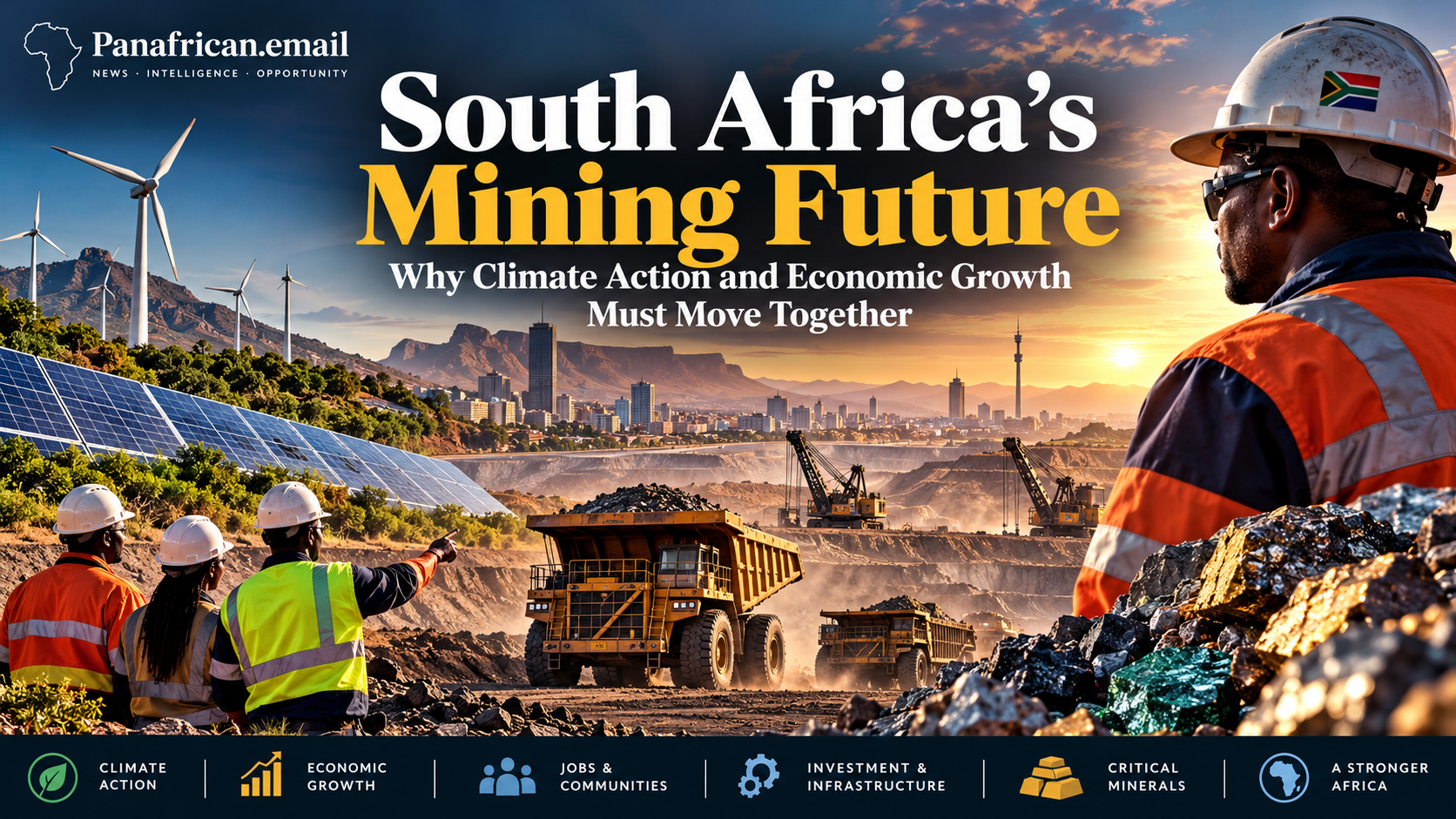
South Africa | Mining | Climate & Investment
South Africa’s mining industry is facing a defining challenge: how to accelerate climate action without undermining the economic growth, investment and employment that the sector provides.
That question was at the center of discussions during the inaugural Climate Change Day of Learning hosted by the Minerals Council South Africa, where representatives from the public and private sectors gathered to examine the implications of climate change for mining and the broader economy.
The message from industry leaders was clear: climate policy and economic development cannot be treated as competing priorities.
Instead, South Africa needs an approach in which emissions reduction, climate resilience, investment and economic growth reinforce one another.
Mining sits at the center of two transitions
Mining occupies a unique position in the global climate debate.
On one side, mining is a major consumer of energy and is under increasing pressure to reduce greenhouse-gas emissions throughout its operations and supply chains.
On the other, the minerals produced by mining are essential to many of the technologies associated with the global energy transition.
Copper, manganese, platinum-group metals, lithium, nickel, cobalt, iron ore and other minerals are increasingly important to renewable energy systems, electricity infrastructure, electric vehicles, batteries and advanced manufacturing.
For South Africa, this creates both a challenge and an opportunity.
The country must reduce the environmental footprint of its existing mining operations while positioning its mineral resources to benefit from growing international demand for materials associated with the energy transition.
As Minerals Council South Africa senior climate specialist Shalendra Subramoney emphasized at the event, climate considerations are increasingly becoming part of the way business is conducted.
Climate change is therefore no longer simply an environmental issue for mining companies. It increasingly affects investment decisions, operational resilience, infrastructure planning, financing, regulation and competitiveness.
Growth cannot be separated from climate resilience
The Minerals Council’s keynote message emphasized the importance of maintaining a balance between climate ambition and economic development.
South Africa needs investment to modernize mines, improve infrastructure, support communities and maintain employment.
At the same time, mining companies must prepare for physical climate risks, including changing rainfall patterns, extreme weather events, water stress and disruptions to infrastructure.
This creates a broader definition of climate action.
Reducing emissions is important, but resilience is equally critical.
A mine that reduces its carbon footprint but remains vulnerable to flooding, water shortages, electricity disruptions or climate-related infrastructure failures can still face significant operational and financial risks.
For investors, climate resilience is increasingly becoming part of the calculation when determining where capital should be deployed.
The investment question
The climate transition is likely to require significant capital.
Mining companies need to invest in cleaner energy, more efficient equipment, electrification, alternative fuels, water management, emissions monitoring and technologies that can reduce the carbon intensity of production.
South Africa also needs investment beyond individual mining operations.
Electricity networks, railways, ports, water systems and other infrastructure are critical to the competitiveness of the country’s mineral sector.
This is particularly important because mining competitiveness is not determined solely by the quality of the ore body.
A country can possess significant mineral resources but struggle to attract investment if electricity is unreliable, rail capacity is constrained, ports are inefficient or regulatory uncertainty increases the cost of developing projects.
Climate policy therefore intersects with a much larger economic-development agenda.
The energy transition could create a new opportunity for African mining
The global shift toward cleaner energy could create an important opportunity for South Africa and the wider African continent.
Africa possesses substantial mineral resources that could become increasingly important as economies build renewable energy infrastructure and electrify transportation.
South Africa already has a sophisticated mining industry, established geological knowledge, processing capabilities and a large industrial base.
The opportunity is to move beyond simply extracting minerals.
The continent can seek greater participation in processing, refining, manufacturing and technology-intensive activities connected to the mineral value chain.
That could create more economic value and employment locally.
For South Africa, the question is therefore not only how much mineral wealth can be extracted, but how much value can be retained within the country.
Jobs remain central to the equation
Climate policy must also account for workers and mining communities.
South Africa’s mining industry remains an important source of employment and economic activity, particularly in regions where mining is a major component of the local economy.
A rapid transition that ignores workers could create significant social and political challenges.
The shift toward lower-carbon mining therefore requires investment in skills, training and new employment opportunities.
Workers may need to acquire capabilities related to renewable energy, electrical systems, automation, environmental management, data analysis and new mining technologies.
This is where the concept of a just transition becomes particularly important.
The objective should not simply be to reduce emissions. It should be to ensure that communities and workers can participate in the economic opportunities created by the transition.
Communities are part of the climate equation
Mining companies also operate within communities that depend on infrastructure, employment and economic activity associated with mines.
Climate change can amplify existing pressures on these communities.
Water availability, food security, infrastructure resilience and employment can all become interconnected issues.
Consequently, climate planning cannot remain confined to corporate sustainability departments.
It increasingly requires collaboration among mining companies, government, investors, communities, labor organizations and other stakeholders.
The Minerals Council’s Climate Change Day of Learning reflects this broader shift toward collaborative climate planning.
Africa’s mineral advantage needs a strategic response
The global energy transition is creating intense competition for critical minerals.
Countries around the world are developing strategies to secure reliable supplies of the resources needed for batteries, electricity networks, renewable energy and advanced technologies.
Africa’s mineral wealth gives the continent an important strategic position.
But mineral abundance alone does not guarantee prosperity.
Countries must develop the infrastructure, skills, financing frameworks, regulatory systems and industrial policies needed to convert geological resources into sustainable economic development.
South Africa has an opportunity to position itself as an important supplier of minerals for the energy transition while simultaneously developing domestic industrial capacity.
That will require long-term thinking.
Climate policy and industrial policy should converge
One of the biggest opportunities emerging from the climate debate is the possibility of connecting environmental policy with industrial development.
Rather than viewing decarbonization solely as a cost, governments and companies can treat it as a catalyst for modernization.
Cleaner electricity can improve the competitiveness of energy-intensive industries.
Renewable energy investment can create new infrastructure and employment.
Modernized mines can improve productivity while reducing emissions.
Better water management can strengthen both environmental performance and operational resilience.
And investment in mineral processing can create additional economic value.
In this model, climate action becomes part of a broader strategy for economic transformation.
South Africa cannot afford a false choice
The debate ultimately comes down to a fundamental question: must South Africa choose between climate action and economic growth?
Industry leaders are arguing that it should not.
The objective should instead be to build a mining sector that is simultaneously competitive, resilient, lower-carbon and capable of supporting employment and economic development.
That will require difficult decisions.
It will require capital.
It will require collaboration between government and industry.
And it will require mining companies to treat climate risk as a strategic business issue rather than simply a compliance obligation.
But the potential reward is significant.
South Africa could use its mineral resources and industrial capabilities to participate more deeply in the global energy transition while strengthening its domestic economy.
The road ahead
The mining sector is entering an era in which climate considerations will increasingly influence how mines are designed, financed, operated and eventually closed.
Companies that understand this shift early may be better positioned to attract capital, manage risk and remain competitive.
For South Africa, the larger challenge is to ensure that the transition produces broad economic benefits.
That means protecting jobs where possible, creating new skills and industries, strengthening communities, improving infrastructure and ensuring that the country’s mineral wealth contributes to long-term development.
The central message from the Minerals Council’s climate gathering is therefore larger than mining.
South Africa’s climate strategy and growth strategy increasingly need to become the same conversation.
If the country’s mining sector can reduce emissions while improving productivity, resilience, investment and employment, climate action does not have to represent a brake on development.
It can become one of the engines of South Africa’s next phase of industrial growth.
Panafrican Intelligence Brief
Country: South Africa
Sector: Mining & Minerals
Theme: Climate Change / Economic Development / Investment
Location: Pretoria, South Africa
Source: Mining Weekly
Status: Unverified intelligence brief
Assessment: Climate policy is increasingly becoming a strategic factor in mining investment, operational resilience and competitiveness.
Why It Matters for Africa
South Africa’s experience is relevant across the continent. African countries with significant mineral resources face a similar challenge: capturing the economic opportunities created by the global energy transition while ensuring mining becomes more resilient, environmentally responsible and beneficial to local communities.
The countries that successfully connect minerals + energy + infrastructure + manufacturing + skills + climate resilience could capture substantially more value from the next generation of global industrial development.
Panafrican.email Intelligence Desk
Leave a Reply