
South Africa | Mining | Copper & Base Metals | Corporate Leadership
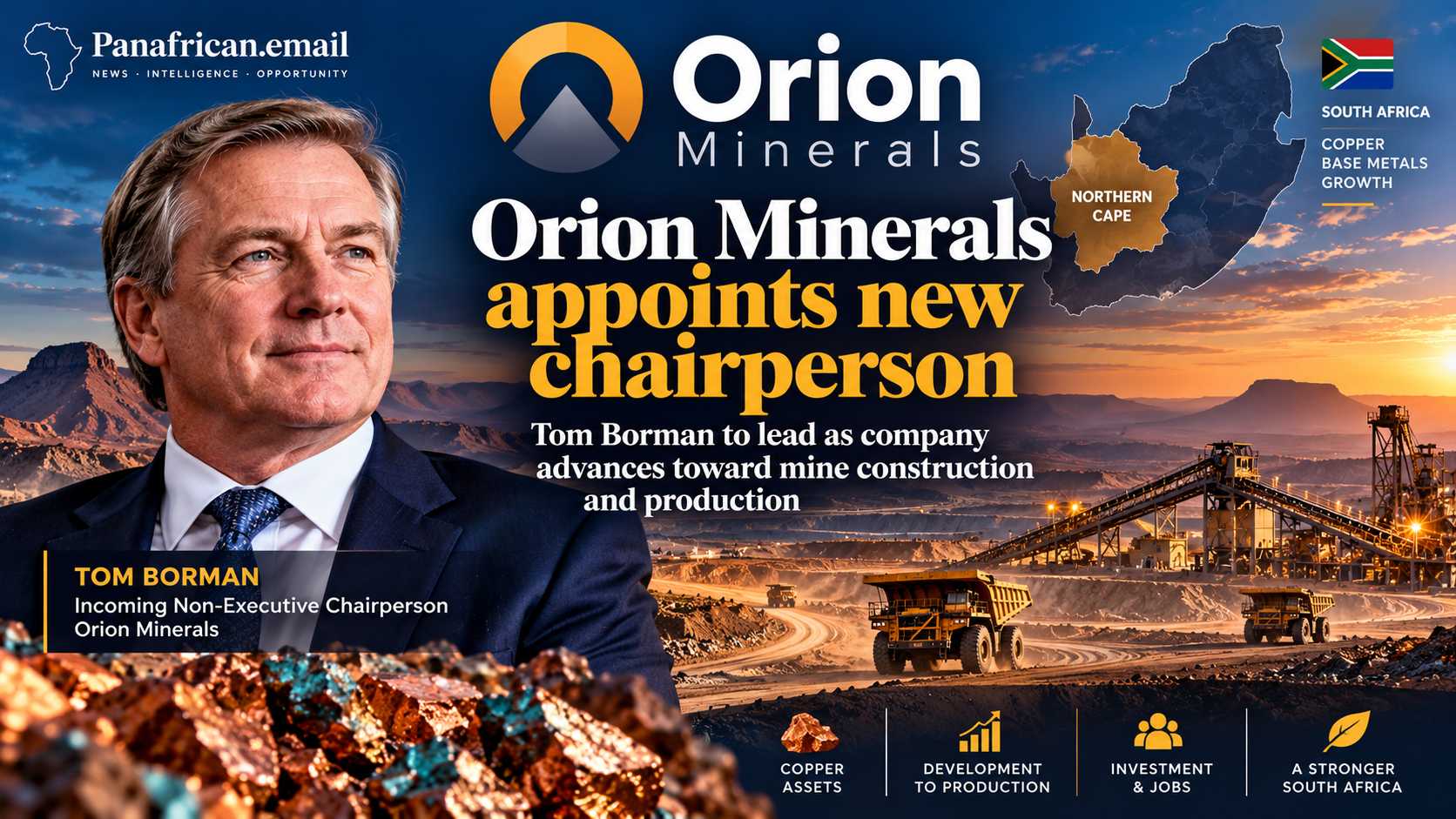
Orion Minerals is preparing for a significant change at board level as the mining developer moves closer to its next phase of growth, with experienced mining executive Thomas “Tom” Borman set to become the company’s incoming non-executive chairperson.
The JSE- and ASX-listed metals explorer and developer announced that Borman will be appointed as a non-executive director and chair by the board following the conclusion of Orion’s Annual General Meeting on November 26, 2026. He will serve as a director until the company’s 2027 AGM, when he will stand for re-election by shareholders. (Mining Weekly)
The appointment comes at an important point in Orion’s development. The company describes itself as transitioning from project development toward mine construction and production, making board experience in financing, mining operations, strategy and corporate development increasingly important.
Borman to succeed Denis Waddell
Borman will succeed Denis Waddell, who is retiring as Orion’s director and chairperson at the conclusion of the November AGM after almost 18 years in the chair.
Waddell will not stand for re-election, and the resolution relating to his re-election will consequently be withdrawn.
Despite leaving the board, Waddell will continue supporting Orion on a part-time consulting basis. The arrangement is intended to provide continuity and preserve access to his institutional knowledge as the company enters a new stage of development. (Sharenet)
The leadership transition therefore represents more than a routine board appointment. It marks the beginning of a new chapter for a company attempting to move from exploration and development into actual mine construction and eventual production.
An experienced mining executive returns to the board
Borman brings extensive experience from the international mining industry.
According to Orion, he spent more than 11 years with BHP in senior management positions, including corporate finance, strategy and business development.
He later joined the executive team at Warrior Coal Investments, which established and consolidated the portfolio of assets that became the Optimum Group of companies. Optimum subsequently listed on the Johannesburg Stock Exchange before being acquired by Glencore in 2012. (Sharenet)
That background gives Borman experience across several areas that could become increasingly important for Orion: corporate finance, mining strategy, development, transactions and the transition of mining assets into operating businesses.
His familiarity with the South African mining industry is also particularly relevant as Orion advances projects in the Northern Cape.
Borman already knows Orion
The incoming chair is not a newcomer to Orion.
Borman previously served as a non-executive director of the company from April 2019 until October 2023.
Since leaving the board, he has remained a significant supporter of the company and substantially increased his investment.
Orion says Borman is currently its largest shareholder, with approximately 14.3% of the company’s issued shares.
That ownership position also means that he will not be regarded as an independent director. (Sharenet)
The distinction is important from a corporate-governance perspective.
While Borman brings substantial mining experience and shareholder alignment to the chair, Orion is simultaneously strengthening independent oversight elsewhere on the board.
Godfrey Gomwe to strengthen independent oversight
As part of the succession process, independent non-executive director Godfrey Gomwe will become Orion’s senior independent non-executive director following the AGM.
Gomwe has served on Orion’s board since April 2019 and chairs the company’s audit committee.
The company says the appointment is intended to provide an additional layer of independent leadership and strengthen governance as Orion progresses through its next phase of growth. (Sharenet)
The combination of Borman’s industry and shareholder experience with Gomwe’s independent oversight is therefore an important element of the board transition.
Why the timing matters
The significance of Borman’s appointment becomes clearer when viewed against Orion’s development strategy.
Orion is no longer positioning itself simply as an exploration story. The company is seeking to advance its assets toward mine construction and production.
That transition fundamentally changes the demands placed on a mining company.
Exploration requires geological expertise and capital allocation. Mine development introduces a much broader set of challenges, including engineering, construction financing, infrastructure, procurement, permitting, operational readiness, workforce development and long-term production planning.
Once construction begins, the financial stakes also increase substantially.
For investors, the question shifts from whether a mineral discovery can be developed to whether the company can successfully execute a complex mining project and ultimately generate sustainable production and shareholder value.
Glencore backing adds another dimension
Orion’s transition is also taking place with backing from global diversified mining company Glencore.
Borman specifically pointed to the company’s progress toward mine construction and production and the support of Glencore when discussing the next phase of Orion’s development. (Sharenet)
Glencore’s involvement is significant because partnerships with major global mining groups can provide smaller developers with access to financing structures, commercial relationships, technical expertise and global market networks.
For Orion, the challenge will be converting that strategic support into successful project execution.
Two copper assets at the center of the story
The leadership change also comes as Orion advances what its outgoing chair described as two outstanding copper assets, alongside a prospective exploration portfolio in South Africa’s Northern Cape.
Copper has become increasingly strategic as global economies invest in electricity infrastructure, renewable energy, electrification, data centers and other technologies requiring substantial quantities of conductive metals.
That gives copper developers exposure to a potentially important long-term demand story.
But the opportunity also comes with significant execution risks.
Developing a copper mine requires substantial capital, infrastructure and technical expertise, while construction costs, commodity prices, permitting, logistics and financing conditions can all influence project economics.
Orion’s move toward production therefore represents a transition from geological potential to operational delivery.
The Northern Cape’s strategic importance
The Northern Cape has long been one of South Africa’s most important mineral-producing regions.
The province contains significant deposits of iron ore, manganese, copper and other minerals and has become an increasingly important area in discussions about South Africa’s future mining and energy economy.
Orion’s development strategy places the company within that broader regional mining landscape.
The potential development of additional copper production could contribute to the diversification of South Africa’s mineral economy while creating opportunities for employment, contractors, infrastructure investment and local economic activity.
The wider challenge is ensuring that mining development translates into durable economic value for communities and the country.
A board designed for the next stage
Orion says its board will continue reviewing its composition, experience and independence as its activities expand.
That reflects a broader reality across the mining sector.
The governance requirements of an exploration company are different from those of a company building and operating a mine.
As projects move toward construction, boards increasingly need experience in:
- Project financing
- Mine development
- Construction oversight
- Operational risk
- Commodity markets
- Capital allocation
- Environmental and social performance
- Government and community relations
- Corporate governance
- Shareholder communication
Borman’s background in mining, finance and strategy is therefore closely aligned with the requirements of Orion’s next stage.
What happens after the AGM?
The immediate milestone is Orion’s November 26 AGM.
Following the conclusion of the meeting, Borman is expected to take over as chair, while Waddell formally retires from the board.
Gomwe will also assume the role of senior independent non-executive director.
Borman will then remain in office as a director until the 2027 AGM, when shareholders will vote on his re-election. (Sharenet)
The leadership transition itself is relatively straightforward.
The larger question is what the new leadership team can accomplish after the transition.
From developer to producer
For Orion Minerals, the next chapter will ultimately be judged by execution.
The company has spent years building its exploration and development portfolio. Its stated ambition now moves toward construction and production.
That means the incoming chair will inherit a company facing a different set of opportunities and risks from those encountered during its earlier exploration-focused years.
Borman’s previous experience with Orion means he enters the role with an understanding of the company’s assets and strategy.
His position as the largest shareholder also creates a strong personal financial alignment with other investors, although his non-independent status makes the role of independent directors particularly important.
What it means for African mining
Orion’s leadership transition is also part of a larger story unfolding across African mining.
The continent possesses enormous mineral resources, but developing those resources into productive mines requires capital, infrastructure, technical expertise and effective governance.
Companies attempting to move from exploration to production must demonstrate that they can manage that transition responsibly.
For South Africa, the development of new copper capacity could become increasingly important as the global economy places greater emphasis on minerals associated with electrification and industrial development.
The success of companies such as Orion will therefore be watched not only by shareholders but by a broader mining and investment community interested in South Africa’s ability to develop its next generation of mineral projects.
The bottom line
Tom Borman’s appointment represents a major leadership transition for Orion Minerals at a strategically important moment.
He brings more than a decade of senior experience at BHP, experience with the development of the Optimum mining group, previous service on Orion’s board and a substantial personal investment in the company. (Sharenet)
At the same time, Denis Waddell’s retirement closes an almost 18-year chapter of leadership, while Godfrey Gomwe’s elevation to senior independent non-executive director is designed to strengthen governance.
The bigger story, however, is not simply who occupies the chair.
It is whether Orion can successfully make the difficult transition from developer to mine builder and producer.
With copper assets in the Northern Cape, a major global mining partner behind its development strategy and a leadership team being reshaped for the next phase, Orion is entering one of the most consequential periods in its corporate history.
For investors and the broader African mining industry, the coming year could provide a clearer indication of whether the company’s long-developed mineral potential can be transformed into operating mines and long-term economic value.
Panafrican.email Intelligence Desk
Leave a Reply