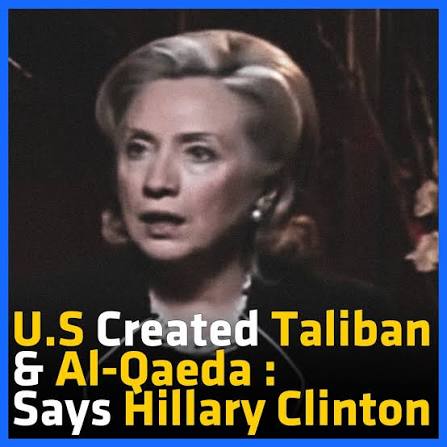
For years, conspiracy theories have swirled in the darker corners of the internet claiming that the United States government intentionally created or funded the Islamic State (ISIS). While such specific claims regarding ISIS have been repeatedly debunked, a far more complex and well-documented historical truth exists: senior American officials, including former Secretary of State Hillary Clinton, have openly admitted that the U.S. did fund and arm the radical Islamist factions in Afghanistan during the 1980s—decisions that ultimately led to the rise of Al-Qaeda and the Taliban.
Here is a detailed look at what Hillary Clinton actually confessed regarding the U.S. war against the Soviet Union and the unintended consequences that followed.
The 1980s Strategy: Arming the Mujahideen
The core of Clinton’s admission revolves around the Cold War era. In the 1980s, the Soviet Union invaded Afghanistan. In response, the United States, under President Ronald Reagan and with bipartisan support from a Democratic-led Congress, embarked on a massive covert operation to support the Afghan resistance fighters, known as the Mujahideen.
During a 2010 interview with Fox News, Clinton stated plainly that the U.S. strategy was deliberate: “We had this brilliant idea that we were going to come to Pakistan and create a force of mujaheddin, equip them with Stinger missiles and everything else, to go after the Soviets inside Afghanistan” . The goal was to bleed the Soviet Union dry and force them to retreat from Central Asia.
In testimony before the House Appropriations Committee in 2009, she elaborated on the mechanics of this strategy. She explained that the U.S. partnered with the Pakistani military and the Inter-Services Intelligence (ISI) agency to recruit fighters. Crucially, she noted that the U.S. allowed Saudi Arabia and other nations to bring in their “Wahabi brand of Islam” to motivate the fighters against the atheist Soviet forces .
“It was President Reagan in partnership with Congress led by Democrats who said you know what it sounds like a pretty good idea… let’s deal with the ISI and the Pakistan military and let’s go recruit these mujahideen… importing their Wahabi brand of Islam so that we can go beat the Soviet Union” .
The Admission of “Blowback”
The strategy worked militarily. The Soviets withdrew from Afghanistan, and Clinton noted that the conflict contributed significantly to the collapse of the Soviet Union. “It wasn’t a bad investment,” she remarked .
However, the victory came with a warning. Clinton has consistently acknowledged that the U.S. failed to plan for the aftermath. In the 2009 hearing, she noted a critical turning point: after the Soviets left, the United States largely abandoned the region. “We then left Pakistan… We said okay fine you deal with the Stingers that we left all over your country… by the way we don’t want to have anything to do with you” .
This abandonment left a power vacuum. The well-armed, battle-hardened, and ideologically radical fighters (the Mujahideen) eventually splintered. Some factions formed the Taliban, while others, like Al-Qaeda, began to turn their sights on the United States.
Clinton summarized this irony succinctly in a 2010 interview: “The people we’re fighting today we were supporting in the fight against the Soviets” . In another appearance, she warned of the consequences of intervention without long-term planning, stating: “We have to be careful, because what we sow is what we reap” .
Distinguishing Fact from Fiction: The ISIS Question
It is important to note that while Clinton has been transparent about the U.S. role in creating the conditions for the Taliban and Al-Qaeda, there is a distinct line regarding ISIS (Islamic State).
In the 2010s, during her tenure as Secretary of State, a conspiracy theory emerged—often dubbed “Password 360″—claiming that Hillary Clinton had admitted in a book that the U.S. and Israel created ISIS. These claims forced the U.S. Embassy in Lebanon to issue a firm denial, stating that such allegations were “patently false” .
However, leaked emails from Clinton’s tenure, published by WikiLeaks, did reveal a different sort of connection to the chaos that spawned ISIS. Emails showed that Clinton was aware that Saudi Arabia and Qatar were funding the Islamic State, despite those nations being official U.S. allies . Furthermore, critics argue that Clinton’s support for the intervention in Libya in 2011—which she championed—led to state collapse and the flow of weapons and jihadists into Syria, creating the ungoverned spaces where ISIS thrived .
Conclusion
Hillary Clinton’s “confession” is not a secret admission of a hidden agenda, but rather a public acknowledgment of historical reality. She has stated plainly that the U.S. funded the Mujahideen in the 1980s, utilizing radical Wahhabi ideology to defeat the Soviet Union, and that this policy contributed directly to the rise of modern terrorism.
While she has denied allegations that the U.S. directly created ISIS, her public statements serve as a case study in the law of unintended consequences in foreign policy—a warning that the allies of today can become the adversaries of tomorrow.
Leave a Reply