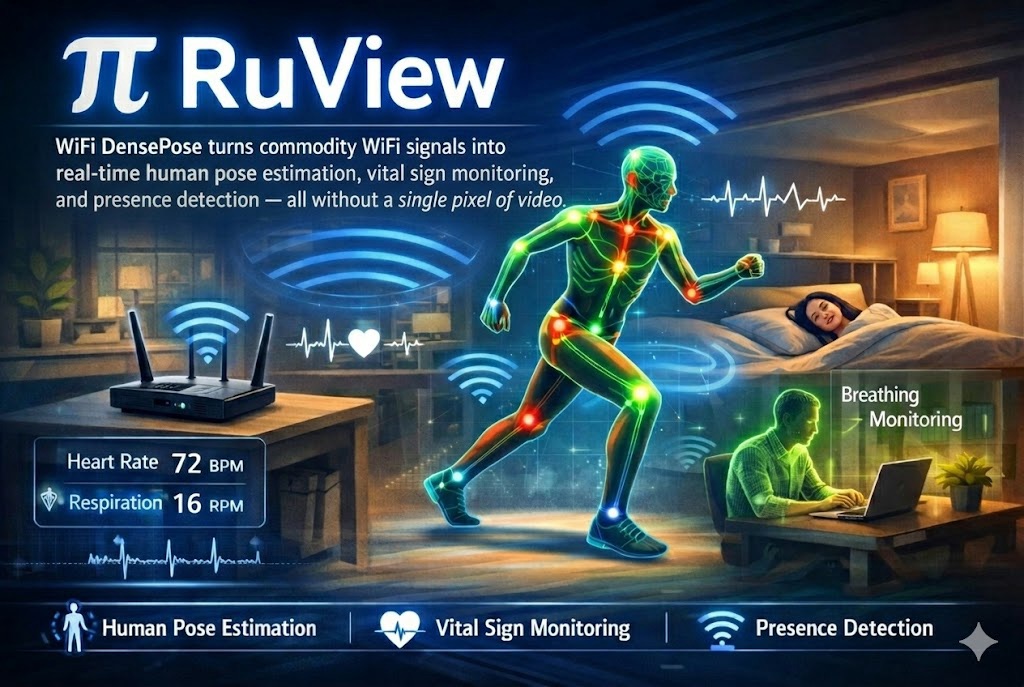

A new open-source project on GitHub is igniting debate across the worlds of artificial intelligence, cybersecurity, smart infrastructure, and digital privacy. The repository, known as RuView, claims it can transform ordinary WiFi signals into a powerful sensing network capable of detecting human presence, monitoring breathing patterns, tracking movement, and even estimating body posture — all without cameras.
At first glance, the concept sounds like science fiction. Yet researchers and engineers have spent years exploring how radio frequency (RF) signals interact with the human body. RuView packages many of those ideas into an ambitious open-source platform that could dramatically reshape how homes, hospitals, offices, and cities monitor physical spaces.
For Africa and the broader Pan-African world, the implications are profound. A technology that works through walls, functions in darkness, costs less than traditional surveillance systems, and runs on low-cost hardware could become a major tool for healthcare, smart infrastructure, public safety, and locally controlled AI systems. But it also raises difficult questions about privacy, regulation, and digital sovereignty.
What Exactly Is RuView?
According to its GitHub documentation, RuView uses WiFi Channel State Information (CSI) — the tiny distortions created when WiFi radio waves bounce off human bodies and objects — to analyze activity inside a room.
Every router continuously floods a space with radio signals. When a person walks, breathes, sits down, or even shifts slightly, the radio reflections change. RuView captures those changes using low-cost ESP32 microcontrollers and machine-learning algorithms to determine whether people are present and what kind of movement is occurring.
The project claims its capabilities include:
- Presence detection
- Occupancy monitoring
- Breathing and heart-rate estimation
- Gesture recognition
- Fall detection
- Room mapping
- Movement tracking through walls
- Sleep monitoring
Unlike traditional surveillance systems, RuView does not rely on cameras, infrared sensors, or wearable devices. The system instead interprets environmental radio patterns.
The Science Behind WiFi Sensing
RuView did not emerge from nowhere. The underlying science has roots in years of academic research into RF sensing and WiFi-based human perception.
Researchers have previously demonstrated systems capable of detecting gestures, estimating body pose, and analyzing movement using WiFi reflections. Projects such as “Person-in-WiFi” and “WiGest” showed that off-the-shelf WiFi hardware could identify human actions and gestures with surprisingly high accuracy.
Another research effort called WiROS explored how WiFi sensing could assist robotics and spatial intelligence systems.
RuView attempts to combine many of these ideas into a single open-source ecosystem powered by inexpensive hardware and AI models optimized to run directly on edge devices.
The repository claims that some deployments can run on hardware costing under $10 per sensor node.
Why the Technology Matters for Africa
Across Africa, governments and businesses are searching for affordable ways to modernize healthcare systems, infrastructure management, security monitoring, and energy efficiency. RuView-style sensing systems could offer a lower-cost alternative to expensive camera networks and imported industrial monitoring equipment.
Potential African use cases include:
Healthcare and Elder Care
In regions where hospitals face shortages of monitoring equipment, WiFi sensing could help detect falls, breathing irregularities, or patient movement without attaching physical sensors to patients.
For elderly populations living alone, the technology could detect emergencies while preserving privacy better than cameras.
Smart Buildings and Energy Efficiency
African cities are rapidly urbanizing. WiFi sensing could help office buildings and apartment complexes reduce electricity usage by detecting room occupancy and automatically managing lighting or cooling systems.
In countries facing unstable power grids, smarter energy management could significantly reduce waste.
Public Infrastructure
Transportation hubs, schools, warehouses, and public buildings could use RF sensing to estimate crowd density and monitor movement without installing massive camera networks.
Because the system works in darkness and through obstacles, it may also prove useful in disaster response or emergency rescue operations.
Locally Controlled AI Systems
One of RuView’s most significant features is its emphasis on edge computing. The project claims most processing occurs locally rather than in the cloud.
For African nations increasingly concerned about foreign data extraction and digital dependency, locally operated AI systems represent a major strategic advantage. Instead of sending surveillance or behavioral data to overseas cloud providers, institutions could potentially operate sensing systems entirely within local networks.
Privacy Questions and Surveillance Concerns
Despite its potential, RuView has already triggered alarm among privacy advocates and cybersecurity researchers.
Critics warn that invisible sensing technologies could create new forms of passive surveillance that are harder to detect than cameras. Unlike visible CCTV systems, RF sensing can operate quietly in the background without obvious indicators.
Some online discussions have questioned whether regulations are prepared for technologies capable of detecting movement and biological signals without direct visual recording.
Others have raised doubts about whether all of RuView’s technical claims have been independently verified. Reddit discussions and developer forums show both excitement and skepticism, with some users arguing that parts of the project may still be experimental or overstated.
Still, even skeptics generally agree that WiFi sensing itself is real and rapidly advancing.
Africa’s Digital Sovereignty Challenge
As Africa embraces AI-driven infrastructure, the RuView debate highlights a larger issue facing the continent: who controls the next generation of sensing technologies?
Historically, Africa has often consumed technologies developed elsewhere. But open-source projects like RuView create opportunities for African universities, startups, and engineers to participate directly in emerging fields such as ambient intelligence, edge AI, and RF sensing.
Countries investing in AI research hubs — including Rwanda, South Africa, Nigeria, Kenya, and Ghana — could become early adopters of locally governed sensing systems for healthcare, agriculture, transportation, and urban management.
At the same time, African lawmakers may soon face difficult policy questions:
- Should invisible RF sensing require consent?
- How should biometric RF data be stored?
- Can WiFi sensing be abused for unauthorized surveillance?
- Who owns environmental intelligence data generated inside homes and workplaces?
These questions are no longer theoretical.
The Beginning of Ambient Intelligence
RuView represents more than a GitHub trend. It signals the arrival of a new technological era where ordinary infrastructure — routers, radio waves, and wireless signals — becomes part of an intelligent sensing environment.
The future smart city may not rely solely on cameras watching streets. Instead, buildings themselves may become aware of movement, presence, and activity through invisible networks embedded into everyday communications systems.
For Pan-African innovators, the challenge will be ensuring these technologies are deployed in ways that strengthen public welfare, preserve civil liberties, and support African technological independence rather than expanding invisible systems of surveillance.
The radio waves already filling the air around us may soon become one of the most powerful sensing tools of the AI age.
Leave a Reply