
INTELLIGENCE ASSESSMENT: Positive
REGION: West Africa
COUNTRY: Ghana
CATEGORY: Aviation / Infrastructure / Connectivity
STATUS: Developing
A new generation of long-haul aviation has arrived in Accra.
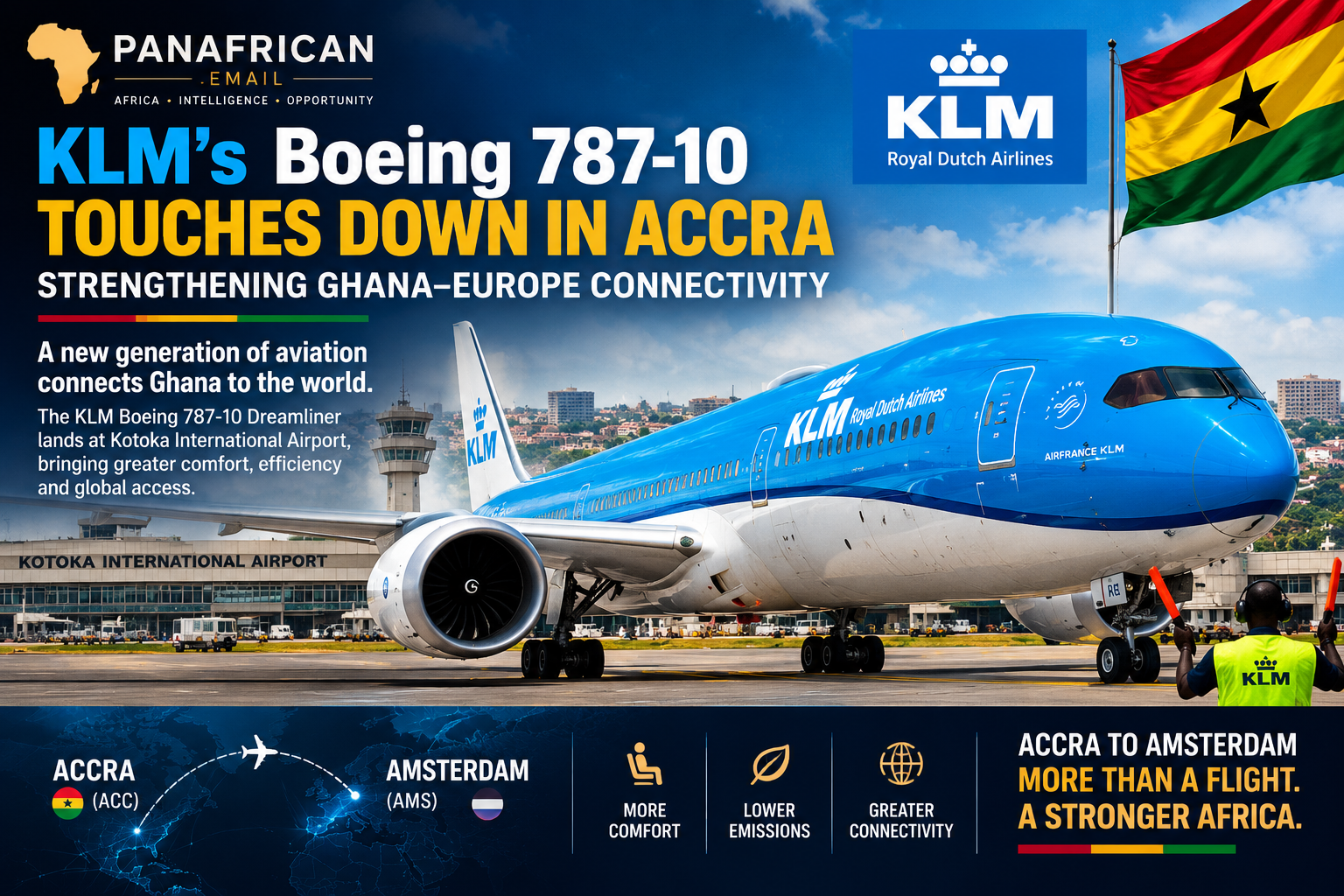
The Boeing 787-10 Dreamliner operated by KLM Royal Dutch Airlines has touched down at Kotoka International Airport, marking a notable moment for Ghana’s growing position as an aviation and commercial gateway in West Africa.
The arrival of the aircraft introduces a larger, modern long-haul platform to the Accra–Amsterdam connection, linking Ghana more directly with one of Europe’s major aviation hubs.
A New Aircraft for an Important Corridor
The Accra–Amsterdam route serves more than tourism.
It connects Ghana to a major European gateway for business, education, trade, investment, diplomacy and onward travel across Europe and beyond.
The Boeing 787-10 is designed for long-distance operations while incorporating newer technologies intended to improve fuel efficiency and passenger comfort compared with previous generations of wide-body aircraft.
For passengers, the aircraft represents an upgrade in the travel experience, with modern cabin interiors, larger windows, improved cabin environment and contemporary long-haul amenities.
For airlines and airports, however, the significance extends beyond passenger comfort.
Ghana’s Position as a Regional Gateway
Kotoka International Airport remains one of the most important aviation gateways in West Africa.
Accra’s location gives Ghana strategic importance for connections between West Africa, Europe and North America. The continued deployment of modern wide-body aircraft on routes serving the capital reflects the importance of Ghana within the international aviation network.
As African economies become increasingly connected to global markets, aviation infrastructure becomes part of the continent’s broader economic architecture.
Air routes carry people, but they also facilitate capital, expertise, tourism, trade and business relationships.
The Dreamliner Era
The Boeing 787 family has become one of the defining aircraft platforms of modern long-haul aviation.
Its design emphasizes efficiency and passenger experience, allowing airlines to operate international routes with newer-generation aircraft while seeking to reduce fuel consumption and associated emissions compared with older aircraft.
KLM’s deployment of the 787-10 on its Accra service therefore places Ghana within a broader modernization of international air travel.
The blue-and-white aircraft on the Accra tarmac is more than an aviation spectacle. It is another indicator of the increasingly interconnected relationship between Ghana and the global economy.
Accra–Amsterdam: More Than a Flight

The Amsterdam connection provides Ghana with access to one of Europe’s most important aviation hubs and creates onward connectivity to destinations throughout Europe and beyond.
For Ghanaian businesses, international organizations, investors, students and travelers, improvements to this corridor can translate into greater accessibility and potentially stronger economic links.
For the African continent, the larger question is whether modern aviation networks can increasingly be built around African cities as destinations and hubs, rather than treating the continent primarily as an endpoint on European or Middle Eastern networks.
Accra is already positioning itself as one of the cities capable of playing that role.
The arrival of KLM’s Boeing 787-10 is therefore both an aviation milestone and a reminder of Ghana’s strategic place in the global transportation network.
Panafrican Intelligence: As African aviation continues to modernize, the competition will increasingly be about who controls connectivity, hubs and the movement of people and capital across the continent. Accra’s expanding international network puts Ghana in an increasingly important position within that contest.
Leave a Reply