
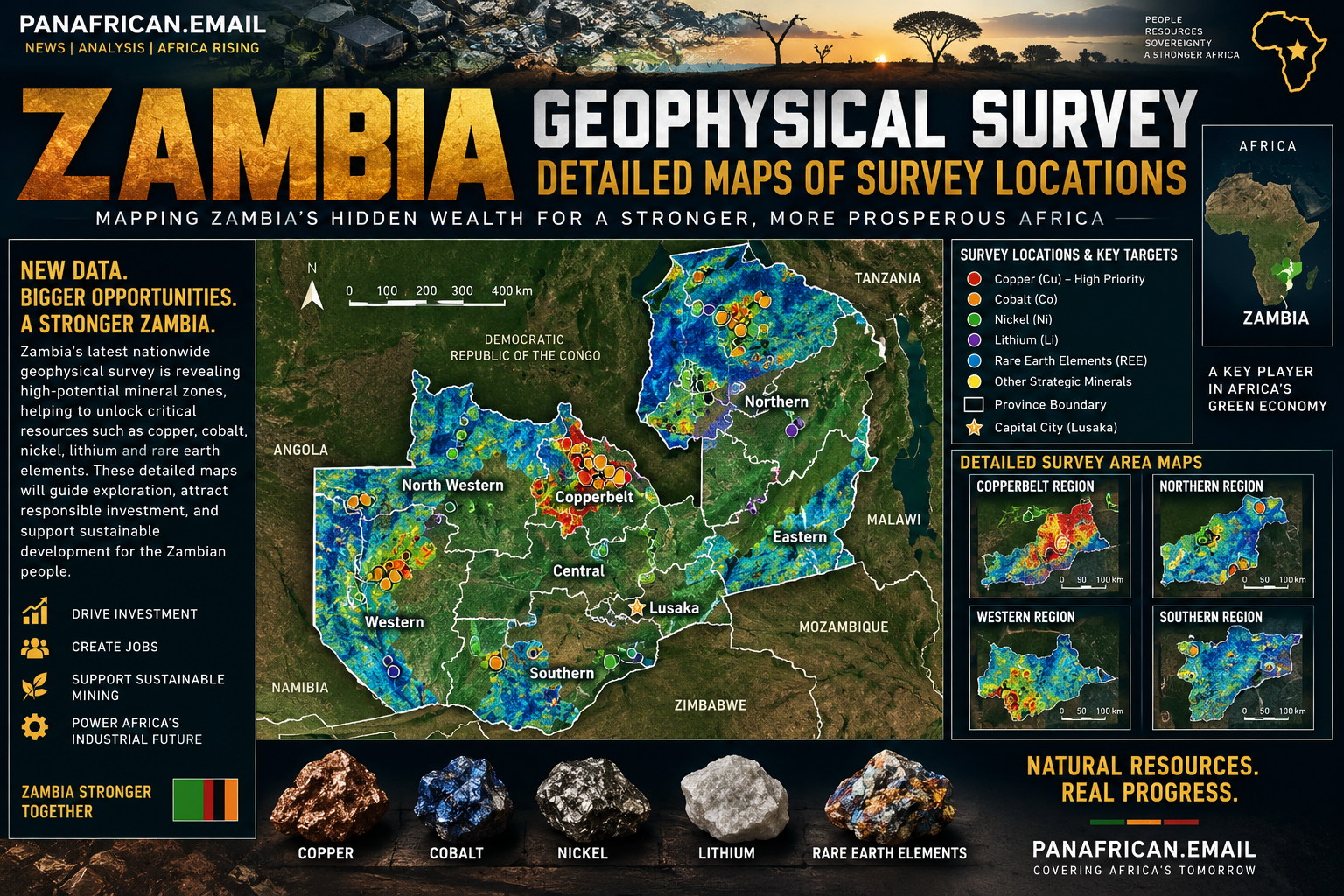
LUSAKA — Zambia is approaching completion of a nationwide high-resolution geophysical survey that officials say could improve knowledge of the country’s mineral resources and help attract new exploration investment.
According to the Ministry of Mines and Minerals Development, the survey was 93.6% complete on September 16 and is expected to be finished in December. Zambia’s previous major geological mapping exercise dates back to 1972.
Why geological data matters
Modern geological mapping can reduce uncertainty for investors by providing better information about mineral deposits and their location. Zambia’s effort comes as global demand rises for copper, cobalt, nickel and other minerals used in electricity networks, electric vehicles, semiconductors and other technologies.
The country is one of Africa’s major copper producers, making it an important part of global supply chains connected to the energy transition.
China and Zambia’s mining relationship
Chinese representatives at the Africa Critical Minerals Conference in Lusaka highlighted the potential for deeper China-Zambia cooperation. A Chinese Embassy counsellor said Zambia’s mineral endowment and the global energy transition create opportunities for cooperation in mining and related industries.
The Chinese Mining Enterprises Association in Zambia said Chinese-funded enterprises represented more than 40 companies across mining, smelting, engineering and logistics, with reported combined investment of more than $3.5 billion and nearly 19,000 local jobs.
From copper exports to industrialisation

Zambian officials are increasingly discussing the need to move beyond exporting copper in relatively low-value forms. The objective is to attract investment into processing and industries that use mineral inputs.
That strategy could include copper processing, components for electrical equipment, engineering services, industrial maintenance and other manufacturing activities connected to mining and energy.
Regulation and investor confidence
Zambia is also reforming its mining regulatory framework. Officials highlighted the Minerals Regulation Commission and Mining Appeals Tribunal as measures intended to create clearer regulation and faster resolution of disputes.
For investors, predictable rules can be as important as mineral potential. For the government, the challenge is balancing investment attraction with environmental standards, local participation and a fair share of economic value.
The China factor
China is a major player in global mineral processing and manufacturing, so Zambia’s relationship with Chinese companies can potentially connect the country’s mineral resources with downstream industrial markets.
At the same time, Zambia is part of a broader global effort to diversify mineral supply chains. That means the country can engage multiple partners and negotiate investment around processing, infrastructure, technology and skills.
What comes next
Completion of the geological survey will give Zambia a stronger information base for exploration. The larger policy question will be whether new investment produces domestic value addition and industrial capacity alongside mineral exports.
For panafrican.email/ readers, Zambia’s story is one to watch because copper and critical minerals increasingly connect African resource policy with electric mobility, renewable energy, artificial intelligence and global manufacturing.