
By Panafrican.email Staff
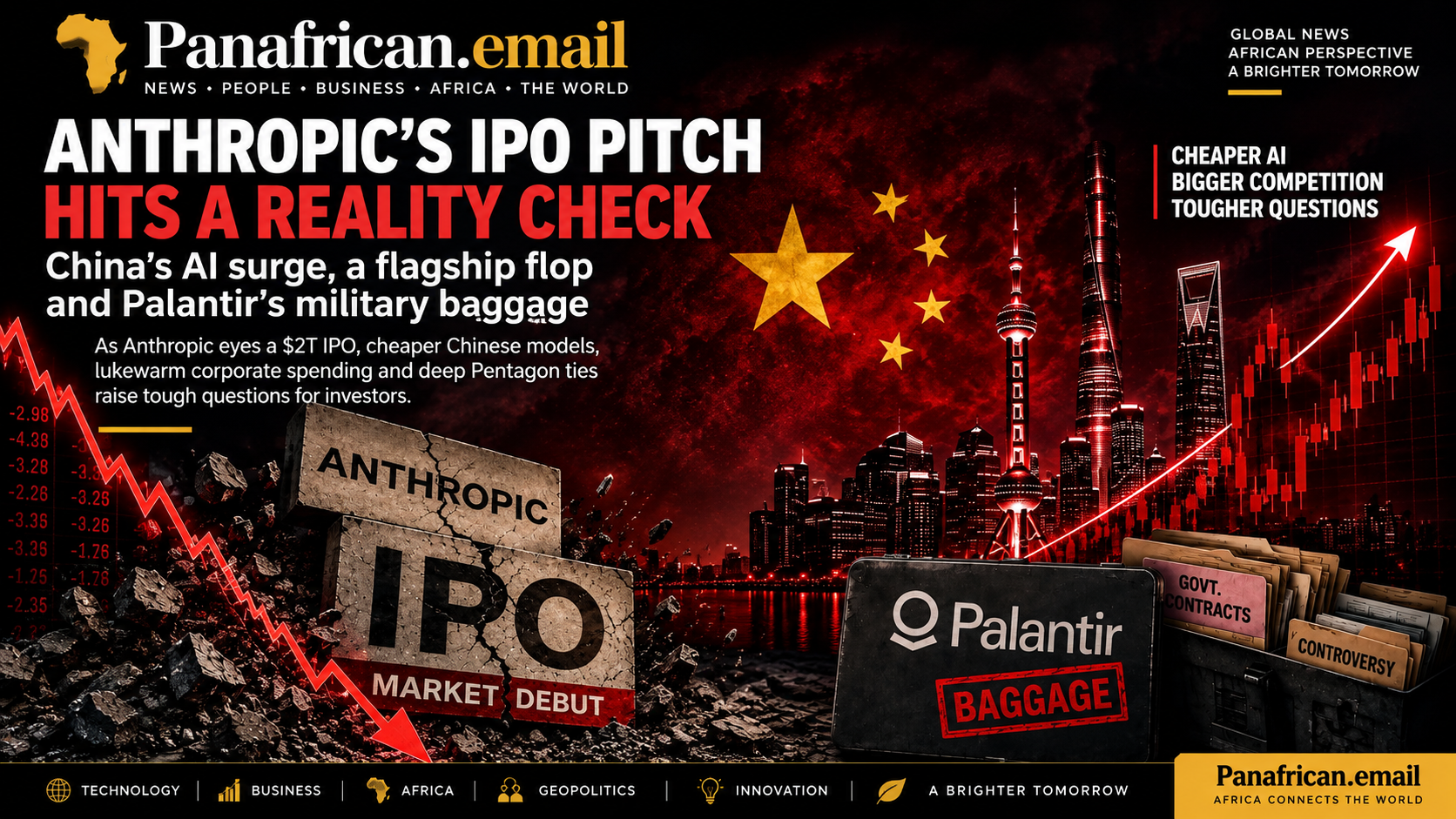
Anthropic is preparing for what could become one of the most closely watched technology initial public offerings in the artificial-intelligence era. But as the U.S. AI company builds its case for public-market investors, it is confronting a rapidly changing competitive landscape in which expensive frontier models are no longer guaranteed to dominate corporate AI spending.
The company behind Claude is reportedly preparing for an IPO that could seek a valuation of $2 trillion or more, potentially as early as October. Such a valuation would place extraordinary expectations on Anthropic at a moment when customers are increasingly comparing performance, price and flexibility across a much broader global AI market.
At the center of the debate is Anthropic’s flagship model strategy, competition from Chinese open-weight developers and the company’s growing relationship with the U.S. government and defense sector.
Corporate AI spending is becoming more selective
For years, the release of a new frontier AI model often generated an immediate rush among businesses eager to test or adopt the latest technology.
That pattern may be changing.
According to the Ramp data cited in the source material, which covers approximately 70,000 companies, Anthropic’s flagship Fable 5 reportedly accounted for only about 11% of overall corporate AI spending more than two months after its launch.
The figures also reportedly show Anthropic’s Opus 5, described as a leaner model released in late July, overtaking Fable 5 in corporate spending.
If those figures accurately reflect the broader market, they would represent an important development for the AI industry: businesses may be becoming less interested in automatically upgrading to the most expensive or most advanced model and more interested in selecting AI systems according to individual workloads.
That distinction matters.
Companies don’t necessarily need the largest model to write internal documentation, summarize information, generate routine software code, analyze spreadsheets or automate customer-service workflows. If smaller or cheaper models can perform those tasks adequately, the economic incentive to purchase premium models declines.
The result could be a market increasingly divided between specialized models, inexpensive open-weight systems and high-end frontier models used only when their additional capabilities justify the cost.
China’s open-weight challenge
The competitive equation becomes even more complicated when Chinese AI developers enter the comparison.
Companies such as Moonshot AI and other Chinese developers have increasingly emphasized models that can be deployed with greater flexibility and, in some cases, at substantially lower costs.
The source material cites claims that Chinese open-source or open-weight models can be 60% to 90% cheaper for comparable workloads.
One example highlighted is Moonshot AI’s Kimi K3, which reportedly climbed from 18th place to No. 1 on the Frontend Code Arena leaderboard, taking the top position in six of seven tested categories.
The same claims suggest that Kimi could cost as much as 90% less than comparable offerings from leading U.S. AI providers.
Such developments matter beyond a simple leaderboard competition.
The strategic advantage of lower-cost AI is that it can potentially make advanced capabilities accessible to companies, developers and institutions that cannot afford premium U.S. frontier-model pricing.
For African technology ecosystems, this aspect of the global AI competition deserves particular attention.
Why the price war matters for Africa
African startups, universities, governments and small businesses frequently operate under tighter technology and infrastructure budgets than large corporations in North America, Europe or Asia.
A dramatic reduction in AI inference costs could therefore have an outsized impact on African adoption.
Lower-cost models could support applications in:
- African-language translation and localization
- Education and tutoring
- Agricultural information services
- Healthcare administration
- Financial inclusion
- Government service delivery
- Software development
- Legal and regulatory information systems
- Journalism and research
- Customer-service automation
- Local business intelligence
The emergence of competitive open-weight models also raises the possibility of more locally controlled AI infrastructure.
Instead of every organization sending data to a large proprietary cloud model, developers can increasingly consider running models through their own infrastructure or through regional cloud providers.
That could become particularly significant as African governments and businesses place greater emphasis on data sovereignty, cybersecurity and digital independence.
AI prices are collapsing
The economics of AI inference have changed dramatically.
The source material cites an estimated decline in the cost of processing GPT-4-level workloads from approximately $60 to around $0.50 per million tokens in less than two years.
Whether every workload experiences that precise reduction is less important than the larger trend: the cost of accessing advanced AI capabilities has fallen rapidly.
That creates a difficult environment for companies whose investment strategies depend on maintaining premium pricing.
AI companies have spent enormous amounts building data centers, acquiring specialized chips and training increasingly sophisticated models. Investors therefore need to understand not only how capable those models are but also how much revenue can ultimately be generated from each unit of computational work.
If model capability improves while prices simultaneously fall, companies must generate enormous volumes of usage to maintain revenue growth.
Chinese models challenge the traditional AI hierarchy
The competitive landscape is also changing geographically.
The source material claims that Chinese open-weight models increased their share of global API traffic from less than 1% to more than 30% within approximately one year.
Such a dramatic figure should be independently scrutinized, including its methodology, definition of API traffic and geographical coverage. Nevertheless, the broader trend is clear: Chinese AI developers are becoming increasingly important competitors in the global model market.
For Silicon Valley companies, this means the AI race is no longer simply a contest between a handful of American laboratories.
It increasingly involves companies operating under different regulatory environments, different capital structures and different approaches to open versus closed model development.
For users, that competition can mean lower prices and more choice.
For investors, it can mean greater uncertainty about long-term margins.
Anthropic’s extraordinary growth expectations
Anthropic nevertheless enters the potential IPO process with significant momentum.
The source material says the company’s revenue reached approximately $65 billion on an annualized basis in July, below investor expectations of roughly $80 billion.
The same material reports losses of approximately $42 billion in 2025, described as roughly five times the previous year’s losses.
These figures require careful examination because annualized revenue and reported annual revenue are not interchangeable measures, particularly for a rapidly growing private technology company.
Nevertheless, the underlying investment question is straightforward:
Can Anthropic convert extraordinary AI demand into sustainable profitability?
Investors evaluating a potential IPO would likely need to examine model-training expenses, inference costs, cloud commitments, hardware requirements, enterprise contracts and the amount of revenue generated by each model generation.
Rapid revenue growth alone does not answer those questions.
The Pentagon connection
Anthropic’s commercial story is also intertwined with a second, more politically sensitive development: its relationship with the U.S. government and military.
Claude has been adopted for government and defense-related applications, and Anthropic has worked with defense-sector technology companies including Palantir.
The source material characterizes these relationships using highly charged language about AI becoming part of a military “kill chain.” That characterization should be distinguished from the documented facts about defense contracts and technology deployments.
The underlying issue, however, is consequential.
As increasingly capable AI systems enter military and intelligence environments, questions arise about how those systems are used, what safeguards govern them, who has authority over their deployment and how much autonomy is permitted.
Anthropic has publicly positioned itself as an AI company with an emphasis on safety and responsible development. Its involvement with government and defense customers therefore creates a complicated intersection between commercial growth, national security and AI governance.
For investors, government contracts can represent a significant source of demand.
For civil society and technology researchers, they also raise questions about transparency and accountability.
The larger AI investment question
Anthropic’s potential IPO therefore arrives at a pivotal moment for the industry.
The first phase of the AI boom was dominated by questions about capability: Which company could build the most powerful model?
The next phase may be dominated by economics.
Which model can deliver sufficient performance at the lowest cost?
Which systems can run locally?
Which companies can turn enormous computing expenditures into sustainable margins?
And which AI platforms will become embedded deeply enough into enterprise workflows that customers continue paying even as competing models become cheaper?
Those questions could be more important to Anthropic’s long-term valuation than any single leaderboard ranking.
Africa is watching the AI cost curve
For Africa, the global AI price war presents both opportunities and risks.
Cheaper models can lower barriers to adoption, allowing African developers to build sophisticated applications without the enormous capital requirements associated with training frontier models from scratch.
Open-weight systems could also encourage universities, startups and governments to experiment with models adapted to African languages, markets and institutional requirements.
But dependence on foreign AI infrastructure remains an important consideration.
If African economies become major consumers of AI without developing local computing capacity, data infrastructure, technical expertise and intellectual property, much of the economic value could continue flowing outside the continent.
The next stage of the AI revolution could therefore become not simply a competition over which model is smartest, but over who controls the infrastructure, data, applications and economics surrounding artificial intelligence.
An IPO under a changing sky
Anthropic’s prospective public offering comes at a moment when the AI market is becoming more competitive, cheaper and increasingly global.
The reported performance of Fable 5, the growing presence of Chinese open-weight models and the rapid decline in inference prices all challenge the assumption that the most expensive frontier model will automatically command the largest share of enterprise spending.
At the same time, Anthropic’s reported revenue growth and expanding government relationships demonstrate why investors remain interested in the company.
The central question for the IPO will ultimately be less about whether AI demand exists — that is increasingly difficult to dispute — and more about how much durable economic value any individual AI provider can capture as model capabilities become commoditized and competition intensifies.
For Anthropic, the public markets may provide the next major test.
For the global AI industry — including Africa’s emerging digital economy — the outcome could help define what the economics of artificial intelligence look like for the next decade.
Leave a Reply