
September 27, 2026 | panafrican.email — West Africa
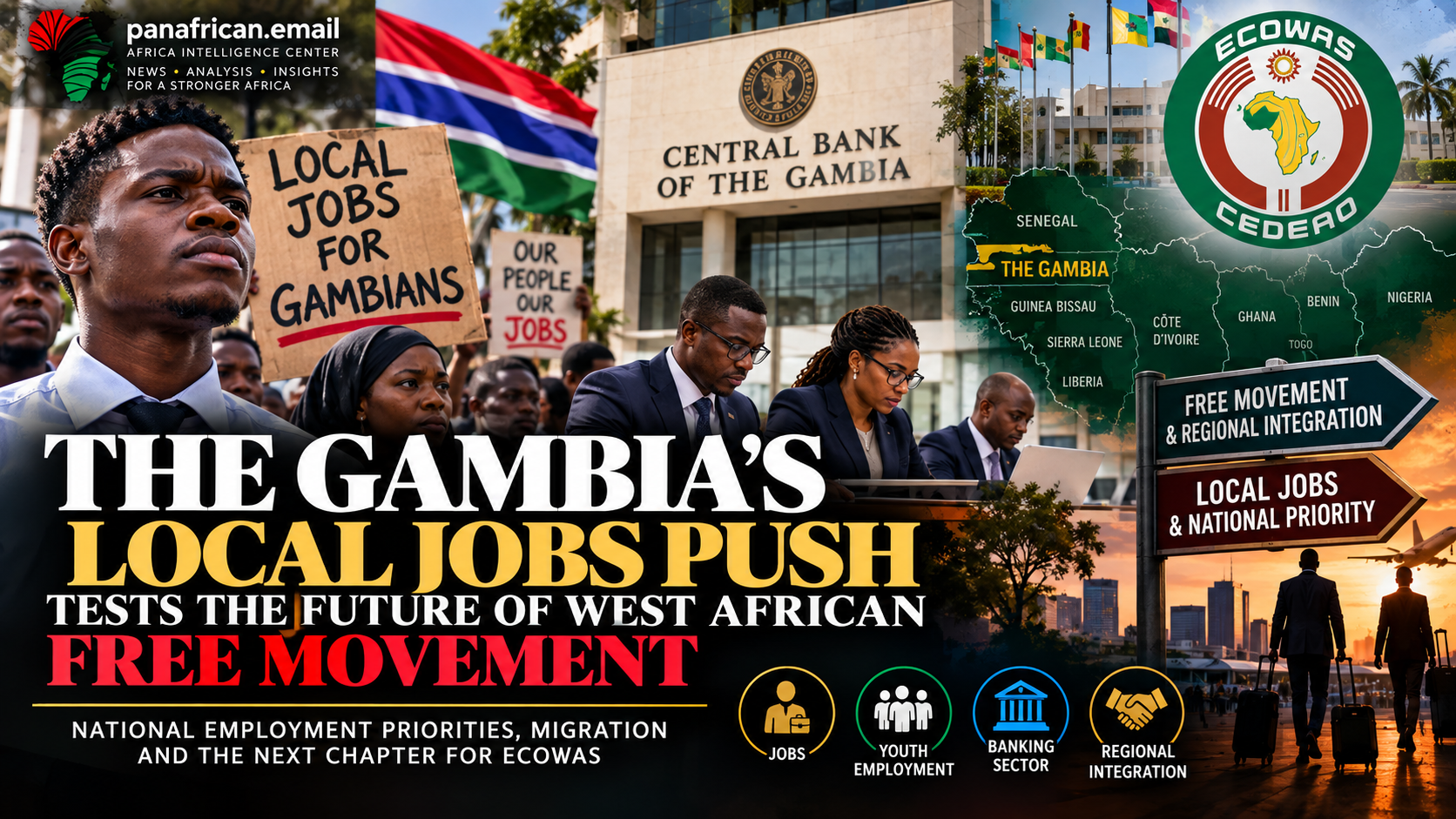
Banjul’s push to prioritize Gambian workers in commercial banking is reopening a much larger question: how should West Africa balance national employment priorities with regional economic integration?
A new employment directive in The Gambia is putting the relationship between national labour policy and West Africa’s free-movement ambitions under renewed scrutiny.
According to reporting by Firstpost Africa, the Central Bank of The Gambia (CBG) has given commercial banks until December 31, 2026, to replace non-Gambian employees in positions that can be filled by qualified Gambian citizens, following an industry-wide audit.
The reported policy comes as The Gambia faces persistent concerns over youth employment, informal work and the ability of its economy to create sufficient opportunities for citizens.
But the banking-sector directive raises a broader regional question: where should national employment preference end and West Africa’s commitment to the movement of workers begin?
A national jobs policy with regional implications
For the Gambian government and regulators, the argument is fundamentally about employment.
If qualified Gambians are available to perform jobs within the domestic banking sector, prioritizing them can be presented as a way of strengthening local professional capacity and ensuring that economic activity generates opportunities for citizens.
The issue is particularly sensitive in a country where young people make up a large portion of the population and where formal employment opportunities remain limited.
The reported banking directive therefore places the spotlight on a familiar policy dilemma across Africa:
Should employers first look for qualified citizens before recruiting workers from abroad?
That question has become increasingly prominent in several African economies, particularly where unemployment and underemployment among young people remain significant political and economic concerns.
The Gambian case is unusual because it directly intersects with West Africa’s long-standing regional integration framework.
What ECOWAS free movement actually provides
The Economic Community of West African States (ECOWAS) has treated the movement of people as one of the foundations of regional integration.
The ECOWAS Protocol on Free Movement of Persons, Residence and Establishment was adopted in 1979. ECOWAS describes the protocol as one of the central pillars of its regional integration and development agenda. (ECOWAS)
The protocol provides for citizens of member states to move within the Community and, subject to applicable rules, to reside in another member state for the purpose of seeking and carrying out employment.
The framework is not an unrestricted guarantee of every job to every ECOWAS citizen. The protocol also recognizes national legislation governing employment and contains exceptions, including provisions concerning public-service employment. (ECOWAS)
That distinction is important.
Free movement does not necessarily mean that every labour market is completely open or that national governments have no authority to regulate employment.
The challenge is determining how far a country can go in protecting domestic employment without undermining the regional principles that make labour mobility possible.
Why the banking sector matters




 Access Bank
 AGIB Bank
 BSIC
BSIC
 Bloom Bank
Ecobank
FirstBank
GTBank
Bloom Bank
Ecobank
FirstBank
GTBank
 Mega Bank
 Trust Bank
 Vista Bank
Zenith Bank
Vista Bank
Zenith Bank
The five-bar comparison represents publicly reported senior/board positions reviewed, not total employee counts. The Central Bank directive covers the licensed commercial banking sector.
The financial sector is particularly significant because banks operate at the center of the regional economy.
West African banking groups frequently operate across multiple countries, allowing financial institutions to transfer expertise, management personnel and technical specialists between markets.
That regional structure can help banks introduce new technology, risk-management systems, compliance practices and financial products.
At the same time, it can create concerns when senior or specialized positions are disproportionately occupied by expatriate employees while qualified nationals remain outside the formal sector.
The Gambian directive therefore potentially affects more than individual employment contracts.
It could influence how regional banking groups recruit, train and deploy employees across West Africa.
Localization versus regional integration
The debate can be understood through two competing policy objectives.
The case for localization
Supporters of prioritizing Gambian workers can argue that:
- qualified citizens should have access to domestic employment opportunities;
- banks operating in The Gambia should contribute to local skills development;
- localization can strengthen the country’s professional workforce;
- replacing expatriate positions with trained Gambians could help reduce unemployment;
- local recruitment can increase the long-term capacity of Gambian institutions.
The Central Bank’s reported audit and deadline appear to be connected to this broader objective.
The policy also comes against a backdrop of efforts to create employment opportunities for Gambian youth.
In March 2026, ECOWAS and the Gambian government reported that the ECOWAS Regional Stabilisation and Development Fund’s pilot project in The Gambia had generated 18,552 jobs, including 6,042 permanent positions. ECOWAS said 80 percent of those permanent jobs were occupied by young people. (ECOWAS)
That demonstrates the scale of the employment challenge facing the country—and why job creation remains central to economic policy.
The argument for regional labour mobility
The other side of the equation is regional integration.
A Gambian company can benefit from hiring a skilled Ghanaian, Nigerian, Senegalese or Sierra Leonean professional in the same way that Gambian workers can seek opportunities elsewhere in the region.
Regional labour mobility can allow skills to move toward areas where they are most needed.
It can also help businesses expand across borders without having to rebuild entire management and technical teams in every country.
For ECOWAS, this movement is part of a much larger economic project.
In February 2026, the ECOWAS Commission held discussions with Sweden on labour-migration governance and the implementation of the Community’s free-movement framework. The discussions included efforts to strengthen safe, orderly and regular migration within West Africa. (ECOWAS)
ECOWAS has also been developing a broader labour-migration strategy emphasizing mobility, skills recognition, youth employment and social protection. (ECOWAS)
This creates an important policy tension.
A country can want more jobs for its citizens while ECOWAS wants more opportunities for citizens across the region.
Those objectives are not necessarily incompatible, but they require careful regulation.
A question of skills—not simply nationality
One of the most important questions surrounding the Gambian policy will be how banks determine whether a position can actually be localized.
A blanket replacement of foreign workers could produce different results from a skills-based localization programme.
A more gradual approach could involve identifying positions where qualified Gambians are already available, establishing training requirements for positions where they are not, and setting timelines for transferring knowledge from expatriate specialists to local employees.
That would turn localization from simply an employment restriction into a workforce-development strategy.
The distinction could matter particularly in highly specialized areas such as:
- cybersecurity;
- financial technology;
- risk management;
- compliance;
- treasury operations;
- investment banking;
- data science;
- information technology;
- actuarial services.
Some positions may have readily available local candidates, while others may require longer-term investment in education and professional training.
The regional banking groups are watching
The consequences could extend to major West African financial groups with operations in The Gambia.
Banks operating across borders have to balance local regulatory requirements with regional staffing models.
If governments across the region increasingly introduce national employment quotas or localization requirements, banks could face a more fragmented labour environment.
For financial institutions, that could mean:
More local recruitment
Banks may need to expand recruitment of Gambian graduates and professionals.
More professional training
Institutions could invest more heavily in graduate programmes, apprenticeships and specialist certifications.
Greater movement of knowledge
Experienced expatriate workers could increasingly be used to train local employees rather than permanently occupy positions.
Higher compliance costs
Banks could need additional systems to demonstrate compliance with national employment requirements.
The bigger African debate
The Gambian development is part of a much wider African discussion.
Across the continent, political and economic debates have increasingly focused on the relationship between migration and employment.
South Africa has experienced political pressure around undocumented migration and employment, while Kenya and other countries have also debated the participation of foreign workers in domestic labour markets.
But the African Union and regional economic communities have simultaneously promoted greater integration and movement of people.
This creates a fundamental contradiction that African policymakers will have to address:
Africa wants to integrate its markets while its governments are also under pressure to protect domestic employment.
The solution may not be choosing one objective over the other.
Instead, governments could focus on skills development, transparent work-permit systems, recognition of qualifications and enforceable labour standards.
The Gambia’s strategic position
The Gambia occupies a particularly interesting position in this debate.
The country is geographically surrounded by Senegal except for its Atlantic coastline, making regional economic relationships particularly important.
Trade, tourism, transport, labour migration and financial services connect the Gambian economy closely with its neighbours.
A labour policy that affects foreign workers therefore operates within an economy already deeply connected to the wider West African market.
The challenge for policymakers is maintaining the advantages of that integration while ensuring that Gambian citizens are not excluded from opportunities in their own economy.
Could localization become a regional model?
If the Gambian banking directive produces measurable improvements in local employment without reducing the quality or stability of financial services, other governments could examine the approach.
But if localization produces unintended consequences—such as skills shortages, higher operating costs or difficulty recruiting specialized professionals—it could prompt policymakers to reconsider how the policy is implemented.
The December 31, 2026 deadline therefore gives the banking sector a relatively clear timeframe around which to plan.
The more important question will be what happens after the deadline.
Will localization become a permanent employment principle?
Will it apply more broadly across other industries?
Will other ECOWAS governments adopt similar approaches?
Or will the banking sector become a test case for a more nuanced system that combines national employment priorities with regional labour mobility?
The future of ECOWAS may depend on getting this balance right
West Africa’s economic integration project was built on the idea that people, businesses, goods and capital should be able to move more freely across national borders.
At the same time, national governments remain responsible for creating economic opportunities for their own citizens.
Those responsibilities do not have to be mutually exclusive.
The Gambia’s banking-sector policy puts the tension into sharp focus.
The real test will be whether localization can be implemented as a programme for building Gambian skills and employment, rather than simply as a mechanism for excluding foreign workers.
For ECOWAS, the question is equally significant.
Regional integration will be stronger if citizens believe that free movement expands opportunity rather than creating competition for scarce jobs.
The Gambia’s experience could therefore become an important case study in the next phase of West African integration: how to build a regional labour market while ensuring that local citizens are equipped to compete within it.
panafrican.email perspective
The debate should move beyond the simple question of whether foreign workers are “taking” local jobs.
A more useful question is:
How can West Africa create enough skilled employment, education and enterprise opportunities that Gambians, Ghanaians, Nigerians, Senegalese, Liberians and other West Africans can participate in an integrated economy without being forced to compete over scarcity?
That is ultimately the larger challenge facing ECOWAS.
Regional free movement can create opportunity—but national economies must simultaneously invest in the people who are expected to benefit from it.
Leave a Reply