
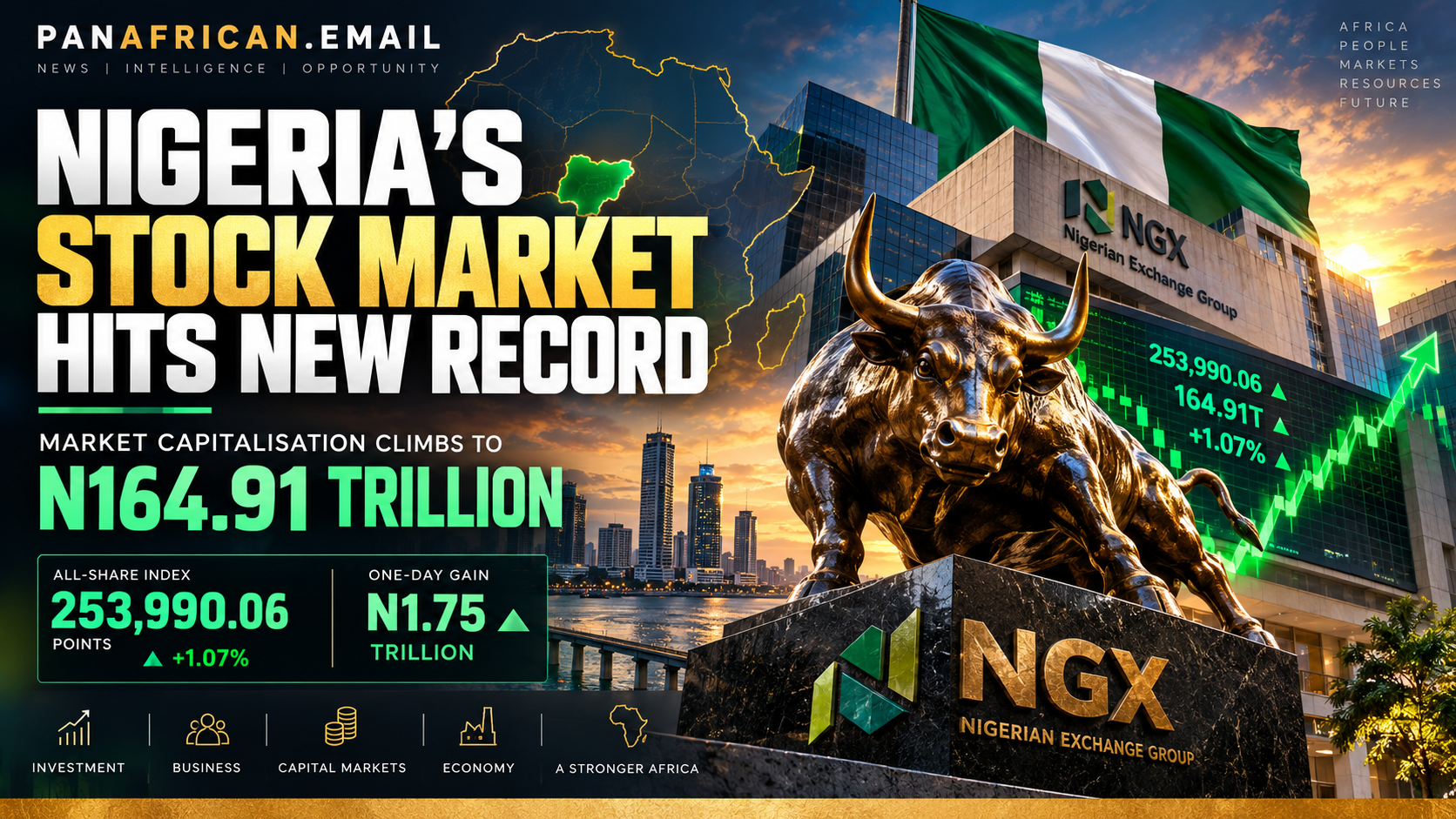
The Nigerian Exchange has reached another historic milestone, with the All-Share Index closing at 253,990.06 points and total equity market capitalisation rising to approximately N164.91 trillion.
Nigeria’s equity market has extended its powerful October rally, pushing the country’s listed-equity market value to a new record as investor activity and heavyweight stocks continue to drive the Nigerian Exchange (NGX) higher.
On Tuesday, October 27, the NGX All-Share Index rose 1.07%, gaining 2,699.52 points to close at 253,990.06 points. At the same time, total market capitalisation increased by approximately N1.75 trillion, climbing from N163.16 trillion to a record N164.91 trillion.
The latest advance represents another record within days of the market crossing the N160 trillion threshold and subsequently breaking through N163 trillion.
A market moving from record to record
The speed of the recent advance is notable.
On Friday, October 23, the Nigerian equities market ended the week with market capitalisation of approximately N160.52 trillion. On Monday, October 26, that figure jumped by N2.64 trillion to N163.16 trillion as the All-Share Index advanced 1.65% to 251,290.54 points.
One trading session later, the market added another N1.75 trillion.
The result was a fresh record of N164.91 trillion and an All-Share Index reading of 253,990.06 points.
Proshare reported that the market’s year-to-date return had reached approximately 63.22%, illustrating just how significant the 2026 rally has become.
The move also places the Nigerian equity market considerably above where it stood at the beginning of the year.
The numbers behind the record
Tuesday’s session was not simply a story of the index rising.
Trading activity was exceptionally concentrated, with approximately 5.23 billion shares changing hands across 35,882 deals.
According to market reports, First HoldCo accounted for approximately 4.87 billion shares of the day’s total volume, making it the dominant contributor to trading activity.
That concentration matters.
A headline record in market capitalisation can suggest broad-based investor confidence, but the underlying trading data provides a more complicated picture. Proshare reported that 20 equities gained while 36 declined, meaning that the positive movement in the benchmark was not evenly distributed across the market.
In other words, Nigeria’s stock market is rising sharply, but investors should distinguish between an index-level rally and broad participation across listed companies.
Dangote Cement emerges as a major force
Among the most important stocks behind the latest move was Dangote Cement.
The company gained 9.80%, closing at N1,341.90 per share and reaching a reported market valuation of approximately N22.64 trillion.
The company’s performance was particularly important because of its weight within Nigeria’s industrial market.
The NGX Industrial Index climbed sharply during the session, with Dangote Cement playing a major role in the sector’s advance. Nairametrics reported that the Industrial Index rose to 11,834.55 points on October 27, compared with 11,218.05 points on October 26.
Other notable gainers included:
- UPDCREIT, up 10.00%
- Honeywell Flour Mills, up 9.67%
- NAHCO, up 8.00%
- Wema Bank, up 4.01%
- Access Holdings, up 3.26%
- Stanbic IBTC, up 3.06%
The gains indicate that buying interest is extending beyond a single company, although the breadth figures show that the rally remains uneven.
Not every sector is participating
The record should therefore not be interpreted as evidence that every part of the Nigerian equity market is experiencing the same conditions.
The NGX Industrial Index was among the strongest performers, while the banking index was essentially flat.
The NGX Banking Index finished at approximately 2,574.61 points, barely changed from the previous session. Gains in Wema Bank and Access Holdings were offset by declines in several major banking stocks, including Fidelity Bank, GTCO and UBA.
The insurance sector was weaker.
The NGX Insurance Index fell 2.44%, according to Proshare, with several insurance companies recording significant losses.
The oil and gas index also slipped slightly.
This divergence is important for investors attempting to understand what is actually driving the market.
A rising headline index can coexist with significant weakness in individual sectors and companies.
Nigeria’s return to the international investment radar
Another factor behind the changing perception of Nigeria’s capital market is the country’s renewed position within international market classifications.
Nigeria returned to the FTSE Russell Frontier Market universe in September 2026, following improvements identified in areas including foreign-exchange liquidity, capital repatriation and market accessibility.
That development has the potential to increase international investor attention toward Nigerian assets.
September had already produced strong equity-market performance. The NGX All-Share Index gained 2.87% during the month, while equity market capitalisation increased by approximately N5.37 trillion to N163.10 trillion.
The subsequent October acceleration has now pushed the market beyond another major psychological threshold.
Domestic investors remain important
The rally is also occurring within a market where domestic participation remains substantial.
Proshare reported that domestic investors accounted for approximately 89.5% of September turnover, while foreign transactions increased during the month from August levels.
This suggests that the current market advance cannot simply be described as foreign capital returning to Nigeria.
Local investors, pension funds, institutional investors and individual market participants remain important components of the Nigerian capital-market ecosystem.
That distinction is particularly important for understanding the durability of the rally.
What the market record does — and does not — mean
A record market capitalisation is an important economic signal, but it should not automatically be interpreted as proof that Nigeria’s underlying economy has improved by the same percentage.
Market capitalisation is determined largely by the prices of listed securities multiplied by their shares outstanding.
When major companies appreciate sharply, the overall value of the exchange can rise rapidly even if economic growth, household purchasing power and corporate performance are moving at different speeds.
The latest NGX figures therefore represent market valuation, rather than a direct measurement of national wealth.
That distinction is especially important in an environment where inflation, exchange-rate movements, interest rates and corporate earnings continue to influence investor decisions.
The concentration question
One of the most interesting aspects of Tuesday’s session was the extraordinary trading concentration in First HoldCo.
With approximately 4.87 billion shares traded out of the 5.23 billion shares recorded across the market, First HoldCo represented the overwhelming majority of volume.
High volume can be positive because it demonstrates liquidity and investor participation.
But analysts also need to determine why that volume occurred.
Large transactions, restructuring activity, institutional repositioning or other corporate events can dramatically increase a stock’s trading volume without necessarily representing an equivalent broad-based shift in investor sentiment.
For the Nigerian market, the distinction between liquidity and breadth will therefore remain important.
A powerful rally with warning signs
The current market picture contains two seemingly contradictory signals.
On one side, Nigeria’s benchmark index is reaching unprecedented levels.
On the other, market breadth remains relatively weak.
Tuesday produced 20 gainers against 36 decliners, according to Proshare.
That means the headline index was lifted substantially by a relatively smaller group of stocks.
Nigeria’s Three-Year
Market Surge
This does not invalidate the rally.
Instead, it suggests that investors should examine the composition of the advance rather than relying solely on the record level of the All-Share Index.
The performance of large-capitalisation companies can have an outsized effect on the benchmark.
Nigeria’s capital market is becoming increasingly important
The significance of the N164.91 trillion milestone extends beyond the daily movement of stock prices.
Nigeria possesses one of Africa’s largest and most sophisticated capital markets, and the expansion of its listed-equity valuation provides another indication of the scale of capital being mobilised through the country’s financial system.
For African investors, the NGX remains an important gateway into sectors including banking, telecommunications, industrial production, consumer goods, energy, transportation and real estate.
For international investors, the combination of market reforms, improved accessibility and Nigeria’s frontier-market status may make the country increasingly relevant when allocating capital across African markets.
What investors will be watching next
The next question is whether the market can consolidate above the new record.
Investors will likely be watching several indicators:
1. Market breadth:
Will more stocks begin participating in the rally, or will gains remain concentrated among a small group of large companies?
2. Corporate earnings:
Can companies deliver earnings growth capable of supporting the higher valuations reflected in share prices?
3. Foreign participation:
Will Nigeria’s renewed international-market status translate into sustained foreign portfolio flows?
4. Interest rates and liquidity:
Changes in monetary conditions can materially affect the attractiveness of equities relative to fixed-income instruments.
5. Exchange-rate stability:
Currency conditions remain critical for both domestic businesses and international investors assessing returns in dollar terms.
6. Commodity and energy prices:
Nigeria’s exposure to oil and gas means developments in global energy markets can continue to influence investor sentiment.
7. Regulatory and economic reforms:
Capital-market accessibility, foreign-exchange reforms and broader economic-policy developments will remain important variables.
An African market worth watching
Nigeria’s latest stock-market record arrives at a moment when investors are reassessing opportunities across African financial markets.
The country has spent years attempting to deepen its capital markets, improve transparency, strengthen financial infrastructure and reconnect domestic securities with international capital.
The latest NGX milestone provides evidence that those markets are capable of generating substantial increases in valuation and liquidity.
But the record also comes with a responsibility for investors and policymakers: ensuring that market expansion is supported by productive investment, corporate earnings, transparent institutions and broader participation.
For businesses seeking capital, a stronger exchange can provide new opportunities.
For Nigerian companies, rising valuations can potentially improve access to equity financing and strengthen their ability to raise capital for expansion.
For investors, however, record prices also require discipline.
A market reaching historic highs is not necessarily a market without risk.
Pan African Intelligence Assessment
Assessment: LOW
Region: Nigeria
Category: Financial Markets / Equities
Status: Verified against current market reporting
Market: Nigerian Exchange (NGX)
Key figure: N164.91 trillion market capitalisation
All-Share Index: 253,990.06 points
One-day market-cap gain: approximately N1.75 trillion
One-day ASI gain: 1.07%
Reported YTD return: approximately 63.22%
Trading volume: approximately 5.23 billion shares
Leave a Reply