BREAKING

Nigeria technology investment   •   Ghana–Jamaica trade   •   Sahel security   •   Kenya technology   •   African markets

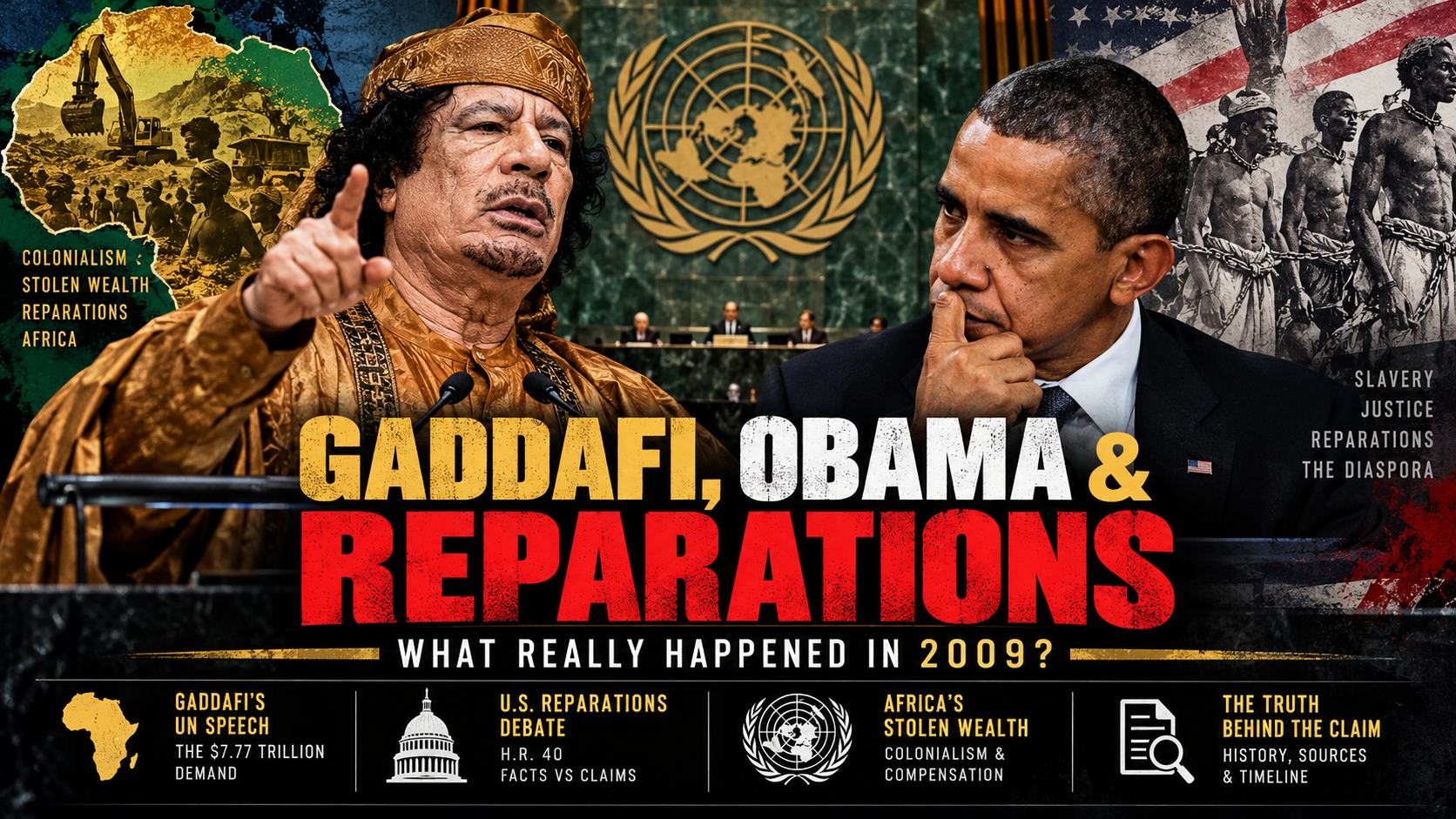
Gaddafi, Obama & Reparations — 2009 UN Multimedia Presentation


Gaddafi, Obama & Reparations — 2009 UN Multimedia Presentation

Panafrican.email • Historical Intelligence Presentation

Gaddafi,
Obama &
Reparations

What actually happened at the United Nations on September 23, 2009 — and what the evidence does, and does not, show about the claim that Barack Obama stopped Muammar Gaddafi from pursuing reparations for Black Americans.

2009 • UN General Assembly • Fact Check
Barack Obama addresses the United Nations General Assembly on September 23, 2009

Two speeches. One historic day.
Obama spoke first; Gaddafi followed.
01 • The historical moment

September 23, 2009

The 64th session of the UN General Assembly placed Barack Obama and Muammar Gaddafi on the same diplomatic stage. Obama delivered his first UN address as U.S. president. Gaddafi then spoke as Libya’s leader and, in the UN record, also on behalf of the African Union.

Morning / Obama: The U.S. president called for multilateral cooperation, nuclear disarmament and a different relationship between the United States and the world.
Later / Gaddafi: The Libyan leader attacked the structure of the Security Council and argued that Africa deserved a greater role in global institutions.
Reparations: Gaddafi explicitly called for compensation to colonized countries and gave a huge monetary figure for Africa’s stolen wealth.

UN records identify Gaddafi’s September 23, 2009 address as part of the 64th General Debate. The UN summary says he was speaking also on behalf of the African Union.

02 • Gaddafi’s argument

“Compensation” for colonial exploitation

The demand

$7.77T*

Contemporary reporting and the speech transcript record Gaddafi demanding compensation for Africa from the countries that colonized it. The exact figure appears with different formatting/transcription in later sources, so this presentation uses the widely reported $7.77 trillion figure.

The wider argument

Gaddafi framed reparations as more than a cash payment. He argued that colonial powers had extracted Africa’s material and human resources and that compensation could serve as a deterrent against future colonial exploitation.

He also pointed to Italy’s compensation agreement with Libya as an example of a former colonial power formally acknowledging and compensating for past wrongdoing.

“Another matter … is that of compensation for countries that were colonized.”— Muammar Gaddafi, UN General Assembly address, September 23, 2009; wording preserved in published transcript/reporting.
03 • The Obama question

Did Obama support U.S. slavery reparations?

There was a real U.S. reparations debate in 2009. H.R. 40, the Commission to Study Reparation Proposals for African-Americans Act, was introduced in Congress in January 2009.

But the evidence does not show that Obama created, sponsored or stopped the bill. FactCheck.org reported in April 2009 that Obama had “nothing to do with it” and had not endorsed slavery reparations.

Obama’s own earlier public position was that the most meaningful “reparations” would be investments in education and opportunity rather than direct payments.

The documented U.S. debate and Gaddafi’s African colonial-reparations demand were related in theme, but they were not the same policy proposal.
04 • The connection

What Gaddafi actually said about Obama

Muammar Gaddafi at the African Union summit in Addis Ababa in February 2009

Gaddafi as African Union chair

Public-domain U.S. Navy imagery from the 12th African Union Summit, February 2009.

He praised Obama — but warned about the future

Gaddafi described Obama as a “son of Africa” and welcomed his election as a historic event. He also said Obama’s presidency was a temporary relief and expressed concern about what would happen after his term.

Crucially, the speech does not document Gaddafi presenting Obama with a specific plan for the United States to pay reparations to African Americans.

05 • The viral claim

“Obama stopped Gaddafi.”

NO

Not supported by the documentary record we can verify.

What can be supported

Gaddafi publicly demanded compensation for colonial exploitation of Africa in 2009. He did so in the same UN session in which he praised Obama.

What cannot be established

There is no reliable evidence in the cited UN record, the 2009 U.S. reparations legislation record, or the FactCheck review showing that Gaddafi had a U.S.-specific African-American reparations program that Obama personally blocked.

06 • Why the story persists

Two reparations conversations became one story.

01

Pan-African compensation

Gaddafi argued that Africa and formerly colonized peoples were owed compensation for resources and human wealth extracted during colonialism.

02

U.S. slavery reparations

H.R. 40 sought a congressional study of reparations proposals for African Americans. It was a U.S. legislative process, not a Gaddafi initiative.

03

Obama’s position

Obama did not endorse direct slavery-reparations payments and was not documented as blocking Gaddafi’s colonial-compensation proposal.

The deeper historical question remains legitimate: who owes what, to whom, and for which historical crime?
08 • Editorial conclusion

The record is more interesting than the myth.

Gaddafi really did call for enormous compensation to Africa for colonial exploitation. He really did praise Obama at the same UN session. Obama really was facing a domestic U.S. reparations debate in 2009.

But those facts do not establish that Obama stopped Gaddafi from delivering reparations to African Americans. The stronger historical story is the intersection of Pan-African reparations, post-colonial justice, U.S. slavery reparations and the politics of global wealth extraction.

#Reparations#PanAfricanism#Gaddafi#BarackObama#AfricanUnion#Colonialism#BlackHistory#HistoricalIntelligence
PANAFRICAN.EMAIL — MULTIMEDIA HISTORY / INTELLIGENCE

Editorial note: This presentation distinguishes documented statements from later claims and interpretations. Monetary figures attributed to Gaddafi are presented as reported historical claims, not as independently calculated economic valuations.

Image note: The Obama image is sourced from a public-domain archival media source. The Gaddafi image is a U.S. Navy image identified by Wikimedia Commons as public domain. Verify licensing before commercial republication.

1 / 9


Comments

Leave a Reply

Your email address will not be published. Required fields are marked *

error: Content is protected !!

Discover more from panafrican.email

Subscribe now to keep reading and get access to the full archive.

Continue reading