
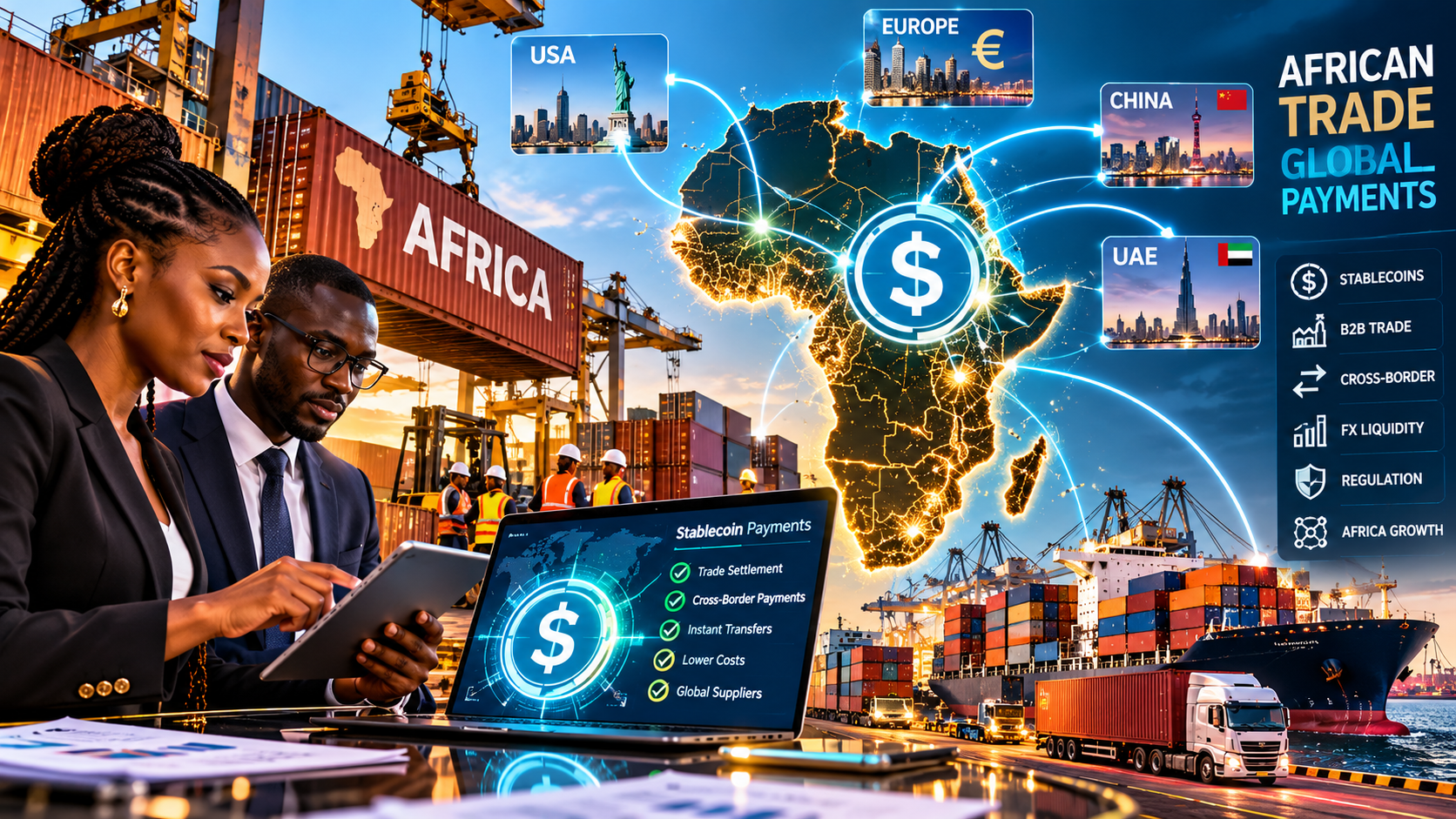
ACCRA, Ghana — October 10, 2026 — Stablecoins could be moving toward a new role in Africa’s financial system, with business-to-business trade payments potentially becoming a larger driver of adoption than consumer remittances.
That is the view of Ryan Kirkley, chief executive and co-founder of Global Settlement Network (GSN), a digital-asset settlement infrastructure company focused on cross-border transactions and institutional financial infrastructure.
Speaking to NewsGhana, Kirkley argued that Africa’s persistent foreign-exchange shortages, fragmented payment networks and dependence on correspondent banking could create a significant opportunity for stablecoins to become part of the infrastructure supporting international trade. (News Ghana)
The argument comes as stablecoin activity increasingly extends beyond individual users sending money across borders. Recent reporting has highlighted growing interest among African businesses in dollar-linked digital assets as companies struggle with access to foreign currency and the cost and complexity of international payments. (ITWeb Africa)
The real opportunity may be business payments
Stablecoins are digital tokens designed to maintain a relatively stable value against an underlying asset, most commonly the US dollar.
For African businesses involved in international trade, the attraction is potentially straightforward: move dollar-denominated value across borders without relying entirely on traditional correspondent banking channels.
Kirkley believes B2B commerce could eventually represent one of the continent’s largest sources of stablecoin transaction volume.
The scenario is particularly relevant to African importers that need to pay suppliers in markets such as China, the United Arab Emirates, India and Europe.
A company may have sufficient local-currency funds to purchase goods but still encounter delays obtaining the dollars required by an overseas supplier. That disconnect between local liquidity and international purchasing power can create significant friction for businesses.
Africa’s dollar problem
The technology itself may not be the biggest obstacle.
For companies operating across African markets, the more difficult problem can be obtaining and converting foreign currency efficiently.
Consider an importer in Nigeria purchasing electronics from a supplier in China. The Nigerian business may have customers, inventory demand and naira available in its bank account, but obtaining the dollars needed for settlement can involve multiple financial institutions, foreign-exchange transactions and delays.
Kirkley argues that stablecoins could shorten parts of this process by allowing value represented digitally in dollars to move more directly between counterparties.
But there is an important qualification.
A faster transfer does not automatically mean a cheaper transfer.
Liquidity could determine whether stablecoins actually save money
Foreign-exchange conversion remains a major component of the cost of international trade.
A business sending US$300,000 to an overseas supplier, for example, could lose thousands of dollars through the exchange-rate spread even if the underlying digital transaction settles almost instantly.
At a 1% conversion spread, a US$300,000 transaction would carry a US$3,000 FX cost.
That means companies evaluating stablecoin payments will need to look beyond transaction speed.
Three questions become critical:
- How much money will the supplier actually receive?
- At what exchange rate will the conversion occur?
- How quickly will the payment become usable by the recipient?
Liquidity at scale is another issue. A provider capable of converting US$1,000 efficiently may not necessarily have enough market depth to handle a US$500,000 corporate transaction without materially affecting the price.
For stablecoins to become meaningful infrastructure for African trade, banks, payment companies and liquidity providers will therefore need reliable mechanisms for converting digital dollars into local currencies.
Correspondent banking remains important
Stablecoins are unlikely to eliminate banks from international commerce.
Trade finance, foreign-exchange liquidity, compliance, sanctions screening, identity verification and local-currency settlement remain important components of the financial system.
Letters of credit, for example, can provide suppliers with protection against non-payment. Banks also play an essential role in verifying businesses and the underlying transactions.
The potential transformation may therefore be less about replacing banks and more about changing the infrastructure through which banks and businesses move value.
That distinction is important.

GSN has positioned itself as infrastructure connecting institutions, digital assets and settlement systems rather than simply another consumer cryptocurrency platform. Previous reporting on the company has described its focus on blockchain-based settlement, tokenisation, compliance infrastructure and digital financial systems for governments and institutions. (TechCabal)
Risks could grow alongside adoption
The rise of stablecoins also introduces new risks.
A business receiving a stablecoin payment still needs confidence that the token can be converted into usable currency. Counterparty liquidity, the financial strength and redemption arrangements of the issuer, custody arrangements and regulatory status all matter.
There is also a fundamental operational risk: blockchain transactions sent to the wrong or compromised wallet may not be reversible in the same way as some traditional bank transactions.
Currency exposure remains another issue.
An African company earning revenue in a local currency but holding dollar-denominated stablecoins is still exposed to movements in the local currency against the dollar.
Stablecoins may provide a digital dollar, but they do not eliminate foreign-exchange risk.
Banks could become part of the next digital settlement layer
Rather than being displaced by stablecoins, African banks could potentially become key providers of the infrastructure supporting them.
Banks could provide local-currency liquidity, custody services, compliance infrastructure and tokenised deposits.
The broader financial industry is already exploring how tokenised bank deposits and central-bank money could operate alongside digital assets in cross-border payments. The Bank for International Settlements’ Project Agorá is one example of the international financial system investigating these possibilities.
For African economies, the question is therefore becoming larger than cryptocurrency.
It is about who controls the rails through which African trade is settled.
Ghana faces its own regulatory balancing act
Ghana is already developing a regulatory framework for virtual assets.
The country’s Virtual Asset Service Providers Act, 2025 (Act 1154) establishes registration requirements involving the Bank of Ghana and Securities and Exchange Commission. The Bank of Ghana has also taken measures concerning the promotion and advertising of virtual-asset and stablecoin products.
That creates a central policy challenge.
Governments want the efficiency and innovation associated with digital finance while maintaining monetary stability, consumer protection, anti-money-laundering controls and oversight of capital flows.
The issue is particularly important if businesses begin moving significant portions of their working capital into dollar-denominated digital assets.
The next stablecoin battleground could be trade corridors
Kirkley expects adoption to develop first along established international trade corridors where African companies already face substantial foreign-exchange and settlement challenges.
China, India, the United Arab Emirates and Europe are likely to remain particularly important connections.
For African businesses, the attraction is not necessarily cryptocurrency speculation.
It is the possibility of creating a more efficient mechanism for paying suppliers, receiving international revenue and managing foreign currency.
That distinction could prove decisive.
Africa’s stablecoin story may ultimately be less about individuals holding digital dollars on their phones and more about companies using digital settlement infrastructure to move millions of dollars through the continent’s trade corridors.
Africa’s financial infrastructure question
The emergence of stablecoins raises a deeper question about Africa’s position in the global financial system.
For decades, many African economies have depended heavily on international correspondent banks and external payment networks to connect local financial systems to the rest of the world.
Blockchain-based settlement could offer another layer.
But the opportunity will depend on whether African regulators, banks, fintech companies and businesses can build systems that combine speed with liquidity, compliance, consumer protection and monetary stability.
The technology may make a payment move faster.
The larger challenge is making sure the money can move efficiently, legally and at a competitive exchange rate once it reaches the other side.
If that infrastructure develops, B2B trade could become one of the most important engines behind Africa’s next phase of stablecoin adoption.
Leave a Reply