
Panafrican.email News Research Desk | September 22, 2026
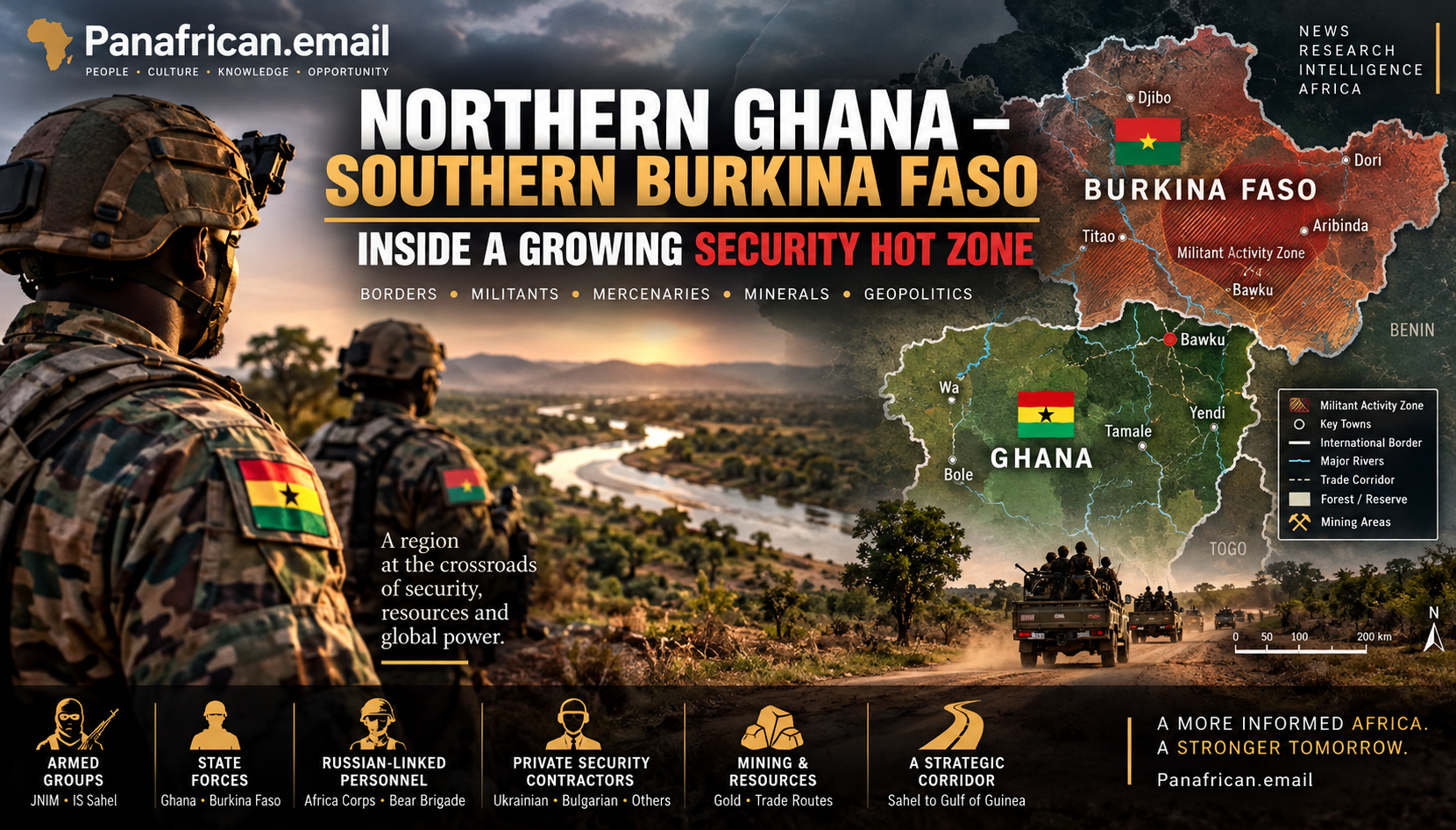
The frontier between northern Ghana and southern Burkina Faso is becoming one of West Africa’s increasingly important security zones.
The region sits at the southern edge of the Sahel’s expanding militant conflict while also functioning as a major commercial corridor connecting Ghana with Burkina Faso and the wider Sahel.
In recent months, Ghana and Burkina Faso have strengthened security cooperation along their shared frontier. At the same time, jihadist networks continue to operate across Burkina Faso, while Russian-linked military personnel and foreign private security actors have become part of the wider regional security landscape.
Against this background, a recruitment claim circulating on social media alleges that a private security company—described as likely Ukrainian and based in Sweden—is seeking personnel to operate against “hostile foreign expeditionary forces” in northern Ghana and southern Burkina Faso.
Panafrican.email has not independently verified that specific recruitment operation.
However, the wider security environment surrounding the Ghana-Burkina frontier is well established and deserves closer examination.
A Border Becoming Strategically Important
Ghana’s northern frontier with Burkina Faso connects communities that have maintained commercial, cultural and family relationships across the border for generations.
The security environment has nevertheless changed substantially as armed conflict has expanded throughout Burkina Faso.
The al-Qaeda-linked Jama’at Nusrat al-Islam wal-Muslimin (JNIM) has become one of the most significant armed organizations operating across the Sahel. Its expansion across Burkina Faso has raised concerns about potential movement and logistical networks toward the coastal states of West Africa.
Northern Ghana is particularly important because it sits immediately south of the Burkina Faso conflict zone.
That does not mean northern Ghana has become another Burkina Faso. Ghana continues to maintain a substantially different security environment.
The concern is spillover.
JNIM and the Southern Edge of the Sahel
JNIM is one of the principal armed groups shaping the security environment across Burkina Faso, Mali and neighboring areas.
The group’s activities have contributed to a broader transformation of the Sahel’s security geography.
National borders do not necessarily correspond to the operating environment of armed organizations. Trade routes, informal crossings, livestock movements, family networks and remote terrain can create connections extending well beyond the immediate battlefield.
For Ghana, this makes the northern regions strategically sensitive.
The country’s objective is not simply to respond to attacks after they occur. It is also to prevent the creation of permanent militant logistics, recruitment or support networks inside Ghanaian territory.
Burkina Faso’s Russian Security Connection
Another major component of the regional security picture is Russia.
Burkina Faso has developed increasingly close military and security relations with Moscow.
Russia’s Africa Corps has become an important element of Moscow’s security architecture in the Sahel following the restructuring of Russia’s former Wagner-related operations.
Russian-linked personnel have been reported in Burkina Faso, alongside domestic military and volunteer forces fighting insurgent organizations.
The presence of Russia-linked security personnel creates another layer to the conflict.
The region is therefore no longer simply a confrontation between governments and jihadist organizations.
It has become a more complicated environment involving:
● national armed forces;
● jihadist organizations;
● Russian-linked military personnel;
● private security contractors;
● intelligence organizations;
● regional security structures; and
● international geopolitical interests.
The Ukrainian Connection
There is also a documented historical Ukrainian connection to Burkina Faso.
Previous Panafrican.email research into the region’s security history has identified evidence of Omega Consulting, a Ukrainian private military/security organization, operating in Burkina Faso during the late 2010s.
Historical reporting also documented Ukrainian and Bulgarian personnel associated with military aviation activity in Burkina Faso.
Companies associated with those earlier activities included Omega Consulting, Aranko Security and Bulgaria’s Metalika.
These historical connections are significant because they demonstrate that foreign private military and security personnel have previously operated within Burkina Faso.
However, they do not prove that any of these organizations are connected to the current recruitment advertisement circulating online.
That distinction is essential.
The Swedish Recruitment Claim
A social-media post currently circulating claims that a private security company—described as likely Ukrainian and based in Sweden—is recruiting personnel to “fight hostile foreign expeditionary forces” in northern Ghana and southern Burkina Faso.
The post further alleges connections to companies in Bulgaria.
At present, Panafrican.email has not independently authenticated those claims.
Several questions remain unanswered:
● What is the legal name of the Swedish company?
● Who owns and controls it?
● Is it actually registered in Sweden?
● What is the evidence for a Ukrainian connection?
● Which Bulgarian companies are allegedly involved?
● Are those companies genuine operating businesses or alleged shell entities?
● Who is financing the recruitment?
● Where would personnel actually be deployed?
● What does the phrase “foreign expeditionary forces” refer to?
● Is the advertisement genuine, altered or fraudulent?
Until those questions are answered, the recruitment allegation should remain classified as UNVERIFIED.
Ghana’s Northern Security Architecture
The uncertainty surrounding the recruitment claim should not obscure the much larger security developments taking place along Ghana’s northern frontier.

Ghana and Burkina Faso have increased military and intelligence cooperation, including efforts involving cross-border patrols, intelligence sharing and surveillance.
Ghana has also strengthened coordination among the armed forces, police, immigration authorities, customs and intelligence institutions in the northern regions.
This reflects a recognition that the country’s northern border is increasingly important to national security.
The objective is to prevent the southward movement of armed groups while maintaining the movement of legitimate people and commerce.
The Wider Security Corridor
The northern Ghana–southern Burkina Faso zone should not be viewed as a single battlefield.
It is better understood as a security corridor.
It contains several overlapping systems:
The militant corridor
JNIM and other jihadist organizations operate across portions of the Sahel, creating potential spillover risks toward the coastal states.
The state-security corridor
Ghana and Burkina Faso are strengthening their military and intelligence cooperation.
The Russian security corridor
Russia’s Africa Corps and associated personnel have expanded Moscow’s security relationship with Sahelian governments.
The private-security corridor
Burkina Faso has a history of foreign private military and security contractors, including documented Ukrainian and Bulgarian involvement.
The commercial corridor
Trade routes connecting Burkina Faso with Ghana’s ports make the region economically important.
The resource corridor
Gold, livestock and other commodities move through the wider border region, creating both legitimate economic opportunities and opportunities for illicit networks.
Who Is Involved?
The regional security picture currently includes several identifiable categories of actors.
Ghanaian security forces:
The Ghana Armed Forces, Police Service, Immigration Service, Customs, intelligence organizations and other government agencies are responsible for Ghanaian territory.
Burkinabè security forces:
Burkina Faso’s military and associated domestic security forces are fighting the country’s insurgency.
JNIM:
An al-Qaeda-linked organization and one of the principal armed groups operating across the Sahel.
Islamic State Sahel Province:
A separate jihadist organization operating in the wider Sahel and competing with JNIM.
Russia’s Africa Corps:
A Russian state-linked military-security structure operating in several Sahelian countries.
Bear Brigade:
A Russia-linked formation reported to have operated in Burkina Faso and described by its own representatives as a private security organization.
Foreign private security actors:
Burkina Faso has historically hosted foreign security contractors, including Ukrainian and Bulgarian-linked personnel.
The alleged Swedish-based Ukrainian company:
Currently unidentified and unverified in relation to the recruitment claim circulating online.
Why This Matters to Ghana
For Ghana, the strategic concern is not simply whether foreign fighters enter the country.
The larger question is whether the country could become drawn into the expanding geopolitical competition surrounding the Sahel.
Northern Ghana sits at the intersection of:
Security.
Trade.
Mining.
Migration.
Intelligence.
Regional diplomacy.
And great-power competition.
The country’s northern regions therefore have importance extending far beyond their immediate borders.
A Hot Zone Without a Conventional War
The term “hot zone” does not necessarily mean that northern Ghana is experiencing conventional warfare.
Instead, it describes an area where multiple security pressures converge.
The frontier is exposed to the consequences of the Sahel insurgency while remaining an important economic gateway.
This creates a delicate situation for Ghana.
Too little security cooperation could allow militant networks to expand.
Too much militarization could disrupt legitimate border communities and commerce.
The challenge is maintaining security while preserving the economic and social connections that have existed across the frontier for generations.

Leave a Reply