
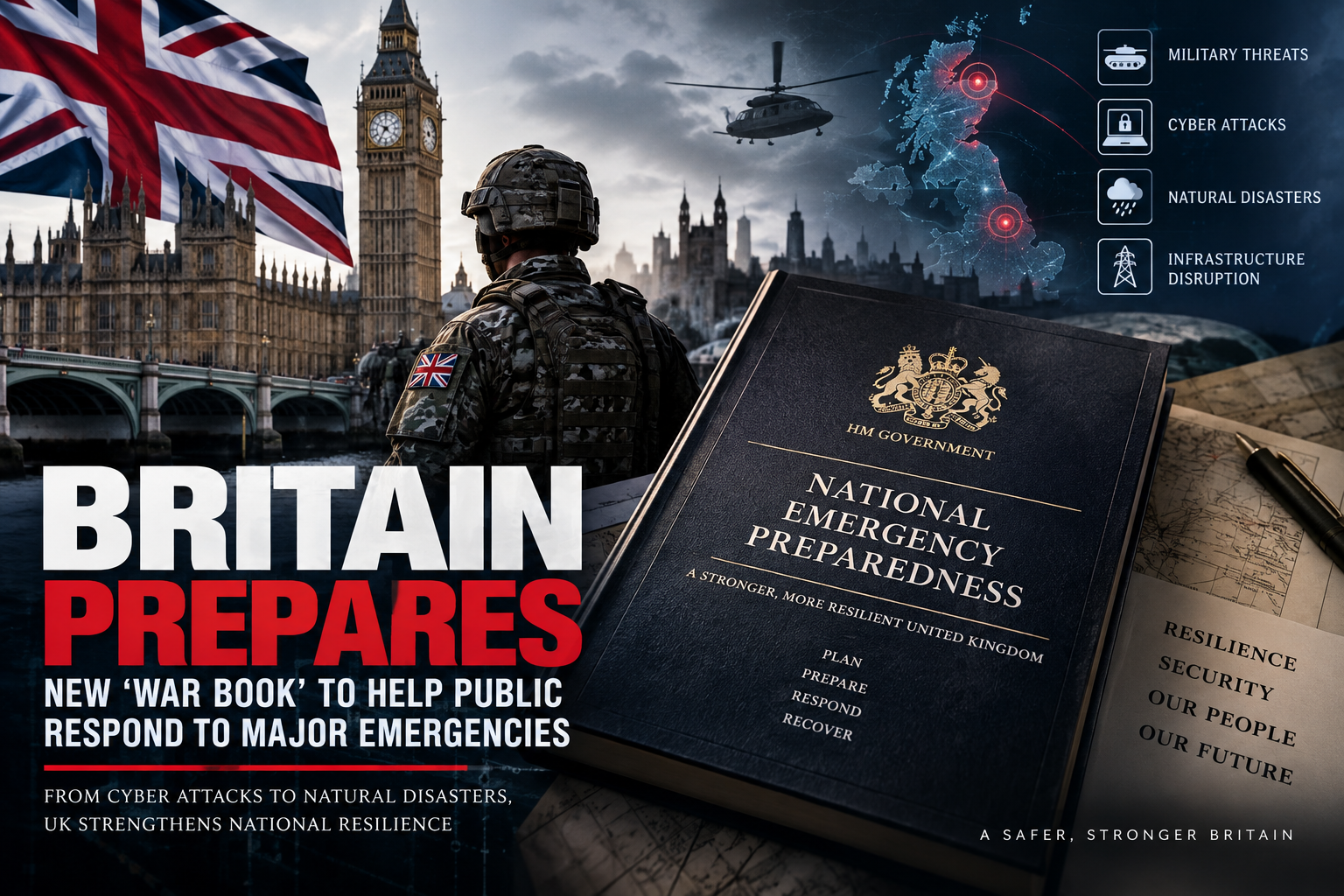
LONDON — The British government is strengthening its preparations for a range of major national emergencies, including severe weather, cyberattacks, disruption to critical infrastructure and potential military threats, as officials update the country’s wider crisis-management and resilience plans.
The move comes amid a broader reassessment of the risks facing the United Kingdom. In July 2026, the government published its updated National Risk Register, identifying the most serious risks facing the country and outlining scenarios that could have significant consequences for communities, businesses and essential services. (GOV.UK)
Among the developments is the updating of classified government crisis plans commonly known as “War Books.” According to the Cabinet Office, these documents are being updated under the government’s Home Defence Programme and are intended to help government departments plan and coordinate their response to threats against the United Kingdom. The government said the plans had last been comprehensively updated in 2004. (GOV.UK)
From war planning to all-hazards preparedness
The terminology surrounding Britain’s preparations can make the initiative sound exclusively military. The government’s current approach, however, covers a much wider range of emergencies.
The 2026 National Risk Register includes risks involving extreme weather, cyberattacks, failures affecting digital infrastructure and other disruptions that could affect essential services. The government has also launched a public awareness campaign designed to encourage households and communities to take practical steps to prepare for emergencies. (GOV.UK)
The objective is not to suggest that a major conflict or catastrophe is imminent. The National Risk Register is explicitly described by the government as a planning tool rather than a prediction of future events. (GOV.UK)
Instead, officials are attempting to build systems capable of functioning when several forms of disruption occur simultaneously.
Cyberattacks emerge as a major concern
ARTILLERY CAPABILITIES
United Kingdom vs Russia — publicly reported inventories
155mm self-propelled artillery
Multiple-launch rocket system
Next-generation 155mm system
152mm self-propelled howitzer
Multiple-launch rocket system
Heavy multiple-launch rocket system
Reported / Estimated Systems
219
~1,750
~1,100
Archer
Range: >50 km
M270 / GMLRS
Range: >70 km
RCH 155
Up to 70 km*
UK figures are based on UK Ministry of Defence equipment reporting.
Russian artillery figures are independent estimates and use different
equipment definitions and reporting dates. The figures should therefore
not be interpreted as a direct measure of combat effectiveness.
Sources: UK Ministry of Defence equipment statistics; International
Institute for Strategic Studies (IISS); British Army equipment information.
*Maximum quoted range depends on ammunition and configuration.
Cybersecurity has become an increasingly important component of Britain’s national resilience planning.
The government’s 2026 Cyber Action Plan states that hostile states and criminal groups are probing British digital defences and seeking opportunities to disrupt public services and other systems. The plan establishes measures intended to strengthen the cybersecurity and resilience of government services. (GOV.UK)
The updated National Risk Register also identifies cyber-related risks involving data infrastructure, water infrastructure and police systems. Digital resilience failures have been added to the register as a separate concern, reflecting lessons from previous large-scale technology disruptions. (GOV.UK)
For ordinary residents, a major cyber incident could have consequences extending beyond computers and websites. Disruption to digital systems can affect access to communications, electricity, water, financial services and other essential functions.
Preparing for severe weather and other emergencies
Britain’s resilience planning also extends to natural and environmental hazards.
Government emergency-response arrangements cover a broad spectrum of incidents, including extreme weather, infectious diseases, chemical and biological hazards, radiological events, cyber incidents and major infrastructure disruptions.
The UK Health Security Agency’s emergency preparedness framework describes an all-hazards approach, with separate plans covering issues such as national power outages, cyberattacks, chemical, biological, radiological and nuclear incidents, pandemics and other high-consequence emergencies. (GOV.UK)
The emphasis is therefore increasingly on resilience rather than preparing for one particular scenario.
Military threats and hybrid warfare
The government’s preparations also reflect concerns about the possibility of threats involving foreign states.
Britain’s National Risk Register includes scenarios involving conventional attacks against the UK mainland or overseas territories, including scenarios combining physical attacks with cyber operations. (GOV.UK)
At the same time, British authorities increasingly describe national security threats in broader terms, including espionage, sabotage, cyber operations, disinformation and interference.
The government said in July that the threat environment had become more complex and that the United Kingdom needed stronger capabilities to respond to state-linked threats. (GOV.UK)
This approach is commonly associated with the concept of hybrid threats, in which military, cyber, economic, informational and other forms of pressure can be combined.
A major home-defence exercise planned for 2027
The preparations are also expected to include a major national exercise.
The government announced that its Home Defence Programme will deliver what it described as the largest UK home-defence exercise in decades in 2027. The exercise, named Exercise ALBISTON SHADOW, is expected to involve ministers, government officials, public-sector organisations and other participants.
Officials said the precise scenario will remain classified, but the exercise will test government preparedness for potential hybrid attacks against the United Kingdom. It is also intended to complement NATO’s forthcoming CMX27 exercise. (GOV.UK)
Such exercises are designed to test whether government departments can continue operating and coordinating during severe disruption rather than simply rehearsing a conventional military confrontation.
What does this mean for the British public?
For the public, the government’s message is primarily one of preparedness rather than panic.
The Cabinet Office has encouraged people to take practical steps that could help them cope with disruptions, whether caused by extreme weather, cyber incidents or other emergencies.
The government’s crisis-management doctrine already provides mechanisms for coordinating national responses. The Amber Book, the central government’s crisis-management framework, establishes structures for coordinating action across government during major emergencies. (GOV.UK)
The system operates on the principle that emergencies should be managed at the lowest appropriate level while allowing higher levels of government to coordinate when the scale or complexity of an incident requires national intervention.
Emergency alerts and other public communication systems can also be used when authorities determine that an imminent threat to life requires public warning. (GOV.UK)
Britain enters a new era of resilience planning
The updating of the UK’s classified “War Books” is therefore one element of a much larger national resilience programme.
The government is simultaneously updating its assessment of national risks, strengthening cyber defences, preparing for extreme weather and infrastructure disruptions, expanding public preparedness messaging and conducting exercises designed to test responses to complex national emergencies.
These preparations do not establish that Britain is heading toward war. Rather, they demonstrate that the government is planning for a wider range of possible crises in an increasingly interconnected security environment.
For British households, the practical message is straightforward: major emergencies can take many forms, and resilience increasingly depends not only on military defence but also on functioning infrastructure, reliable communications, cybersecurity, effective government coordination and communities capable of coping with disruption.
As Britain updates its emergency planning architecture, the distinction between national defence, civil preparedness and digital resilience is becoming increasingly interconnected.
PanAfrican.email will continue to follow developments in Britain’s national resilience, defence, cybersecurity and emergency-preparedness programmes.
Watch this video on TikTok
Leave a Reply