
By Panafrican.email — Media, Power & Geopolitics
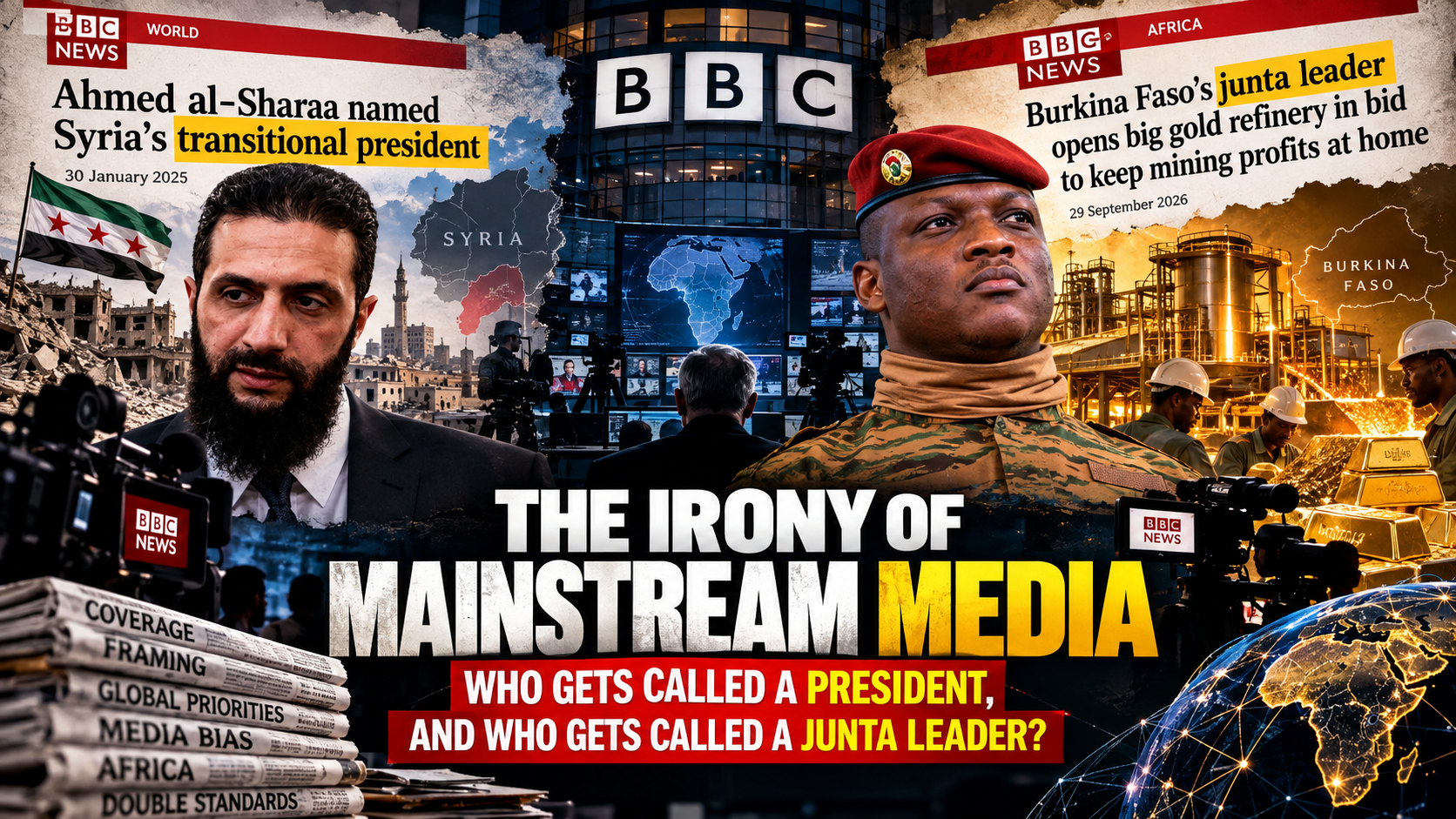
There is a revealing irony in the way mainstream international media describes political power across different parts of the world.
Two BBC News posts circulating online provide a useful case study.
One headline from January 2025 announced:
“Ahmed al-Sharaa named Syria’s transitional president.”
Another, published in September 2026, described Burkina Faso’s Ibrahim Traoré as:
“Burkina Faso’s junta leader.”
The two headlines concern very different countries and political circumstances, and they should not be treated as identical events. But the contrast raises an important question about the power of terminology in international journalism:
Who gets described primarily through an institutional title, and who gets described primarily through the circumstances under which they came to power?
Words Are Not Neutral
News headlines do more than communicate information.
They establish the frame through which readers encounter an event.
“Transitional president” emphasizes an office and a political transition.
“Junta leader” emphasizes military rule and the manner in which power was acquired.
Both descriptions can contain factual information. But they direct the audience’s attention toward different aspects of a political reality.

Ahmed al-Sharaa was declared Syria’s transitional president on January 29, 2025, following the overthrow of Bashar al-Assad. Reuters reported at the time that Syria’s constitution had been suspended and that Sharaa had been granted authority to establish a temporary legislative council. (Reuters)
Burkina Faso’s Ibrahim Traoré came to power through the September 2022 military coup and has subsequently governed through a military-led political system. BBC’s September 2026 reporting describes him as the country’s junta leader while reporting on his government’s effort to increase state control over mineral resources. (BBC)
The underlying histories are therefore different.
But the terminology remains worth examining.
The Politics of the Label
A headline can make a political actor appear primarily as a holder of an office, a revolutionary, a military ruler, a president, a strongman, or a transitional authority.
Those labels carry different associations.
A reader unfamiliar with the underlying history may receive a very different first impression depending on which characteristic appears in the headline.
This is particularly important in coverage of Africa and the Global South, where political transitions frequently involve military intervention, constitutional disputes, popular uprisings, foreign intervention and contested legitimacy.
The question for African readers should therefore not simply be:
“Is the headline factually correct?”
It should also be:
“What part of the political reality has the headline chosen to make most visible?”
Burkina Faso’s Gold Refinery
The BBC’s September 29, 2026 report focused on a significant economic development in Burkina Faso: the opening of the country’s first gold refinery in Ouagadougou.

The facility, known as Raffinor-BF, reportedly has an initial capacity of 164 tonnes of gold per year, with plans for capacity to eventually reach 515 tonnes. The project cost more than 11 billion CFA francs, approximately $19 million, according to the presidency. (BBC)
The refinery is part of Traoré’s government’s effort to process more of Burkina Faso’s mineral resources domestically rather than exporting raw materials for processing abroad.
The government has also increased state participation in the mining sector. BBC reported that foreign mining companies are now required to give the state a 15% stake in their operations and train local workers. (BBC)
This is economically significant beyond Burkina Faso.
Across West Africa, governments are increasingly examining how much value remains inside producing countries after minerals leave the ground. Ghana, Guinea, Mali and Côte d’Ivoire have also pursued policies aimed at increasing domestic processing or state participation in the mineral economy. (BBC)
Yet the headline foregrounds “junta leader”, while the economic story concerns one of the continent’s larger strategic questions:
Who controls Africa’s natural resources, where are they processed, and who captures the value?
Syria’s Transition
The Syria story presents a different political context.
When Ahmed al-Sharaa was declared transitional president in January 2025, Reuters described a sweeping restructuring of Syria’s political institutions following the overthrow of Assad.
The constitution was suspended, the former parliament and Baath Party were dissolved, and Sharaa was given authority to establish a temporary legislative council. (Reuters)
The transition itself subsequently became the subject of international scrutiny.
Reuters reported in February 2025 that Syria’s national dialogue process faced criticism over inclusivity, including the exclusion of important minority and Kurdish representatives. (Reuters)
Later reporting also examined Sharaa’s transformation from his earlier role as the leader of an Islamist armed movement into Syria’s new political leadership. (Reuters)
The point is not that one description is automatically correct and the other incorrect.
The point is that political language can compress complicated histories into a few words.
The View Count Creates Another Question
The screenshot circulating online also displays dramatically different view counts.
The January 2025 Syria post shows approximately 95,500 views, while the September 2026 Burkina Faso post shows approximately 1.9 million views.
Those numbers are interesting, but they should not be treated as proof that the BBC deliberately gave one story more importance.
Social-media view counts can be affected by timing, algorithms, audience interest, reposting, platform distribution and many other factors.
Nevertheless, the figures demonstrate something important about today’s information environment:
News organizations no longer completely control the life of a story after publication.
Audiences, algorithms and social networks participate in determining which stories travel.
The African Question
For African media consumers, the deeper issue is not whether Western media organizations should describe African military governments critically.
They should report the facts accurately, including coups, constitutional violations, armed conflict, restrictions on civil liberties and allegations of human-rights abuses where those facts are relevant.
But the same analytical standard should be applied across regions.
If the circumstances of a leader’s rise to power are important, they should be clearly explained.
If the leader subsequently becomes the internationally recognized head of a transitional government, that should also be explained.
And if a government launches a major economic project, the economic consequences deserve attention alongside the political controversy surrounding the government.
That is the difference between reporting a political label and reporting the political reality behind it.
Beyond “Junta” and “President”
The African media ecosystem increasingly needs journalism capable of moving beyond inherited geopolitical vocabulary.
Burkina Faso: Gold Production Growth
Mine gold production, 2020–2025
94 tonnes in 2025. The central economic question is how much of this
growing mineral value Burkina Faso can retain through domestic refining,
taxation, local processing and industrial development.
U.S. Geological Survey; Burkina Faso EITI; World Bank.
2025 figure is an estimate.
Instead of stopping at:
“junta leader opens refinery,”
a deeper African economic story asks:
- How much gold does Burkina Faso produce?
- How much was previously exported unprocessed?
- Who owns the mines?
- How much revenue does the state receive?
- How much value will domestic refining retain?
- Can the refinery operate at its proposed capacity?
- Will artisanal miners benefit?
- What happens to foreign mining companies?
- Can domestic processing create industrial jobs?
- What environmental and security challenges remain?
Those questions tell readers considerably more about Burkina Faso’s future than a single political label.
The same principle applies to Syria.
Rather than simply calling someone a “transitional president,” serious journalism must examine who controls the state, how institutions are being reconstructed, whether minority communities are represented, what constitutional arrangements are being created and whether promised political transitions actually occur.
The Real Irony
The irony is not necessarily that mainstream media uses one label for one leader and another label for another.
The deeper irony is that the headline can become more memorable than the facts underneath it.
Readers may remember “junta leader.”
They may remember “transitional president.”
But they may never learn about the refinery’s capacity, the structure of Burkina Faso’s mining sector, Syria’s constitutional transition or the institutional questions surrounding either government.
That is where African journalism has an opportunity.
The continent does not need media coverage that simply reverses the labels and turns every African government into a hero or every Western institution into an antagonist.
It needs journalism that asks harder questions.
Who controls the resources?
Who controls the institutions?
Who benefits from the economy?
Who gets to define legitimacy?
And who controls the narrative?
Those questions move the conversation beyond headlines.
And perhaps that is the most important lesson from the two BBC posts: the language used to describe power deserves almost as much scrutiny as power itself.
BBC News coverage of Burkina Faso’s gold refinery
Leave a Reply