
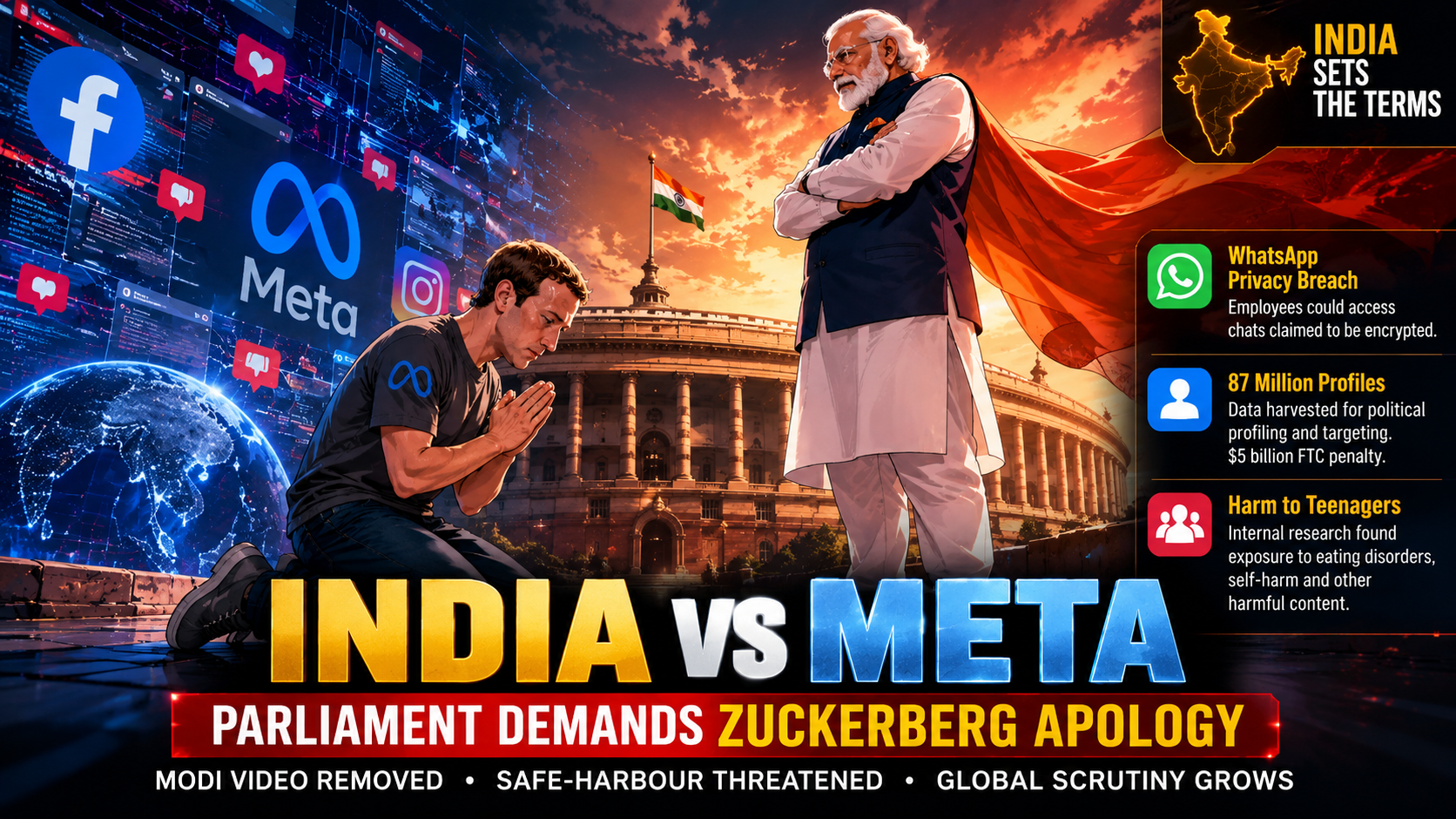
NEW DELHI — A temporary removal of a video featuring Indian Prime Minister Narendra Modi from Facebook has triggered a confrontation between India’s parliamentary technology committee and Meta, with lawmakers demanding a personal apology from Meta CEO Mark Zuckerberg and warning that the company could face consequences to its legal protections in the country.
The video, which addressed young Indians and issues surrounding examination paper leaks, was reportedly unavailable on Facebook for approximately five hours before being restored. Meta attributed the incident to an error in its systems. (India Today)
The incident quickly escalated beyond a routine content-moderation dispute.
Parliament Demands Personal Apology
India’s Parliamentary Standing Committee on Communications and Information Technology demanded that Zuckerberg personally apologise within three days over the temporary removal of Modi’s video.

The committee also called for action against those responsible for the incident. According to reporting on the committee’s letter, lawmakers considered Meta’s explanation insufficient and sought greater accountability from the company’s leadership. (The Indian Express)
The committee’s warning also raised the issue of safe-harbour protection under Section 79 of India’s Information Technology Act.
Safe-harbour provisions generally protect online intermediaries from being held directly liable for third-party content when specified legal conditions are met. Indian lawmakers warned that Meta could face the loss of that protection if the company did not comply with the committee’s demands. (Hindustan Times)
Meta Apologises — But Not Zuckerberg Personally
Within the controversy, Meta did issue an apology.
However, the apology was delivered by Joel Kaplan, Meta’s Chief Global Affairs Officer, who met Indian officials and apologised for what he described as an error in restricting Modi’s post.
That distinction matters because the parliamentary demand was specifically for an apology from Zuckerberg himself. Reports therefore should not describe the episode simply as Zuckerberg personally apologising unless further evidence establishes that he did so. (India Today)
Meta’s explanation was that the temporary restriction resulted from a technical or algorithmic error. The video was subsequently restored.
A Larger Debate Over Algorithmic Power
The dispute has become part of a much wider debate about how technology companies moderate political content and how much authority automated systems should have over information distributed to millions of people.
Social-media platforms increasingly rely on automated systems to identify potentially problematic material, enforce policies and determine what users see. When those systems incorrectly restrict legitimate content, questions arise about transparency, accountability and the ability of companies to correct errors quickly.
The India-Meta dispute illustrates the particular sensitivity of those issues when the affected material involves a sitting head of government.
At the same time, Meta’s position that the restriction was an error highlights another challenge: automated moderation systems operate at enormous scale, making mistakes possible even when platforms establish rules intended to protect users and political expression.
Meta’s Longer Privacy and Data Record
The current controversy is also being viewed against the backdrop of Meta’s much longer history of regulatory scrutiny.
In 2019, the U.S. Federal Trade Commission announced a $5 billion penalty against Facebook over allegations that the company violated a previous FTC privacy order and misled users about their ability to control their personal information. The FTC described the penalty as the largest of its kind at the time. (Federal Trade Commission)
The same regulatory episode involved allegations surrounding Cambridge Analytica and the collection of personal information from millions of Facebook users for purposes including voter profiling and targeting. The FTC separately brought action against Cambridge Analytica and associated individuals over deceptive methods used to obtain personal information. (Federal Trade Commission)
These cases helped establish privacy and data governance as major regulatory issues surrounding Facebook and, later, Meta.
Concerns About Young Users
Meta has also faced continuing scrutiny over the impact of Instagram and other platforms on younger users.

Research made public through litigation and whistleblower disclosures has examined issues including body image, eating-disorder-related material and other potentially harmful experiences for adolescents. A 2025 Reuters report on internal Meta research described greater exposure to “eating disorder adjacent” content among teens who reported dissatisfaction with their bodies, while noting that the research did not establish causation. (Reuters)
Meta has acknowledged concerns around sensitive content and has introduced additional restrictions for teenage users. The company says its policies are designed to reduce teenagers’ exposure to material involving suicide, self-harm and eating disorders. (Facebook)
In 2026, Meta also announced additional parental alerts related to searches for suicide and self-harm content on Instagram, expanding measures intended to help parents respond when teenagers may be experiencing distress. (Facebook)
India Tests the Limits of Platform Accountability
The dispute over Modi’s video therefore extends beyond one Facebook post.
At its core is a question increasingly being asked around the world: Who should be accountable when an algorithm makes a politically significant mistake?
Technology companies operate global platforms, but their services are subject to national laws and regulatory systems. Governments, meanwhile, must balance platform accountability with questions of free expression, due process and the independence of private technology companies.
India’s parliamentary committee has made clear that it expects major technology platforms to operate within the country’s legal framework.
For Meta, the episode represents another test of how its global content-moderation systems interact with the laws and political institutions of one of its largest markets.
The immediate video dispute was resolved when the post was restored and Meta issued an apology through its senior leadership. But the broader questions surrounding algorithmic moderation, safe-harbour protections, political content and corporate accountability remain part of the continuing India-Meta relationship.
The Bigger Picture
The India episode demonstrates how quickly a seemingly technical moderation error can become a major regulatory dispute when it involves political speech.
It also highlights the growing importance of transparency around automated decision-making. As Facebook, Instagram, WhatsApp and other platforms increasingly rely on algorithms and artificial intelligence to manage enormous volumes of content, governments and users alike are demanding clearer explanations when those systems make consequential mistakes.
For India, the controversy has become another test of how much responsibility global technology companies should bear when operating within the country’s digital ecosystem.
For Meta, it is another reminder that an algorithmic decision can have consequences far beyond the screen on which it occurs.
Editorial note for Panafrican.email: I would avoid the original post’s claims that Zuckerberg “crawled back,” that he personally apologised, or that Meta “took the money while algorithms absorbed the blame.” Those are rhetorical or interpretive claims rather than established facts. The documented sequence is stronger journalism: video restricted → Meta attributed it to an error → video restored → Meta executive Joel Kaplan apologised → parliamentary committee demanded Zuckerberg’s personal apology and raised the safe-harbour issue.
Leave a Reply