
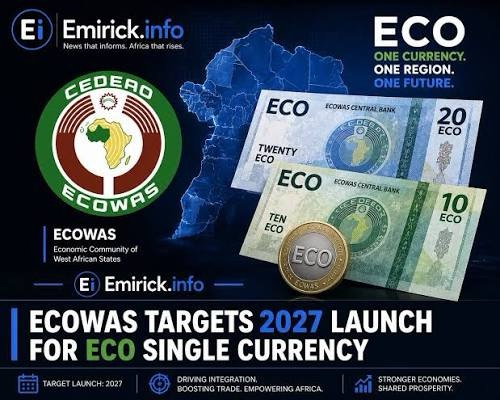
Abuja, Nigeria — The Economic Community of West African States (ECOWAS) has renewed its commitment to introducing the long-awaited Eco, a single regional currency, setting 2027 as the new target for its launch. The announcement was reaffirmed during the bloc’s latest summit, where regional leaders described the initiative as a critical milestone in advancing economic integration, boosting intra-African trade, and strengthening the region’s financial independence.
The Eco project has been in development for more than two decades and is widely regarded as one of ECOWAS’ most ambitious integration goals. If successfully implemented, the common currency would replace multiple national currencies across participating member states, making cross-border trade easier, reducing transaction costs, and promoting greater economic cooperation among West African nations.
Despite renewed optimism, the project has faced repeated delays over the years. Previous launch dates were postponed after many member states failed to meet the strict macroeconomic convergence criteria required for a monetary union. These benchmarks include maintaining low inflation, limiting budget deficits, ensuring stable exchange rates, and keeping public debt within agreed thresholds.
At the recent summit, ECOWAS leaders emphasized that the Eco remains central to the bloc’s vision of creating a more unified regional economy capable of competing in the global marketplace. They argued that a shared currency would facilitate trade, encourage investment, and support the objectives of the African Continental Free Trade Area (AfCFTA) by removing some of the financial barriers that currently hinder commerce across borders.
However, economists remain divided over whether the 2027 timeline is achievable. While some believe recent efforts to strengthen regional cooperation have created fresh momentum, others caution that significant economic disparities among member states continue to pose major challenges. Differences in inflation rates, fiscal discipline, economic structures, and monetary policies have long complicated efforts to establish a stable currency union.
Political instability and security concerns in parts of West Africa have also added uncertainty to the project. Recent changes in government in several ECOWAS member states, alongside varying economic performances across the region, have raised questions about whether all participating countries will be ready to adopt a common monetary framework within the proposed timeframe.
Supporters of the Eco argue that a successful launch could transform West Africa’s economic landscape by increasing regional trade, attracting foreign investment, simplifying cross-border payments, and reducing dependence on external currencies. They believe the currency could strengthen economic resilience and provide businesses with a more predictable financial environment.
Critics, however, warn that introducing a shared currency without sufficient economic convergence could expose weaker economies to financial shocks and limit governments’ ability to respond independently to domestic economic challenges.
As preparations continue, ECOWAS faces the difficult task of translating political commitment into practical implementation. The coming months are expected to be crucial as member states work toward meeting the required economic conditions and finalizing the institutional framework needed to support the Eco.
Whether the 2027 deadline becomes a historic turning point or another postponed milestone remains uncertain. For millions of West Africans, however, the success of the Eco could reshape the region’s economic future by fostering closer integration, expanding trade opportunities, and strengthening regional unity.