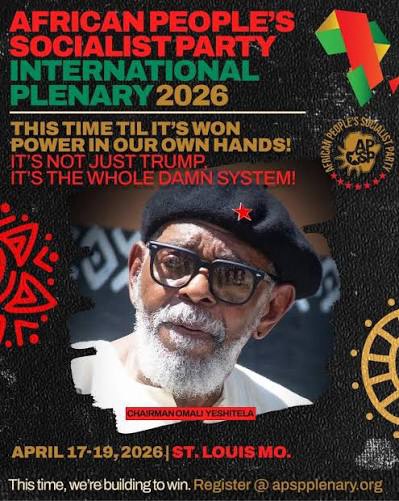
The Burning Spear TV_Chairman Omali Yeshitela delivers groundbreaking 2026 Political Report
Chairman Omali Yeshitela’s 2026 Political Report was officially broadcast on The Burning Spear TV, delivering a core anti-colonial analysis focused on African liberation, imperialist resistance, and the advancement of the Uhuru Movement. [1, 2]
Key Highlights of the Report
- Anti-Colonial Directives: The report provides the primary ideological framework for the African People’s Socialist Party (APSP), emphasizing that modern imperialist actions remain deeply rooted in historical colonial structures. [1, 2]
- Electoral Politics: Yeshitela outlines strategic methods to inject revolutionary anti-colonial politics into mainstream electoral arenas, referencing recent Uhuru movement campaigns. [1]
- Global Solidarity Networks: The presentation emphasizes building international unity against U.S.-led imperialism, demanding reparations, and connecting the struggles of African people with globally oppressed populations. [1, 2, 3]
- Building Dual Power: The address emphasizes organizing community-led economic and health infrastructure, such as the One Africa! One Nation! Uhuru Flea Marketplaces, to establish independent African community control. [1]
The full 34-minute broadcast and corresponding panel presentations are distributed across official Uhuru Movement platforms and media channels, including updates on The Burning Spear website. [1, 2]
• Yeshitela, chairman of the African People’s Socialist Party since its 1972 founding, uses the report to outline the Uhuru Movement’s strategy for African liberation, anti-colonial resistance, and building dual power.
• The account’s thread promotes related resources from Burning Spear media, including articles framing current imperialism as rooted in historical attacks on Africa and a PDF on African Internationalism.
Learn about the African People’s Socialist Party history
Thoughts
The African People’s Socialist Party (APSP) is a communist, African internationalist political party in the United States, founded in May 1972 (on African Liberation Day). It leads the broader Uhuru Movement (“Uhuru” meaning “freedom” in Swahili). The party describes itself as the “advanced detachment of the African working class” and aims to complete the unfinished Black Power/Black Liberation struggles of the 1960s, achieve African self-determination, reparations, and ultimately the total liberation and socialist unification of Africa and African people worldwide under working-class leadership.
Omali Yeshitela (born Joseph Waller in 1941 in St. Petersburg, Florida) has served as chairman and central leader since its founding. He remains the most prominent figure.
Origins and Founding (1960s–1972)Yeshitela’s activism began in the Civil Rights and emerging Black Power era:
• He was influenced by events like the 1955 Emmett Till lynching.
• He served in the U.S. Army (1959–1963), where he encountered racism and learned about African anti-colonial struggles.
• In the mid-1960s, he worked with SNCC (Student Nonviolent Coordinating Committee), CORE, and community organizing in Florida.
• In 1966, he gained national attention by tearing down a racist mural at St. Petersburg City Hall (the wall remains blank today), leading to a prison sentence. While imprisoned, he organized further.
In 1968, amid the assassinations of Martin Luther King Jr. and Black Panther Bobby Hutton, and during local strikes, Yeshitela founded the Junta of Militant Organizations (JOMO) in St. Petersburg—a Black Power group modeled partly on the Black Panthers, focused on community defense, protests against police brutality and discrimination, and connections to African liberation struggles (e.g., Mau Mau in Kenya). JOMO launched The Burning Spear (now the party’s official newspaper, the longest-running Black Power-era publication).
In May 1972, APSP was formed by merging three Florida-based Black Power organizations:
• JOMO (the largest and most experienced, led by Yeshitela)
• Black Rights Fighters (from Fort Myers, led by Lawrence Mann; focused on migrant farm workers)
• Black Study Group (from Gainesville, led by Katura Carey; student/intellectual-oriented)
The explicit goal was to “complete the Black Revolution of the 1960s,” which the party argues was militarily defeated by U.S. government counterinsurgency (COINTELPRO, assassinations, raids, etc.). The party adopted The Burning Spear as its organ and shifted emphasis toward Pan-Africanism and building a revolutionary vanguard party.
Leave a Reply