
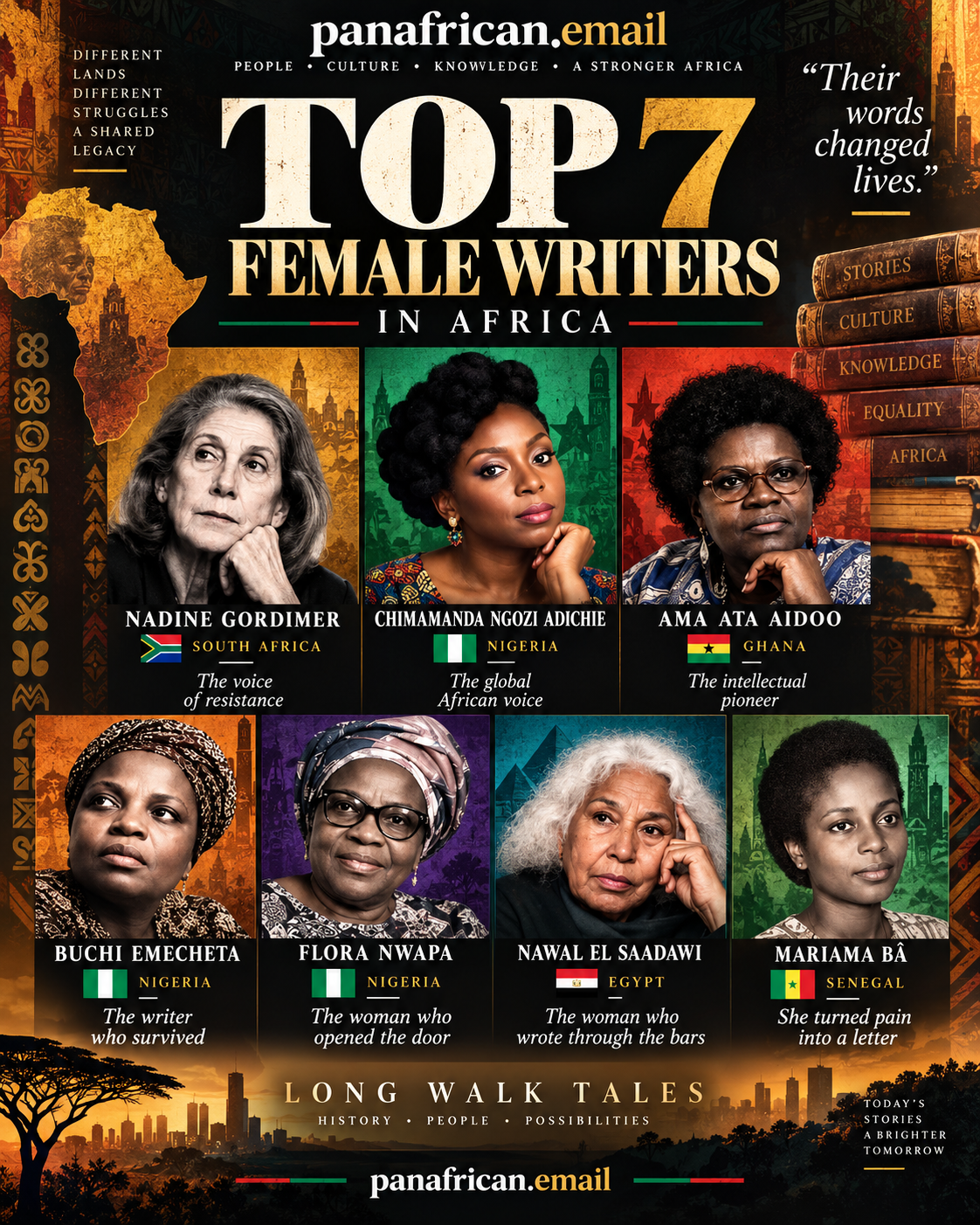
Top 7
Female Writers in Africa
Seven women. Seven countries, histories and literary traditions.
Their words challenged power, documented memory, confronted injustice
and expanded the possibilities of African literature.

The continent has always had stories.
These women changed who was allowed to tell them.
African literature is not a single tradition. It is a conversation
across languages, borders, generations and political systems.
From apartheid South Africa to postcolonial Nigeria, from Ghana and
Senegal to Egypt, the women featured here transformed personal
experience into literature that could speak to an entire continent
and to the world.
Their writing explored colonialism, patriarchy, race, migration,
motherhood, war, sexuality, political repression, identity and the
complicated relationship between Africa and the wider world.
Seven Literary Voices
Different countries. Different generations. Different struggles.
One extraordinary literary legacy.

Nadine Gordimer
Nadine Gordimer became one of the most important literary voices
to confront apartheid and its effects on South African society.
Her fiction examined race, power, political repression and the
moral compromises created by an unjust system.
Her writing demonstrated how the novel could become a form of
witness — recording a society while simultaneously challenging it.
July’s People
Burger’s Daughter
My Son’s Story

Chimamanda Ngozi Adichie
Chimamanda Ngozi Adichie is one of the most internationally
influential contemporary African writers. Her fiction explores
Nigeria, migration, race, gender, love, war and the complex
identities created between Africa and the diaspora.
Her work has helped bring contemporary African experiences into
global literary conversations without reducing Africa to a single story.
Purple Hibiscus
Half of a Yellow Sun
Americanah

Ama Ata Aidoo
Ama Ata Aidoo was a pioneering Ghanaian writer whose work
challenged conventional ideas about African women, colonialism,
independence, marriage and social expectations.
She insisted that African women were not merely subjects within
literature but intellectuals, narrators and architects of their
own histories.
Changes
Our Sister Killjoy
Anowa

Buchi Emecheta
Buchi Emecheta wrote powerfully about women’s lives, motherhood,
migration, poverty, family and the struggle for independence.
Her Nigerian and diasporic experiences became central to a body
of work that questioned the structures limiting women’s choices.
Her novels gave literary visibility to women whose struggles were
often ignored by both colonial narratives and traditional social structures.
The Joys of Motherhood
Second-Class Citizen
In the Ditch

Flora Nwapa
Flora Nwapa is widely regarded as one of the pioneering women of
modern African literature. Her fiction centered African women as
complex protagonists rather than supporting characters in stories
dominated by men.
Her writing examined marriage, economics, independence, community
and the social expectations surrounding Nigerian women.
Efuru
Idu
One Is Enough

Nawal El Saadawi
Nawal El Saadawi was an Egyptian physician, novelist and feminist
thinker whose writing confronted patriarchy, political authority,
religious institutions and the control of women’s bodies.
Her willingness to write about subjects considered taboo made her
one of the most controversial and influential intellectual voices
in the modern Arab and African worlds.
Woman at Point Zero
God Dies by the Nile
Memoirs of a Woman Doctor

Mariama Bâ
Mariama Bâ transformed intimate experiences of marriage, grief,
friendship and gender inequality into literature of extraordinary
emotional and political power.
Her work gave readers an intimate view of Senegalese women’s lives
while questioning traditions that could restrict women’s autonomy.
So Long a Letter
Scarlet Song
They turned literature into a form of resistance.
These writers did more than produce books. They created records of
societies undergoing enormous political and cultural transformation.
Their characters questioned inherited power. Their narrators
challenged official histories. Their stories made private
experiences political.
And their work helped establish a space where African women could
describe Africa from their own intellectual, emotional and cultural
perspectives.
She was writing herself into history.
From apartheid to colonialism, from migration to marriage, from
political repression to questions of identity, these writers made
literature a place where Africa could speak in its own voice.
Their Recurring Questions
Identity
Who are we after colonialism, migration and cultural transformation?
Freedom
What does liberation mean when political independence does not
automatically produce personal freedom?
Womanhood
How can women define themselves beyond the expectations imposed by
family, society and institutions?
Memory
Who controls the historical record — and what happens when ordinary
people begin telling their own stories?
A Literary Continuum
Flora Nwapa
Opened important space for African women as central literary voices
in the postcolonial era.
Ama Ata Aidoo & Buchi Emecheta
Expanded the conversation around gender, independence, marriage,
migration and African women’s intellectual lives.
Nadine Gordimer & Nawal El Saadawi
Used literature as an instrument for confronting political systems,
patriarchy and repression.
Mariama Bâ
Demonstrated how intimate correspondence and women’s personal
experiences could become powerful social commentary.
Chimamanda Ngozi Adichie
Carries the conversation into a globalized African literary era,
connecting Nigeria, Africa and the diaspora.
Words change lives.
Stories change worlds.
The legacy of African women writers is not confined to literature.
It lives in classrooms, movements, families, political conversations,
cultural memory and the imagination of generations yet to come.
Different lands. Different struggles. A shared legacy.

A Voice Worth Remembering
Alongside the seven writers featured in this collection are other
African women whose literary contributions deserve recognition.
Their work forms part of the wider intellectual and cultural
tradition that continues to shape African literature.
This honorable mention recognizes another important voice whose work
belongs within the continuing conversation about African women,
literature, identity, memory and cultural expression.
Women · Words · Worlds
Leave a Reply