
Panafrican Intelligence Brief | Social Policy & Child Protection
Executive Assessment
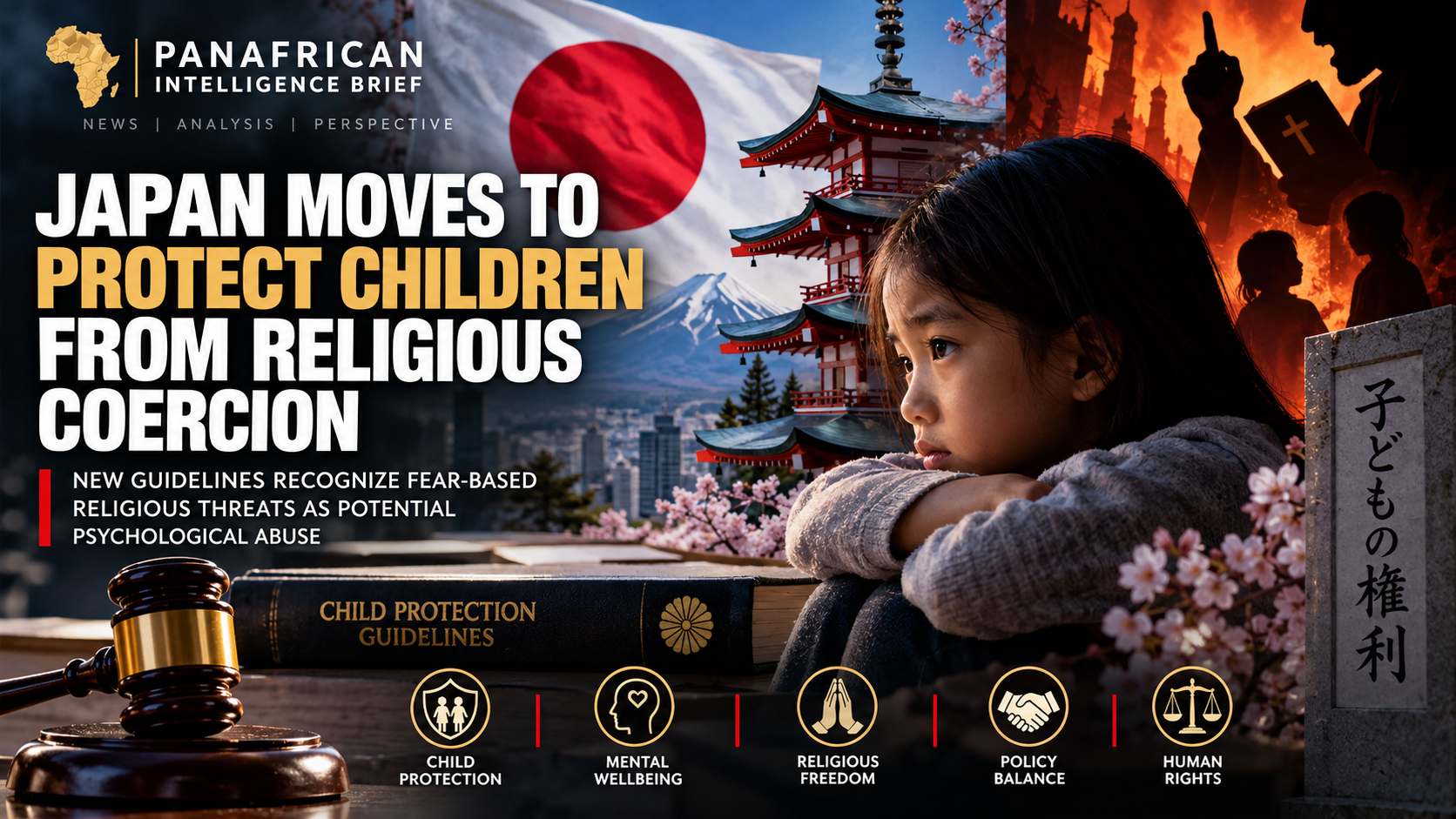
Japan has taken a significant step toward addressing psychological abuse associated with religious coercion, establishing guidance that recognizes certain fear-based religious practices directed at children as potential psychological abuse.
Introduced in December 2022, Japan’s child-abuse guidance specifically addresses situations in which children may be subjected to threats involving hell, divine punishment, curses, or other religious consequences in an effort to frighten, control, or manipulate their behavior.
The policy does not prohibit parents or religious institutions from teaching children about religion, heaven, hell, religious doctrine, or spiritual beliefs. Instead, the distinction centers on how those beliefs are used: religious instruction remains protected, while coercive practices that cause psychological harm may fall within the scope of child abuse.
For policymakers, educators, religious organizations, and child-protection institutions, Japan’s approach provides an important case study in balancing freedom of religion with the psychological protection of minors.
1. The Intelligence Signal
Japan: Religious Affiliation & Importance
Share of Japanese adults identifying with a religion compared with those who say religion is very important in their lives.
The central policy signal is Japan’s recognition that psychological abuse does not necessarily require physical violence.
A child can potentially experience serious emotional harm through repeated intimidation, threats, humiliation, isolation, or coercive control.
In religious settings, the concern arises when spiritual concepts are deliberately transformed into instruments of fear.
Examples can include repeatedly telling a child that disobedience will result in eternal punishment, divine retaliation, curses, spiritual destruction, or other catastrophic consequences in order to compel obedience.
The distinction is therefore between teaching a belief and using fear surrounding that belief as a mechanism of psychological control.
2. What Japan Changed
Japan’s December 2022 guidance emerged amid growing public concern about children exposed to coercive religious environments.
The guidance sought to clarify circumstances in which conduct associated with religious practices could constitute psychological abuse.
The underlying principle is significant:
Religious belief does not automatically excuse conduct that causes psychological harm to a child.
At the same time, the policy does not establish a general prohibition against religious education.
Japan: Constitutional Religious Freedom
Key religious-freedom protections established under Article 20 of the
Constitution of Japan.
Parents may continue to introduce children to their religious traditions. Religious communities may continue teaching doctrine. Children may continue learning about concepts such as heaven, hell, morality, sin, salvation, ancestors, spirits, or divine judgment.
The concern is the coercive use of those concepts against minors.
3. Religion Versus Psychological Coercion
This distinction is critical.
A child being taught that a particular religion believes in heaven or hell is fundamentally different from a child being repeatedly threatened with hell specifically to create fear and force compliance.
Likewise, explaining a religious doctrine differs from using spiritual threats to isolate a child, prevent them from seeking help, force participation in religious activities, or punish ordinary childhood behavior.
Japan’s framework therefore raises a broader policy question:
At what point does religious instruction become psychological coercion?
That question has implications far beyond Japan.
4. Why Children Are Particularly Vulnerable
Children generally depend on adults for security, identity, education, housing, food, and emotional support.
Consequently, threats involving supernatural punishment can carry a different psychological weight for a child than they might for an independent adult.
Repeated messages that a child is destined for eternal punishment, divine destruction, spiritual contamination, or supernatural retaliation can potentially create persistent fear and anxiety.
The risk becomes more significant when fear is combined with:
- isolation from people outside the religious community;
- forced participation in religious activities;
- punishment for questioning religious teachings;
- threats against family relationships;
- restrictions on education or social interaction;
- repeated humiliation or intimidation;
- claims that leaving or questioning the faith will result in catastrophic consequences.
The policy concern is therefore not religion itself but coercive psychological conditioning.
5. Mental-Health Dimension
The issue also intersects with the broader field of childhood psychological development.
Persistent fear-based environments can contribute to emotional distress and anxiety, particularly when children are repeatedly told that ordinary mistakes or acts of independence will produce catastrophic spiritual consequences.
The long-term impact can vary significantly between individuals. Religious belief itself should not be equated with psychological harm.
The relevant risk factor is the pattern of coercion, intimidation, and fear.
This distinction is essential for policymakers because overly broad definitions could unnecessarily interfere with legitimate religious expression, while definitions that are too narrow could fail to protect vulnerable children.
6. Strategic Policy Balance
Japan’s approach illustrates a difficult three-way policy balance:
1. Religious freedom
Individuals and families retain the ability to practice and transmit religious beliefs.
2. Parental and institutional authority
Parents and religious communities retain important roles in raising and educating children.
3. Child protection
Those rights do not necessarily extend to practices that cause serious psychological harm or use coercion to control minors.
The resulting policy challenge is establishing objective indicators for distinguishing legitimate religious education from abusive psychological manipulation.
7. African Policy Relevance
The Japanese development deserves attention across Africa because religious institutions play major social, educational, charitable, and cultural roles across the continent.
Christian, Muslim, traditional African, and other religious communities often participate directly in children’s education and social development.
That makes the question of religious freedom versus child protection particularly important.
African policymakers should avoid importing foreign regulatory models without considering local cultural and constitutional contexts. However, Japan’s experience can provide a useful comparative framework for examining how child-protection systems respond when religious authority intersects with psychological coercion.
The broader principle is applicable across jurisdictions:
Children should be able to receive religious education without being subjected to psychological intimidation or coercive control.
8. Intelligence Assessment
Assessment: Japan’s 2022 guidance represents an important evolution in the way governments conceptualize child abuse.
The development signals a movement away from defining abuse exclusively through physical injury and toward greater recognition of psychological coercion and emotional control.
Its significance lies in the distinction between belief and behavior.
The state is not required to determine whether a particular religious belief is true or false. Instead, the regulatory question becomes whether adults are using that belief as a mechanism to intimidate, manipulate, or psychologically harm a child.
That distinction could become increasingly important as governments worldwide confront questions surrounding children’s rights, parental authority, religious freedom, education, and psychological wellbeing.
Bottom Line
Japan’s policy does not amount to a ban on teaching children about religion, heaven, hell, divine judgment, or spiritual beliefs.
Its focus is narrower and more consequential: protecting minors when religious concepts are allegedly weaponized through fear, intimidation, or coercive psychological control.
For Africa, the development offers a useful comparative case study in how governments can attempt to protect children while preserving legitimate religious freedom.
The emerging policy question is not simply what children are taught to believe, but whether fear is being deliberately used to control them.
Panafrican Intelligence Assessment:
The Japanese model warrants continued monitoring as an international reference point for the developing intersection of child protection, religious freedom, psychological abuse, and institutional accountability.
Leave a Reply