
Panafrican Intelligence Brief | Uganda | Politics & Religion
STATUS: Unverified
INTELLIGENCE LEVEL: Low
SOURCE: Monitor
CATEGORY: Politics
REGION: Uganda
Executive Assessment
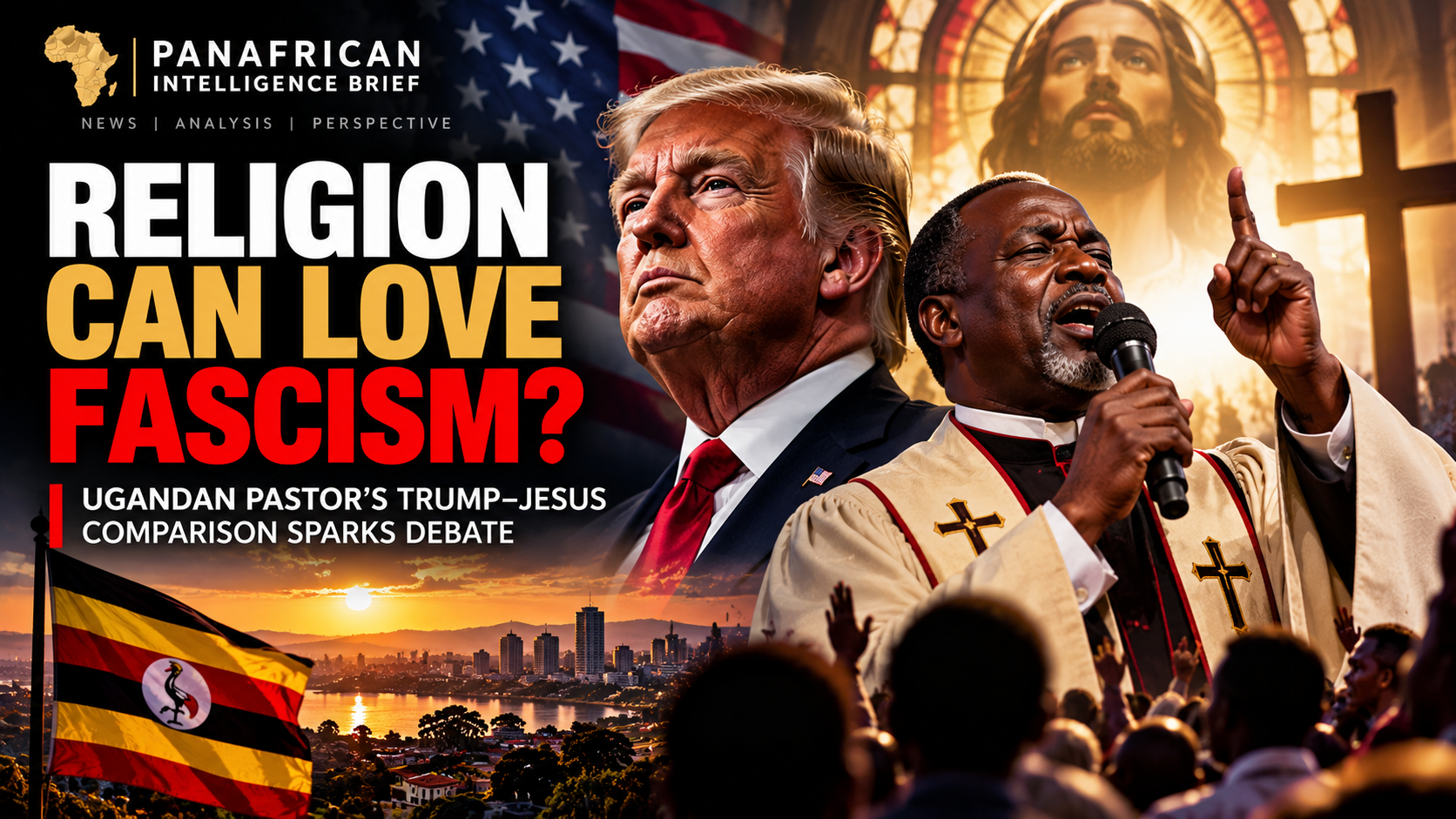
A reported statement by a Ugandan pastor comparing Donald Trump to Jesus has generated controversy and raises a broader question about the relationship between religious authority, political leadership, and ideological movements.
The report remains unverified. Panafrican Intelligence has not independently established the full context of the pastor’s remarks, including whether the comparison was intended literally, rhetorically, symbolically, or as political commentary.
Nevertheless, the reported statement represents a potentially significant example of the increasingly blurred boundary between religious messaging and political identity.
The central intelligence question is therefore not simply whether a pastor compared Trump with Jesus, but how religious language is being used to construct political legitimacy and loyalty.
The Intelligence Signal
The reported controversy centers on an alleged comparison between Trump and Jesus by a pastor in Uganda.
Such comparisons can carry considerable political and religious significance because Jesus represents a central sacred figure for Christians, while Trump has become a highly polarizing political figure whose international influence extends well beyond the United States.
When political leaders are described using religious imagery, political support can acquire a theological dimension.
Instead of being framed solely around policies, elections, economic interests, or governance, political allegiance can become associated with concepts such as faith, morality, divine purpose, spiritual warfare, or religious destiny.
That transformation deserves attention from political and social analysts.
Religion and Political Mobilization
Religious institutions possess considerable influence in many African societies.
Pastors, bishops, imams, traditional authorities, and other religious leaders can shape public conversations on morality, leadership, family, economics, national identity, and political responsibility.
That influence can become particularly powerful when political figures are presented through religious narratives.
The danger is not religious participation in politics itself. Religious communities have legitimate interests in public policy and democratic life.
The concern emerges when political loyalty becomes indistinguishable from religious loyalty.
If disagreement with a political leader is portrayed as opposition to God, faith, or religious truth, political debate can become substantially more difficult.
The Fascism Question
The intelligence report carries the provocative headline “Religion can love fascism.”
That phrase should be treated as an analytical proposition rather than a conclusion about Uganda, Christianity, or any particular religious community.
Historically, religious movements and authoritarian political movements have sometimes formed alliances when their interests overlap. Political movements can seek religious legitimacy, while religious organizations may seek political protection, influence, or access to state power.
This does not mean that religion inherently produces authoritarianism.
Nor does support for a particular politician automatically constitute support for fascism.
The analytical issue is the mechanism of political-religious alignment: how sacred authority, charismatic leadership, nationalism, political grievance, and institutional power can reinforce one another.

Why the Trump–Jesus Comparison Matters
Trump’s political movement has developed a significant relationship with sections of American evangelical Christianity.
Consequently, a religious leader outside the United States invoking Jesus while comparing him with Trump could indicate the international circulation of political-religious narratives originating in American politics.
For African audiences, this raises questions about the transmission of political ideology through:
- international religious networks;
- social media;
- American evangelical movements;
- political influencers;
- diaspora communities;
- Christian broadcasting networks;
- transnational conferences and ministries.
Uganda is therefore potentially relevant not simply because of the reported statement, but because it illustrates how American political symbolism can enter African religious discourse.
Intelligence Gaps
Because the original report is classified as LOW confidence and UNVERIFIED, several questions remain open:
Who made the statement?
The available intelligence does not establish the pastor’s identity.
What exactly was said?
The precise quotation and surrounding remarks have not been independently verified.
What was the context?
The comparison may have occurred during a sermon, political event, interview, social-media broadcast, or another setting.
Was the comparison theological or political?
Without the complete statement, the intended meaning cannot be established.
What was the audience response?
The available intelligence does not establish whether the remarks represented a wider movement or an individual expression.
These gaps prevent the report from being treated as confirmed evidence of a broader Ugandan political trend.
Panafrican Intelligence Assessment
Confidence: LOW
The available information is insufficient to conclude that Uganda is experiencing a broader movement toward religious endorsement of authoritarian or fascist politics.
However, the reported episode warrants monitoring because it touches three strategically important areas:
1. Religious political influence
Religious leaders can significantly influence political perceptions and voter behavior.
2. Transnational ideological circulation
Political narratives originating in the United States increasingly circulate through global religious and digital networks.
3. Sacralization of political leadership
When political figures are described using sacred imagery, political allegiance can become emotionally and morally reinforced.
The appropriate analytical position is therefore observation rather than conclusion.
Bottom Line
The reported comparison of Donald Trump with Jesus by a Ugandan pastor remains unverified and should not be treated as established fact.
But the controversy highlights a larger phenomenon worth watching: the intersection of religious authority, charismatic political leadership, nationalism, and transnational ideology.
For Panafrican intelligence analysis, the important question is not whether Christianity, Islam, or any other religion “supports fascism.”
The more useful question is:
Under what circumstances can religious institutions, political movements, and charismatic leaders reinforce one another—and what happens when political loyalty begins to acquire the authority of religious belief?
That is the intelligence signal worth monitoring across Uganda and the wider African political landscape.
Leave a Reply