
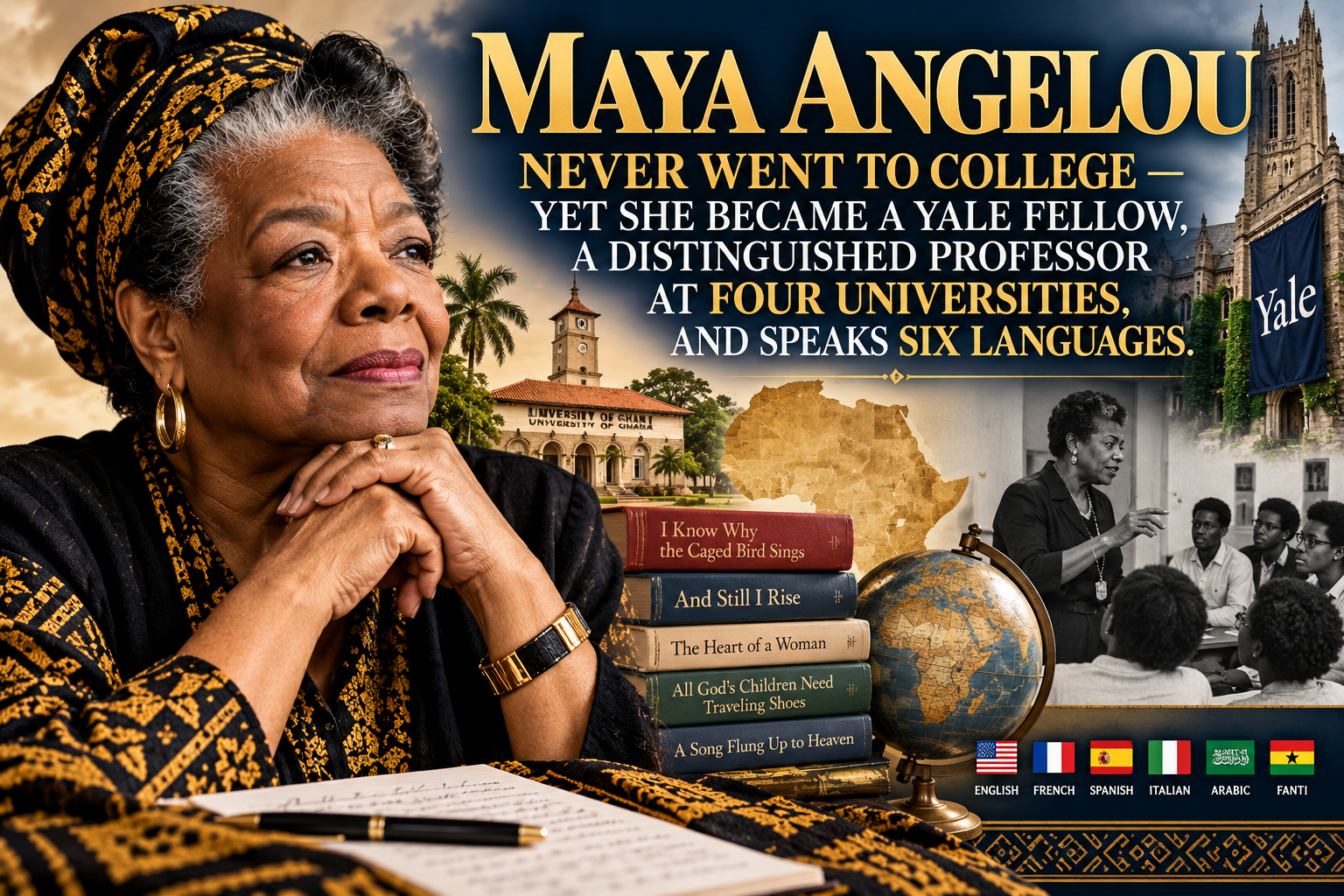
Maya Angelou never completed college. Yet she became a university professor, a celebrated author, an internationally recognized poet, a civil-rights activist, and a recipient of more than 30 honorary degrees.
That fact alone makes her educational journey extraordinary.
In an age when academic credentials are often treated as the gateway to intellectual authority, Angelou’s life offers a different lesson: education can happen in classrooms, but it can also happen through experience, reading, travel, work, struggle, observation and an extraordinary commitment to learning.
Her story was not one of rejecting education. Quite the opposite.
Maya Angelou was a lifelong student.
She Did Not Follow the Conventional Academic Path
Born Marguerite Annie Johnson in St. Louis in 1928, Angelou attended George Washington High School in San Francisco. She also studied dance and drama at the California Labor School. But she never attended a traditional four-year college or earned a conventional university degree. (Poetry Foundation)
Her formal education, however, was only one part of her intellectual development.
She read extensively, traveled internationally, worked in journalism, studied languages, participated in political movements, performed on stage, wrote for newspapers and eventually became one of the most influential literary voices of the twentieth century.
Her life became her university.
The Education of Experience
Angelou’s résumé reads almost like the biography of several different people.
She worked as a streetcar conductor in San Francisco. She became a dancer, singer and actress. She toured internationally with Porgy and Bess. She worked as a journalist in Egypt and Ghana. She became involved with the civil-rights movement and worked alongside figures including Martin Luther King Jr. and Malcolm X.
When she lived in Ghana during the early 1960s, she became part of the intellectual and political community surrounding African independence. She worked with the University of Ghana’s School of Music and Drama and wrote for Ghanaian publications. (NCPedia)
That experience mattered enormously.
Angelou was not simply collecting jobs.
She was collecting perspectives.
Africa Changed Her Intellectual World
Her years in Ghana were particularly important.
For an African American intellectual living in newly independent Ghana, Africa offered an opportunity to reconsider identity outside the racial structures of the United States.
She encountered African intellectuals, students, artists and political activists while living in Accra. She also developed relationships with other members of the African diaspora.
Her time in Ghana helped expand her understanding of African identity, colonialism, race, culture and the global Black experience.
Angelou later brought those experiences into her writing and teaching.
This is one reason her intellectual biography cannot be measured simply by asking which university she attended.
She learned from Africa, America, literature, politics, theater, journalism and life itself.
She Became a University Professor
Perhaps the most remarkable part of the story is what happened later.
In 1982, Wake Forest University appointed Angelou as its Reynolds Professor of American Studies. She became the university’s first Reynolds Professor of American Studies and remained associated with Wake Forest for the rest of her life. (American Academy of Arts and Sciences)
She taught courses dealing with subjects including race, politics, literature, African culture, the American South, poetry and Shakespeare.
Wake Forest students were therefore not merely listening to a famous poet.
They were studying with someone whose life had crossed continents, cultures and professions.
Angelou herself described the relationship in an illuminating way: she said she discovered her passion for teaching at Wake Forest and characterized herself as a teacher who writes. (Remembering Dr. Maya Angelou)
The “Four Universities” Claim Needs Context
A popular version of the story says that Angelou became a “distinguished professor at four universities.”
The underlying idea has some truth, but the wording is too loose.
Archival records from the New York Public Library show that Angelou held teaching appointments at several institutions beyond Wake Forest. These included a distinguished visiting professorship at California State University, Sacramento; a distinguished visiting professorship at Radford University; and a distinguished visiting professorship at the University of Exeter. Her primary academic home was Wake Forest University. (NYPL Archives)
So the more accurate lesson is even more interesting:
A woman without a conventional college degree eventually taught at major universities on both sides of the Atlantic.
She Became “Dr. Angelou” Through Honorary Degrees
Another important distinction concerns her title.
Angelou was frequently called Dr. Maya Angelou, but she did not earn a traditional doctoral degree through graduate study.
Universities honored her with honorary degrees because of her extraordinary contributions to literature, culture, education and public life.
By 2007, the University of Minnesota recorded that Angelou had received 33 honorary degrees. (University Awards)
Other sources have counted even more honorary degrees over the course of her life.
This distinction matters.
An honorary degree does not mean that someone completed a doctoral program. It means that a university has chosen to honor an individual’s achievements by conferring an academic degree honoris causa.
Angelou’s honorary degrees therefore represented recognition of accomplishments she had already achieved.
What About Yale?
The claim that Maya Angelou was a “Yale fellow” is much harder to substantiate and should not be repeated as established fact.
Yale maintains historical records of its honorary-degree recipients, and its official materials distinguish honorary degrees from Yale Corporation fellowships and other university appointments. The reliable biographical sources reviewed for Angelou document her numerous honorary degrees and her professorship at Wake Forest, but they do not establish that she was a Yale fellow. (University Life Office)
This is an important example of how inspirational internet biographies can gradually combine several true facts into one statement that is partly inaccurate.
The truth is already powerful enough.
Maya Angelou did not need a Yale fellowship to make her story extraordinary.
She Really Did Become Fluent in Multiple Languages
The language portion of the viral claim is considerably better supported.
During her years abroad, particularly in Egypt and Ghana, Angelou studied languages and became fluent in French, Spanish, Italian, Arabic and Fanti, a West African language. Along with English, this is commonly described as six languages. (NCPedia)
That accomplishment is especially striking because language learning was not simply an academic exercise for Angelou.
Language became a way of entering other cultures.
It allowed her to communicate across national and cultural boundaries and reinforced something that appears repeatedly throughout her life: curiosity was one of her greatest intellectual tools.
Her Most Important Classroom Was the World
Angelou’s life challenges a narrow definition of education.
A classroom can provide knowledge.
But experience can provide context.
Travel can provide perspective.
Reading can provide generations of accumulated thought.
Conversation can provide wisdom.
Failure can provide discipline.
Work can provide practical knowledge.
And adversity can force a person to develop intellectual and emotional resources that cannot always be taught in a lecture hall.
Angelou experienced all of these forms of education.
She became an author after years of living.
She became a teacher after years of learning.
She became a professor after establishing herself as a writer, thinker and public intellectual.
From Silence to One of America’s Most Powerful Voices
There is an even deeper dimension to Angelou’s educational journey.
As a child, Angelou experienced severe trauma and became mute for years. Literature and language eventually became central to her recovery and intellectual development.
The woman who once stopped speaking ultimately became famous for the extraordinary power of her voice.
She published I Know Why the Caged Bird Sings in 1969, a memoir that became one of the defining works of American literature.
She wrote poetry, essays, autobiographies, screenplays and children’s books.
She directed films.
She performed.
She taught.
And in 1993, she stood before the world at President Bill Clinton’s inauguration and delivered “On the Pulse of Morning.”
A woman who had once struggled to speak had become one of America’s most recognizable public voices.
Her Greatest Achievement Was Not a Degree
Degrees can demonstrate that someone successfully completed a particular course of study.
They are valuable.
But Angelou’s story demonstrates that credentials and education are not identical concepts.
Her life demonstrates the value of self-education.
She read.
She traveled.
She listened.
She studied languages.
She worked among people from different cultures.
She participated in political movements.
She wrote.
She taught.
And she continuously transformed experience into knowledge.
Her academic career eventually reflected what she had already built through decades of intellectual labor.
The Real Lesson for Young Africans
For young Africans—and especially for people building careers outside conventional institutions—Angelou’s story carries a powerful message.
Education should not stop when formal schooling stops.
If you cannot immediately enter a university, you can still read.
If you cannot afford a library, you can seek legitimate digital resources.
If you cannot travel internationally, you can study the histories and cultures of other societies.
If you do not have an academic title, you can still become knowledgeable.
And if you eventually enter a university, your education should not end when you graduate.
The world remains the classroom.
Angelou’s journey also demonstrates the power of African and diasporic intellectual exchange. Her years in Ghana were not a footnote to her American career. They formed part of the intellectual journey that helped her understand herself and the wider Black world.
Beyond the Viral Quote
The popular statement about Maya Angelou is attractive because it compresses an extraordinary life into one sentence:
She never went to college, yet she became a professor and mastered multiple languages.
But the complete story is more powerful.
She did not become successful because education was unnecessary.
She became extraordinary because she pursued education in many forms.
She learned before she taught.
She read before she wrote.
She traveled before she became a global voice.
She experienced before she interpreted.
And when universities eventually gave her honorary degrees and academic appointments, those institutions were recognizing a lifetime of intellectual achievement.
The Real Maya Angelou Lesson
The lesson is not that college does not matter.
The lesson is that college is one pathway to education—not the only pathway.
Maya Angelou’s life demonstrates what can happen when curiosity becomes a lifelong discipline.
She entered adulthood without a university degree.
She left behind books that became part of the literary canon, students who remembered her teaching, honorary degrees from universities across the United States, international recognition, and a body of work that continues to influence readers around the world. (University Awards)
Her credentials came later.
Her education came first.
And perhaps that is the most important distinction of all.
Maya Angelou did not become a great thinker because a university gave her permission to think.
She became a great thinker—and eventually universities came to recognize what she had already become.
Leave a Reply