
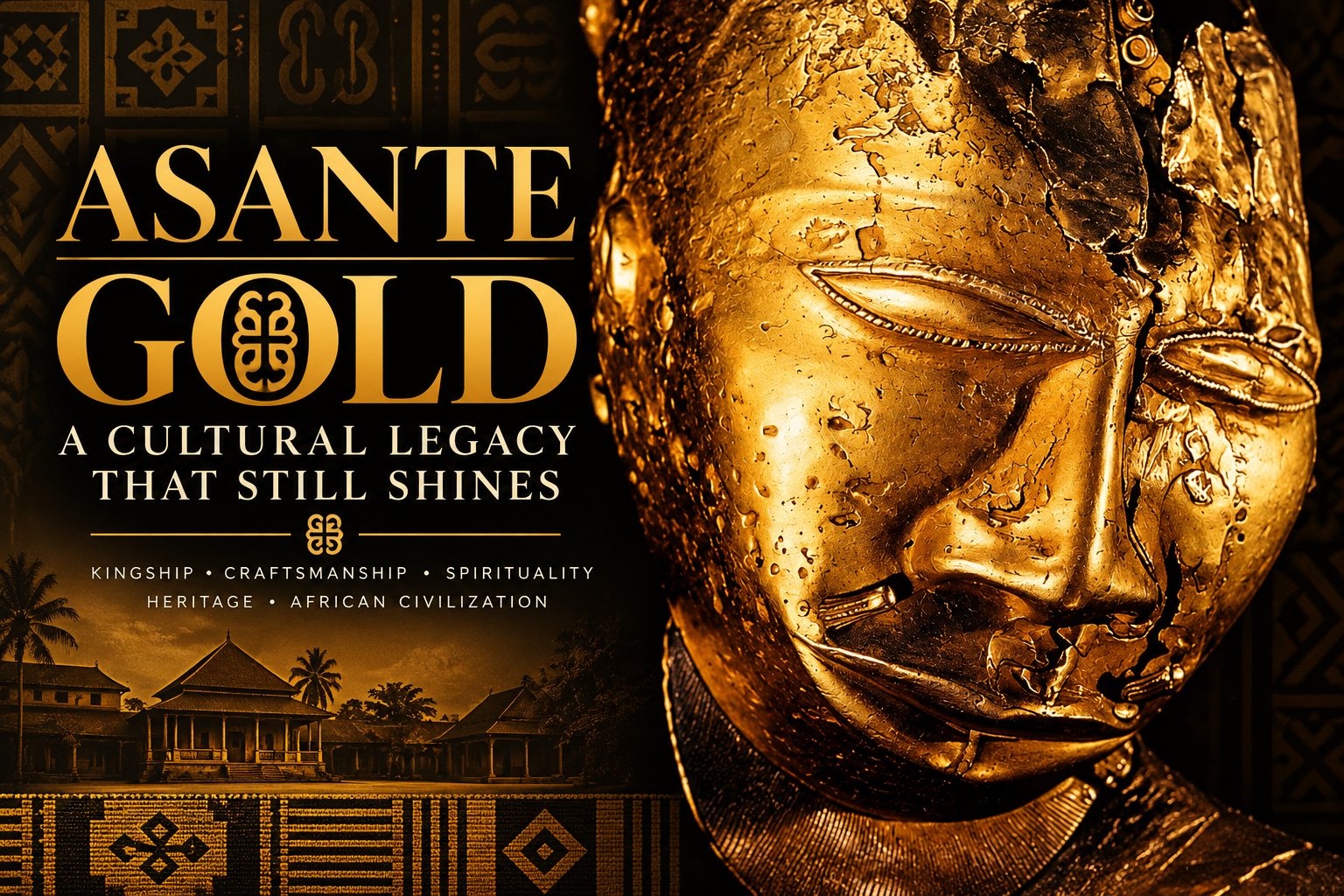
Gold has long occupied a position of extraordinary importance in the history of West Africa. Nowhere is this relationship more visually powerful than in the artistic traditions of the Asante Kingdom, where gold became far more than a measure of wealth. It became a language of authority, spirituality, ancestry, diplomacy, and cultural identity.
The remarkable goldwork represented in this image belongs to that larger Asante tradition—a world in which objects worn or carried by rulers and officials communicated status and meaning without requiring written words.
The Golden Kingdom
The Asante Kingdom emerged as a major political power in the forest region of present-day Ghana during the late seventeenth and early eighteenth centuries. Its rise was closely connected to the political unification of Akan communities under the authority of the Asantehene, the king of Asante.
Gold was central to the economic and political strength of the kingdom. The forest and river systems of the region contained significant gold resources, and Asante merchants participated in extensive regional trade networks. But the importance of gold cannot be understood solely through economics.
For the Asante, gold was incorporated into the visual language of kingship.
Gold appeared on crowns, swords, staffs, sandals, jewelry, stools, ceremonial objects, and other regalia associated with the court. These objects helped transform political authority into something visible. A ruler’s presence could be recognized through an entire vocabulary of materials, symbols, gestures, colors, and objects.
Gold as a Language of Authority
Asante royal regalia was not simply decoration.
A ceremonial sword, for example, could represent authority, protection, office, or the political power of the person entitled to carry it. Gold coverings and ornaments elevated the object from an ordinary implement into an instrument of ceremony.
The same principle applied to the elaborate gold ornaments associated with court officials.
At royal gatherings, diplomacy, festivals, and state ceremonies, regalia helped establish a hierarchy of authority. The objects surrounding the Asantehene communicated the structure of the kingdom itself.
In this sense, Asante goldwork can be understood as a form of visual political communication.
A visitor did not need to read a document to understand that they were standing before a powerful institution. The brilliance of the gold, the complexity of the craftsmanship, the procession of officials, and the carefully controlled ceremonial environment collectively announced the presence of the state.
The Sacred Dimension
The Asante relationship with gold also extended beyond political power.
Akan traditions placed profound importance on ancestors, spiritual forces, and the continuity between the living community and those who came before. Royal institutions were therefore connected to a sacred conception of authority.
The Asantehene was not merely an individual occupying a political office. Kingship was embedded within ancestral and spiritual traditions.
This helps explain why royal objects were treated with extraordinary care.
Certain objects of regalia belonged to the institution of the kingship rather than to an individual king as private property. They could survive the death of one ruler and continue into the reign of another.
The object therefore became a vessel of continuity.
Its material survived the individual.
Its meaning survived the generation.
Its presence connected the living political community to its history.
The Genius of the Goldsmith

Behind every extraordinary piece of Asante goldwork was a sophisticated tradition of craftsmanship.
Asante goldsmiths developed techniques for casting, hammering, engraving, twisting, joining, and ornamenting precious metals. Their work demonstrates that metallurgy in West Africa possessed its own highly developed artistic and technical traditions long before European colonial rule.
The goldsmith was therefore more than a craftsman.
The workshop was part of the cultural infrastructure of the kingdom.
Through generations of apprenticeship, techniques and symbolic knowledge were transmitted from one generation to another. Designs could carry references to proverbs, animals, plants, political ideas, historical events, and philosophical concepts.
The result was an art form in which beauty and information existed simultaneously.
The Meaning of the Sword
Objects resembling the ceremonial sword and elaborate gold-mounted ornaments shown here belong to a wider tradition of Akan and Asante state regalia.
The sword has particular significance within Asante political culture. Swords could be associated with authority and office, while ceremonial sword-bearing formed part of the visual vocabulary of the royal court.
The addition of gold transformed the object into something deliberately spectacular.
It announced that this was not merely an instrument of physical force.
It was an emblem of institutional power.
Its decoration could also transform a functional object into a historical artifact—something whose significance depended upon the office, ceremony, lineage, and traditions surrounding it.

Gold and the Asantehene
The greatest concentration of this symbolic language existed around the Asantehene and the royal court at Kumasi.
The Golden Stool, Sika Dwa Kofi, became the most famous symbol of Asante national identity. According to Asante tradition, it embodies the soul and unity of the Asante people.
This distinction is important.
The power of Asante was not ultimately contained in gold itself.
Gold was the medium.
The deeper value lay in the people, the ancestors, the political institutions, and the collective identity that the objects represented.
The Golden Stool and royal regalia therefore illustrate a broader African understanding of political authority: sovereignty can be embodied in objects, ceremonies, genealogies, sacred spaces, and collective memory.
Colonialism and Cultural Survival
The nineteenth and early twentieth centuries brought enormous disruption to Asante political independence.
The Asante-British wars culminated in the defeat and exile of Asantehene Prempeh I in 1896 and the eventual British annexation of Asante in 1902.
Yet military defeat did not erase Asante cultural identity.
The institutions of kingship, traditional authorities, festivals, artistic traditions, oral histories, crafts, and royal regalia continued to provide a framework for cultural continuity.
This is one of the most important lessons contained in Asante material culture.
A kingdom can lose political sovereignty without losing its civilization.
Objects can become archives.
A sword can preserve a political tradition.
A crown can preserve a genealogy.
A gold ornament can preserve a philosophy.
A ceremonial object can become a surviving witness to a world that colonial records could never fully describe.
The Legacy Today
The legacy of Asante goldwork remains visible throughout Ghana and across the African diaspora.
Museums and collections around the world hold examples of Asante artistic traditions, while contemporary Ghanaian designers, jewelers, artists, historians, and cultural institutions continue to draw upon Akan visual language.
But the greatest significance of these objects is not their monetary value.
Their true value is historical.
They demonstrate that African civilizations developed sophisticated systems of government, diplomacy, commerce, metallurgy, philosophy, aesthetics, and symbolic communication.
They challenge the old colonial narrative that African history began when Europeans arrived to record it.
Long before colonial borders were imposed on the region, Asante society had developed its own political institutions, commercial networks, artistic schools, philosophical traditions, and systems of authority.
The gold simply made some of that history impossible to overlook.
A Civilization Written in Metal
Look closely at an Asante gold object and it is possible to see several histories at once.
There is the history of the gold itself—the geological wealth of West Africa.
There is the history of the artisan—the knowledge passed through generations.
There is the history of the court—the political system that commissioned and protected the object.
There is the history of the ancestors—the spiritual world that gave kingship its deeper meaning.
And there is the history of the modern African nation—the continuing effort to preserve and interpret this inheritance.
That is why Asante goldwork deserves to be understood not merely as beautiful African art.
It is historical evidence.
It is political symbolism.
It is technological achievement.
It is spiritual memory.
And above all, it is cultural continuity.
The gold may shine because of its material nature. But the legacy shines because generations of people gave that metal meaning.
Asante gold was never simply wealth made visible. It was history made tangible.
Leave a Reply