
Fact Check | Israel | Disinformation | Social Media
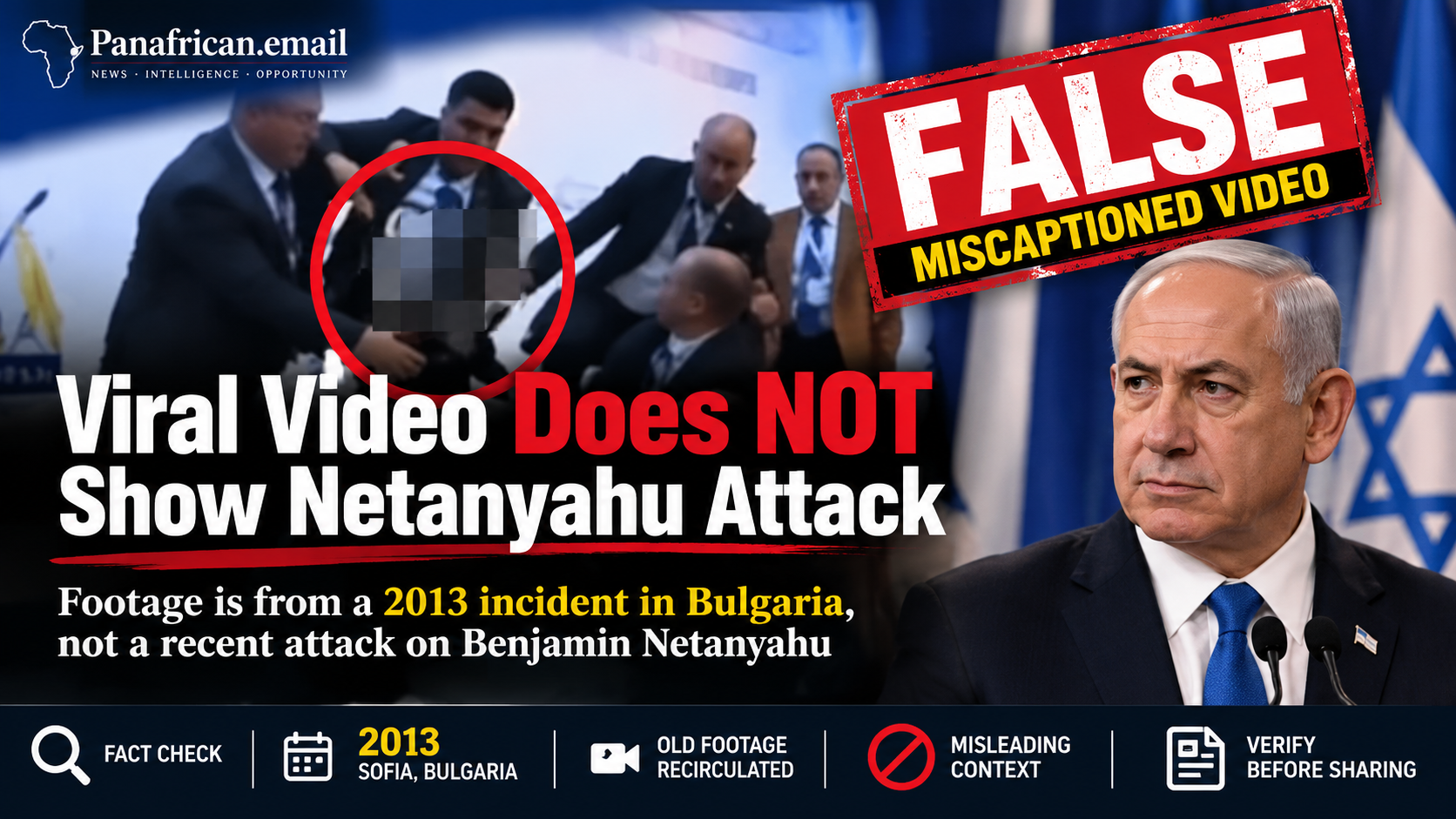
A dramatic video circulating on social media is being falsely presented as evidence that Israeli Prime Minister Benjamin Netanyahu was the target of a shooting during a press conference.
The claim, which appears in the social-media post shown above, says a high-ranking Israeli official was subjected to a life-threatening attack and alleges that the bullet was actually intended for Netanyahu but missed him.
The accompanying footage appears to show security personnel rushing toward a man on a stage as people scatter and attempt to restrain him.
But the video does not show Benjamin Netanyahu, and the incident did not take place in Israel.
Fact-checking organizations have traced the footage to an incident in Sofia, Bulgaria, in January 2013, involving Bulgarian politician Ahmed Dogan. (NCIJ Network)
The video is real — but the caption is false
One reason the claim can appear convincing is that the footage itself is authentic.
It is not an AI-generated video or an entirely fabricated scene.
The problem is the context attached to it.
The footage shows an attempted attack on Ahmed Dogan, then leader of Bulgaria’s Movement for Rights and Freedoms, during a party conference in Sofia on January 19, 2013.
A man approached Dogan while he was speaking and pointed what was described in contemporary reporting as a gas pistol toward him. Security personnel and others at the event quickly intervened and subdued the attacker.
Dogan was not seriously injured. (NCIJ Network)
The same footage has repeatedly resurfaced online with false claims that it depicts an attack on Netanyahu.
How Netanyahu became attached to the old footage
The latest version of the claim emerged on social media in October 2026, amid heightened political and security tensions in Israel.
The post shown in the supplied screenshot presents the footage as breaking news and claims that Netanyahu was the intended target.
The video’s poor image quality makes identification difficult. A separate image of Netanyahu appears to have been associated with the circulating post, further encouraging viewers to connect the footage with the Israeli prime minister.
But investigations by multiple fact-checking organizations found that the actual footage depicts a completely different politician in a different country more than a decade earlier. (Lead Stories)
Who is actually shown in the video?
The man at the center of the incident is Ahmed Dogan, a prominent Bulgarian politician and longtime leader of the Movement for Rights and Freedoms.
The incident occurred during a party conference in Sofia on January 19, 2013.
According to fact-checking investigations, the attacker approached the stage and pointed a gas pistol at Dogan. The weapon did not successfully fire, and people attending the conference immediately moved to restrain the attacker.
The footage subsequently became widely circulated because of the dramatic confrontation on stage.
Years later, clips from the incident have repeatedly been stripped of their original context and recaptioned as attacks involving other political figures. (NCIJ Network)
No evidence of a Netanyahu shooting in the video
The central claim in the social-media post is that Netanyahu was nearly shot during the event.
The video provides no evidence for that claim.
There is also no credible reporting identified by the fact-checkers confirming that the footage represents an October 2026 shooting attempt against Netanyahu.
The NCIJ Network reported that searches for credible reporting found no evidence of the alleged attack and identified the footage as the 2013 Bulgarian incident. (NCIJ Network)
So while there have been genuine security incidents and serious violence involving Israeli officials and security personnel, this particular video is not evidence of one involving Netanyahu.
Why verification matters during breaking news
The episode demonstrates one of the most important challenges facing news organizations and social-media users during periods of heightened tension: real footage can be used to tell a completely false story.
There is a critical difference between fabricated video and miscaptioned video.
A fabricated video may be digitally generated or manipulated.
A miscaptioned video can be completely genuine while the accompanying claim is false.
That distinction is especially important because viewers often assume that authentic-looking footage automatically proves the story attached to it.
It does not.
The wider information environment around Netanyahu
The false claim is circulating against a backdrop of intense political and security developments involving Netanyahu and Israel.
That environment has produced numerous misleading claims about the Israeli prime minister.
Earlier in 2026, false social-media narratives claimed Netanyahu had died or been seriously injured. Reuters and other fact-checking organizations subsequently examined those claims and found them to be false. (Reuters)
In March, for example, Netanyahu appeared publicly and dismissed online rumors concerning his supposed death. Fact-checkers also examined claims involving footage of one of his press briefings and found that supposed abnormalities in his hands were not evidence that the video was artificially generated. (Reuters)
These examples illustrate how quickly political rumors can become attached to genuine photographs and videos.
What the supplied screenshot gets wrong
The social-media post makes several claims that should not be presented as established fact:
Claim: Netanyahu was attacked during a press conference.
Finding: False/miscaptioned. The footage does not show Netanyahu.
Claim: A bullet was fired at Netanyahu but missed.
Finding: Unsupported. The supplied footage does not establish this.
Claim: Security personnel arrested a terrorist who attacked Netanyahu.
Finding: False in the context of this video. The footage depicts the 2013 incident involving Ahmed Dogan in Bulgaria.
Claim: The incident shown is recent.
Finding: False. The video dates to January 2013. (NCIJ Network)
Why the footage continues to resurface
The video has characteristics that make it particularly susceptible to misinformation.
It is short.
The footage is relatively low resolution.
The confrontation happens quickly.
The identity of the person at the podium is not immediately obvious.
And the scene contains enough apparent chaos to make a dramatic caption seem plausible.
When a video is detached from its original date, location and participants, viewers may have no easy way to determine where it came from.
That is why reverse-image searches, archival reporting and independent fact-checking remain important tools for journalists and readers.
Panafrican.email verification
VERDICT: FALSE / MISCAPTIONED
The viral footage does not show Benjamin Netanyahu being shot at or attacked during a recent press conference.
The footage shows a January 2013 attempted attack on Bulgarian politician Ahmed Dogan during a party conference in Sofia.
The incident is real, but the social-media claim attaching it to Netanyahu is not. (NCIJ Network)
What readers should do
Before sharing dramatic breaking-news footage, check three basic questions:
- When was the video originally recorded?
- Where did the incident actually happen?
- Have independent news organizations confirmed the event?
A video can be genuine and still tell a completely false story when its context is changed.
In this case, an 11-year-old video from Bulgaria has been repackaged as breaking news from Israel.
That distinction matters.
Panafrican.email Intelligence & Fact-Check Desk
Leave a Reply