
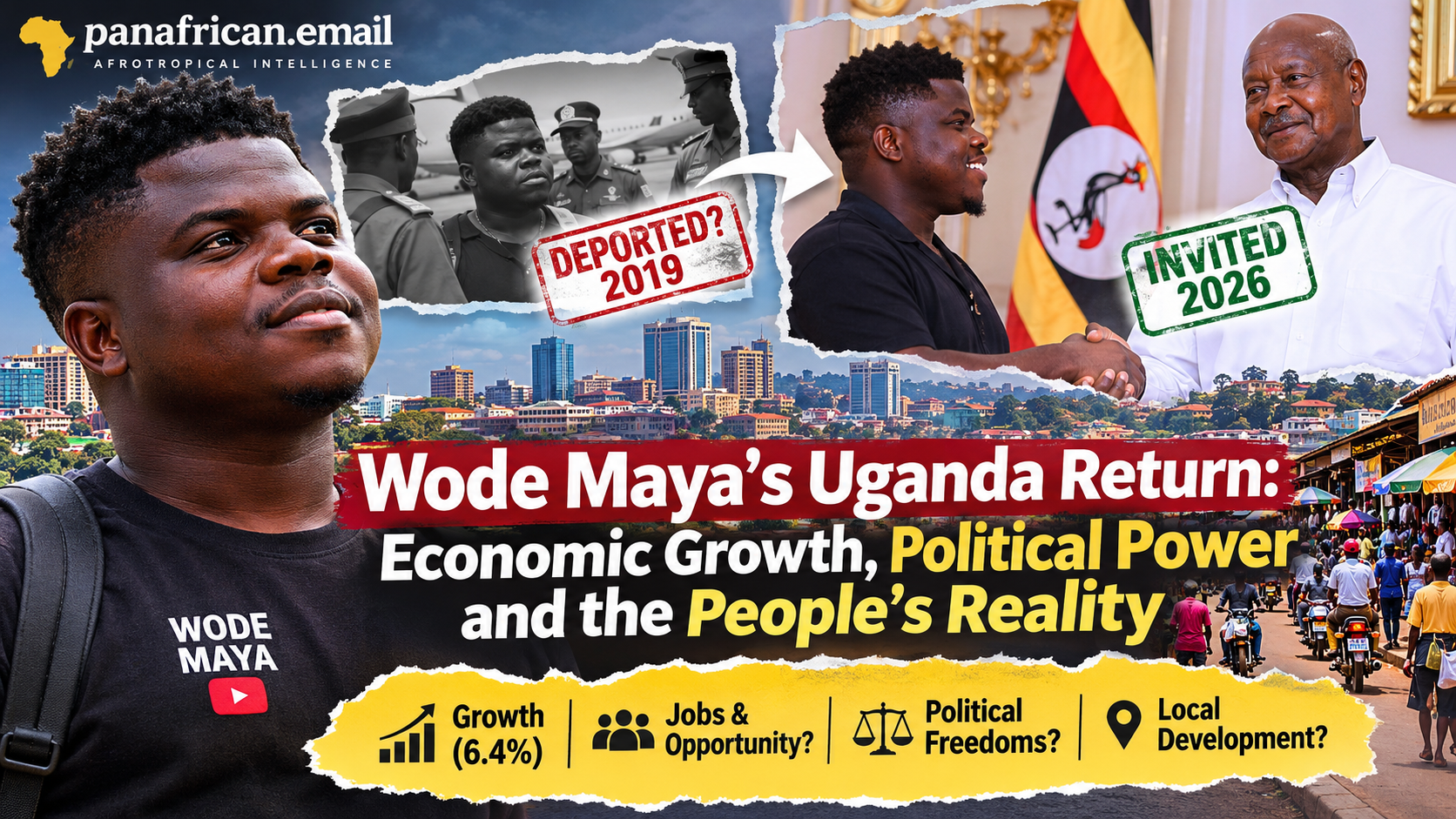
Wode Maya’s Uganda Return: Growth, Political Power & the People’s Reality
An evidence-led intelligence assessment of a creator’s reported removal and subsequent presidential reception, set against Uganda’s economic growth, labour-market pressures and political institutions.
Uganda Bureau of Statistics — preliminary annual estimate of economic output growth
UBOS composite measure of unmet labour demand; not the unemployment rate
World Bank — share living below US$3 per day, measured using 2021 purchasing-power parity
Freedom House 2026 assessment of political rights and civil liberties; score out of 100
01 / From alleged deportation to presidential reception
Ghanaian creator Wode Maya has described an earlier removal from Uganda in 2019 and a later return as a guest of President Yoweri Museveni in 2026. The earlier circumstances are presented as his account; a formal immigration determination has not been independently verified here. A presidential meeting should not be interpreted, on its own, as proof of a broader change in media freedom.
| Period | Event | Evidence status |
|---|---|---|
| 2019 | Wode Maya describes being removed from Uganda amid suspicion about filming | Creator’s account; official basis not independently verified |
| November 2026 | Reported return and reception involving President Museveni | Reported event; details should be checked against primary records |
| 2026 | Public discussion of economic opportunity and political authority | Analysis, not a public-opinion survey |
02 / Featured video
Video supplied by the publisher. Claims made in the video are not automatically independent verification.
03 / The growth–opportunity paradox
Economic output can rise while many households continue to face insecure employment, limited credit, high living costs and uneven access to infrastructure. The indicators below use different reference periods and methodologies and should not be compared as if they were the same measure.
Economic and social indicators — visual comparison
Scale: 0–100%; a small bar is expected for an annual growth rate
Bars share a visual 0–100 scale but represent different concepts, not components of a total.
04 / Political economy matrix
| System | National-level success | Local question | Evidence needed |
|---|---|---|---|
| Investment | Higher capital formation | Do local firms win contracts? | Procurement and firm-level data |
| Jobs | Expanding output | Are new jobs secure and adequately paid? | Labour-force and wage surveys |
| Infrastructure | New roads and electricity | Which districts benefit? | District service-coverage data |
| Tourism | Growing visitor interest | How much income stays locally? | Tourism satellite accounts |
| Governance | National promotion and diplomacy | Can journalists and residents scrutinise power? | Legal records and independent monitoring |
05 / What can be said about public dissatisfaction?
Growth, inequality, dissatisfaction and electoral preferences are distinct. Kampala’s experience may differ from smaller towns and rural districts. Africa is not one economic or political system: institutional histories and development outcomes vary substantially across countries.
06 / Assessment
Wode Maya’s account highlights a broader tension between official nation-branding and independent storytelling. Uganda can record genuine GDP expansion while large numbers of people still lack dependable work and economic security. A rigorous assessment must consider who receives the benefits, where investment lands and what space citizens have to question decisions.
Sources and methodology
Uganda Bureau of Statistics (UBOS) · World Bank country data · World Bank Poverty and Inequality Platform · Freedom House 2026 · Human Rights Watch Uganda
Editorial standard: creator testimony is attributed; macroeconomic figures are dated; political assessments are identified as assessments; no unsupported majority-opinion claim is made. Interactive-style bar charts are rendered in HTML/CSS without JavaScript.
Leave a Reply