
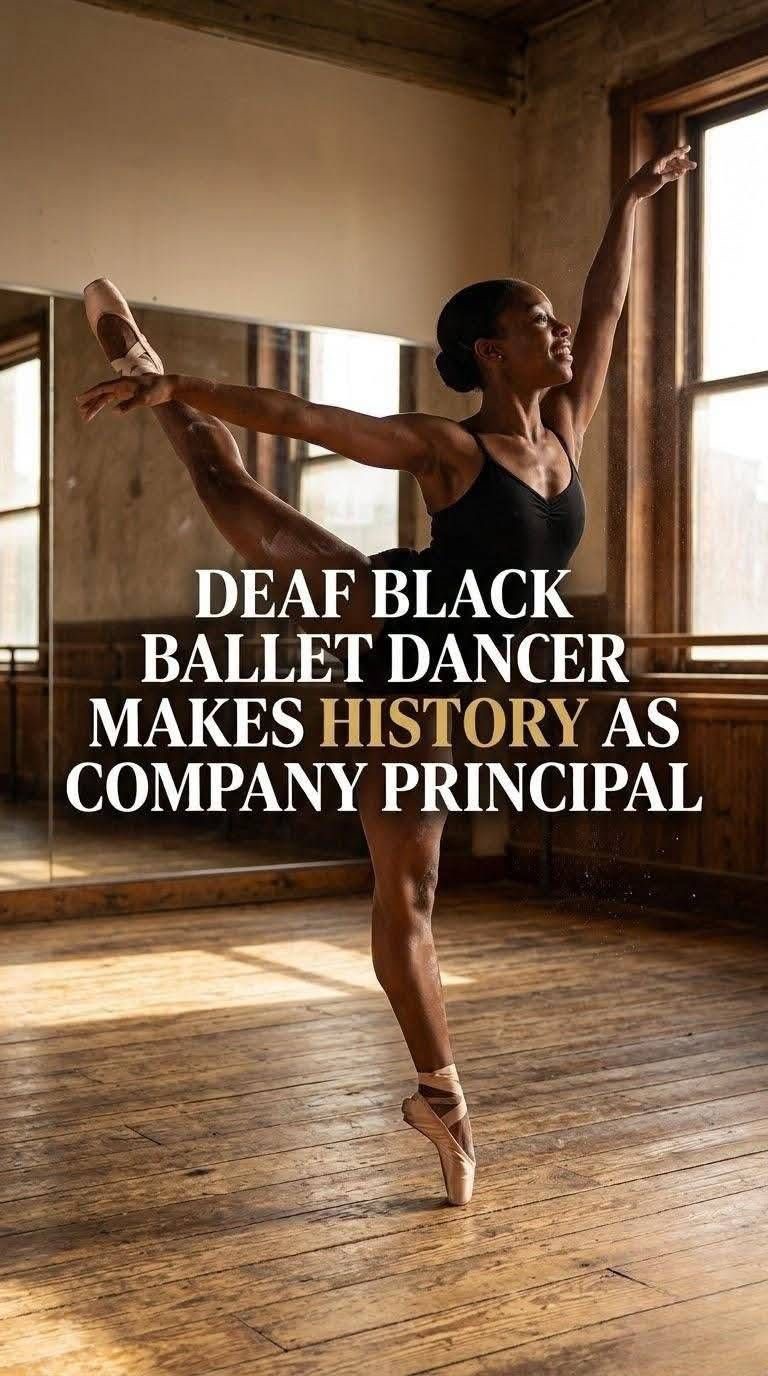
Jasmine Washington is challenging long-held assumptions about who can become a professional ballet dancer, emerging as a groundbreaking figure in the world of classical dance and representation.
For generations, ballet has often been viewed as an art form defined by strict traditions, physical precision and an almost absolute dependence on musical cues. But Jasmine Washington’s journey demonstrates that the language of dance can extend far beyond the ability to hear music.
Washington became the first Deaf African American dancer promoted to principal soloist with the National City Ballet, marking a significant milestone not only for Black representation in classical dance, but also for Deaf artists who have historically faced barriers to professional opportunities.
Her achievement is rooted in an extraordinary ability to experience dance through movement, vibration, rhythm and physical awareness.
Rather than relying exclusively on sound, Washington developed techniques that allow her to connect with the music and choreography through her body. The vibrations of the stage, the movement of fellow dancers and carefully developed visual and physical cues became essential components of her artistic vocabulary.
Feeling the Music Through the Stage
One of the most striking elements of Washington’s approach is her relationship with the ballet floor.
Through her wooden pointe shoes, she can detect subtle vibrations traveling through the stage. Those sensations provide another way of understanding rhythm and timing, allowing her to remain connected to the structure of a performance.
For Washington, the stage is more than a surface on which choreography takes place. It becomes a physical instrument.
Every landing, turn, jump and movement creates information that can be experienced through the body.
That physical connection has helped her master intricate classical choreography while developing a performance style that demonstrates that hearing is not a prerequisite for artistic excellence.
Breaking Barriers in Classical Ballet
Washington’s rise to principal soloist carries significance because professional ballet has historically struggled with diversity and accessibility.
Black dancers have faced longstanding challenges within the classical ballet world, from limited representation in major companies to debates surrounding traditional aesthetics and opportunities for advancement.
Deaf dancers face another layer of obstacles because conventional ballet training frequently relies on musical accompaniment, verbal instruction and auditory cues.
Washington’s career challenges both assumptions simultaneously.
Her promotion represents an important expansion of the image of who can stand at center stage in classical ballet: a Black dancer, a Deaf artist and a highly accomplished professional whose relationship with music is experienced differently but no less meaningfully.
Representation Beyond the Stage
Washington’s accomplishment also carries significance beyond her individual career.
For young Black and Deaf children interested in dance, seeing someone who shares aspects of their experience achieve a senior position within a professional ballet company can fundamentally change what they believe is possible.
Representation can transform an aspiration from something that appears distant into something tangible.
A young dancer watching Washington perform can see that disability does not automatically eliminate the possibility of pursuing a career in the arts. A young Black dancer can see that classical ballet can include artists who look like them and come from different cultural and physical experiences.
That visibility matters in an industry where opportunity has not always been equally distributed.
Redefining What It Means to Dance
Washington’s story ultimately raises a larger question: What does it mean to hear music?
For many people, music is primarily an auditory experience. For Washington, rhythm can be understood through vibration, movement, visual communication and physical sensation.
Her dancing demonstrates that musicality does not necessarily have to begin with the ears.
It can begin with the body.
That perspective offers ballet a broader understanding of accessibility while challenging audiences to reconsider the relationship between music and movement.
The stage becomes a place where different forms of perception can coexist.
A Milestone for Pan-African Representation
From Africa and the Caribbean to North America and Europe, Black artists have continually reshaped global culture through music, fashion, theater and dance. Washington’s achievement adds another chapter to that broader story of African-descended artists breaking into institutions that historically offered limited space for them.
Her accomplishment is therefore more than an individual career milestone. It is part of a continuing movement toward greater visibility for Black artists and disabled artists across the global creative industries.
As ballet companies increasingly confront questions of diversity, accessibility and representation, dancers such as Jasmine Washington demonstrate what the future of the art form can look like.
A future where the stage does not ask an artist to fit a predetermined definition of who belongs.
Instead, the stage becomes a place where talent, discipline, creativity and determination determine how far a dancer can rise.
Jasmine Washington’s journey is a reminder that sometimes the most powerful way to change an institution is simply to enter it, master its language and then redefine what is possible.
Leave a Reply