
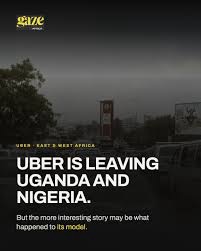
Uber’s experience in Africa offers a powerful lesson for global technology companies: entering an African market is not the same as building a business for Africa.
For roughly a decade, Uber pursued growth across some of Africa’s most promising urban transportation markets. But as economic conditions changed dramatically, the gap between a global platform model and local realities became increasingly difficult to ignore.
Nigeria provides one of the clearest examples.
When the Nigerian naira came under severe pressure, operating costs rose sharply. Fuel prices increased, inflation squeezed household incomes and drivers found themselves earning less in real terms while spending more simply to remain on the road.
For drivers dependent on ride-hailing income, the economics became increasingly difficult.
Some passengers and drivers began turning to cash transactions outside the app, creating a fundamental problem for a platform whose business model depends on digital matching, pricing and payments.
The technology itself was not necessarily the problem.
The problem was whether the economics of the platform still worked for the people using it.
When the Economics Stop Working
Ride-hailing companies operate at the intersection of technology and everyday life. A successful application can connect millions of passengers with drivers, but the platform ultimately depends on a simple equation: drivers must be able to make enough money to justify staying on the road, while passengers must be able to afford the service.
When that equation breaks down, technology cannot solve the problem by itself.
Currency depreciation, fuel prices, inflation, vehicle maintenance, insurance, taxation and local purchasing power all influence whether a ride-hailing platform can remain viable.
This is particularly important in African markets, where economic conditions can change rapidly.
A fare structure designed around assumptions from another market may become unworkable when fuel prices double or a currency loses significant value.
The Demand Did Not Disappear
Yet there is another side to the story.
Africa’s transportation challenge did not disappear because one international technology company struggled with the economics.
Quite the opposite.
Nigeria remains one of the world’s largest and most important transportation markets, while rapidly growing African cities continue to experience enormous demand for taxis, motorcycles, buses, delivery services and other forms of urban mobility.
Millions of people need to move between homes, workplaces, schools, markets, airports and commercial centers every day.
That creates an enormous opportunity for companies capable of designing transportation platforms around African conditions rather than attempting to simply reproduce models developed elsewhere.
Local Competition Is Adapting
Companies such as Bolt, inDrive and Yango have demonstrated different approaches to competing in African markets.
One important distinction has been flexibility.
In some markets, platforms have experimented with pricing structures and operating models that give drivers and passengers more influence over fares. InDrive, for example, has built its model around negotiated prices, allowing riders and drivers to agree on fares rather than relying entirely on an automated fixed-price system.
That type of flexibility can be particularly important in markets where inflation and operating costs are changing faster than traditional pricing models can respond.
Local payment preferences also matter.
African consumers have developed a diverse financial ecosystem that includes mobile money, bank transfers, digital wallets, cards and cash. A mobility company that understands these payment habits can potentially reach customers who might otherwise be excluded from a strictly card-based platform.
Africa Cannot Be Treated as a Single Market
There is another lesson hidden inside Africa’s mobility race.
Africa is not one market.
Nigeria’s transportation system is fundamentally different from Uganda’s. Ghana has different economic conditions from Kenya. Liberia has different infrastructure challenges from South Africa.
Even within individual countries, transportation patterns can differ dramatically between major cities and rural communities.
A successful African mobility company therefore needs more than an application.
It needs local knowledge.
That can mean understanding fuel economics, road conditions, driver financing, vehicle ownership, informal transportation networks, mobile-money adoption, consumer behavior and government regulations.
The winners may ultimately be the companies that can combine sophisticated technology with this granular understanding of local markets.
The Next Mobility Giant Could Be African
The most important lesson from Uber’s African experience may not be that the market is difficult.
It may be that the market remains underbuilt.
Africa’s cities are growing. Urban populations are expanding. E-commerce is increasing. Delivery services are becoming more important. Digital payments are spreading. And millions of people continue to depend on informal transportation systems every day.
That creates an enormous opening for entrepreneurs.
The next major African mobility company may not begin with a massive Silicon Valley headquarters or billions of dollars in venture capital.
It could begin with a team in Lagos, Kampala, Accra, Nairobi, Monrovia or another African city that understands a simple question better than its competitors:
How do people actually move?
That company could eventually build a transportation ecosystem encompassing ride-hailing, motorcycle taxis, vehicle financing, logistics, delivery, fleet management, insurance and digital payments.
The opportunity extends far beyond summoning a car through an application.
Building for Africa, Not Simply Entering Africa
Africa does not need technology companies merely interested in accessing its consumers.
It needs companies willing to build with African consumers, drivers, entrepreneurs and communities.
That means designing products around local currencies, local payment systems, local transportation habits and local economic realities.
It also means listening to drivers.
The driver is not simply a supplier of labor. In many African mobility markets, drivers are entrepreneurs carrying the cost of fuel, maintenance, financing and vehicle depreciation.
If the economics do not work for them, the platform eventually suffers.
The future of African mobility will therefore depend on creating models in which passengers receive affordable transportation while drivers can earn sustainable incomes.
A Market Waiting for Its Own Solution
Uber’s experience should not be interpreted as evidence that Africa’s mobility market is failing.
It may be evidence that the market is waiting for a different model.
Global companies can bring enormous capital, technology and experience. But local entrepreneurs possess something equally valuable: an understanding of how their cities actually function.
The future may belong to companies that combine both.
Africa’s mobility market is enormous, fragmented and still developing. The company that ultimately dominates it will need to do more than build a better app.
It will need to understand the continent.
The next great African mobility platform may not come from San Francisco, London or another global technology hub. It may come from Africa itself — built by entrepreneurs who understand that Africa does not need to be adapted to technology. Technology needs to be adapted to Africa.
Leave a Reply