
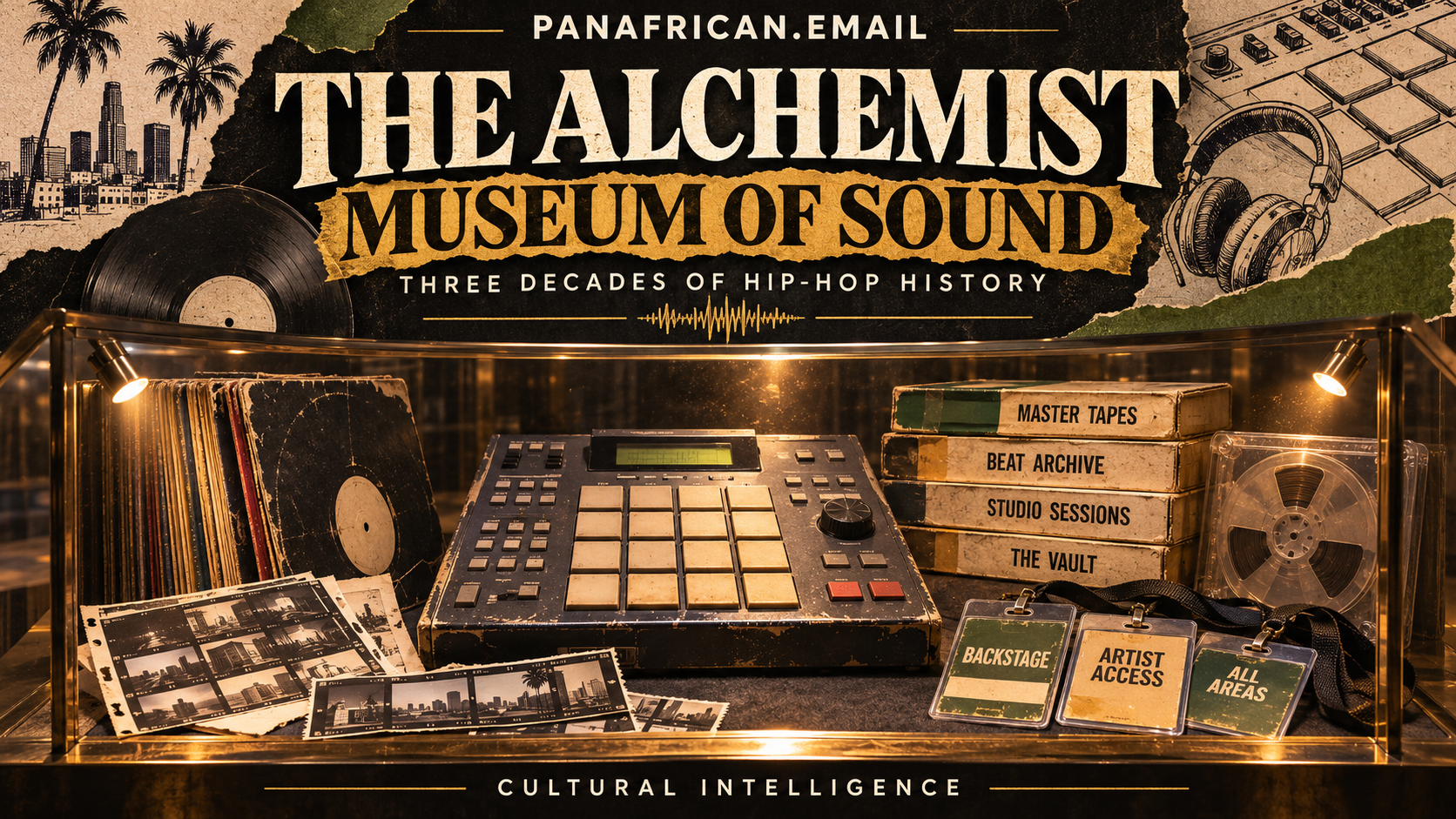
The archive
behind the sound.
Inside The Alchemist Museum of Sound: hip-hop’s working history becomes an interactive exhibition.
OPEN-SOURCE CULTURAL ASSESSMENT
A producer’s archive becomes a public encounter.
Camp Flog Gnaw’s official guide identifies the Alchemist Museum of Sound (A.M.O.S.) as an interactive audiovisual exhibition in Okaga Village. It brings together material preserved by The Alchemist across more than three decades: photographs, video, studio and touring relics, and album-art history. [1]
Complex Music’s reel presents a private walkthrough, connecting physical objects with the sounds and relationships behind the producer’s career. The source frame shows tour credentials in a glass case, including a clearly legible House of Pain pass. Individual dates and ownership of every credential cannot be established from this image alone. [2][3]
Watch the museum video.
The source in context
The reel caption describes a private tour of The Alchemist’s museum at Camp Flog Gnaw, with artifacts, previously unseen footage and the sounds behind his beats. [2]
What to look for
- Tour credentials as records of movement and working relationships.
- Objects that link the studio, stage and visual identity of a release.
- How listening and interaction explain a producer’s creative process.
Instagram controls playback and availability. If embedded playback is unavailable, select Watch on Instagram. Playback requires internet access.
Objects, evidence and interpretation.
A category-level register, not a complete museum inventory. Rows identify their evidence source and limit.
| Material | Evidence | Cultural value · analysis | Verification limit |
|---|---|---|---|
| Tour credentials | Visible in source frame [3] | Documents live-music networks and access. | Dates and full credential histories are unreadable. |
| Photography | Organizer confirms archived photographs [1] | Preserves people, places and working environments. | No item-level provenance assessed. |
| Video archive | Organizer describes rare and unseen footage [1] | Records creative practice beyond finished tracks. | No complete footage catalog available. |
| Recording and touring relics | Listed by the organizer [1] | Connects finished music to its production and circulation. | Object quantities and valuations unavailable. |
| Album-art history | Named in the official exhibit description [1] | Connects sound to visual authorship and release identity. | No comprehensive artwork inventory verified. |
From preservation to public memory.
Evidence coverage chart
Counts refer only to the five artifact categories in the register above. They do not measure exhibit size.
Denominator: 5 report categories. Exclusive classification by the evidence used in this report; categories may overlap in the actual exhibit.
Archive context timeline
Selected reference points; spacing is schematic, not proportional to elapsed time.
Cultural value graph · conceptual, not a financial model
Editorial framework: preserved material gains new meaning when audiences can connect objects, stories and sound. No attendance, revenue or market-value figures are asserted.
Why this matters for African and diaspora archives.
Preserve the process
For African musicians, labels and cultural repositories, this offers a practical model: preserve drafts, session records, instruments, photographs and touring documents alongside final releases. Context turns a collectible into evidence.
Build a living repository
An African and diaspora collection can connect an object to its maker, community, use and audio or oral history. For a platform such as Camarilla Mask, the transferable lesson is a documented relationship between material, story and experience.
Assessment: A.M.O.S. is a useful example of artist-led cultural preservation. Its strongest documented feature is the combination of physical archives and audiovisual interpretation. Public evidence reviewed here does not establish commercial performance, long-term museum operation or a permanent venue.
| Next intelligence requirement | Why it matters | Current status |
|---|---|---|
| Complete exhibit catalog | Would establish object counts, dates and provenance. | Not obtained |
| Future public access | Would clarify whether the exhibition continues beyond the festival. | Not established |
Evidence ledger.
- Camp Flog Gnaw — official Explore guide. Exhibit description, archive scope, festival dates and Okaga Village location. Accessed 18 November 2026.
- Complex Music — original Instagram reel. Caption and publication date inspected on the public page; posted 17 November 2026. Contextual source for the museum coverage.
- Complex Music reel screenshot. Visual evidence limited to the displayed frame; not an independent authentication of every artifact.
- Recording Academy — Alfredo awards record. Confirms the 2021 Best Rap Album nomination for Freddie Gibbs and The Alchemist.
Method: public-source review and limited screenshot inspection. Charts summarize this report’s evidence categories; the value graph is editorial analysis. No invented audience, sales, valuation or streaming data. This is independent editorial coverage and does not imply affiliation with Complex, The Alchemist or Camp Flog Gnaw.
Leave a Reply