
The Airwaves Have Become the New Battlefield
For decades, the mobile-phone industry has been built around a deceptively simple idea: build towers, connect those towers with networks, and persuade customers to pay for access.
Elon Musk’s SpaceX is now challenging that model.
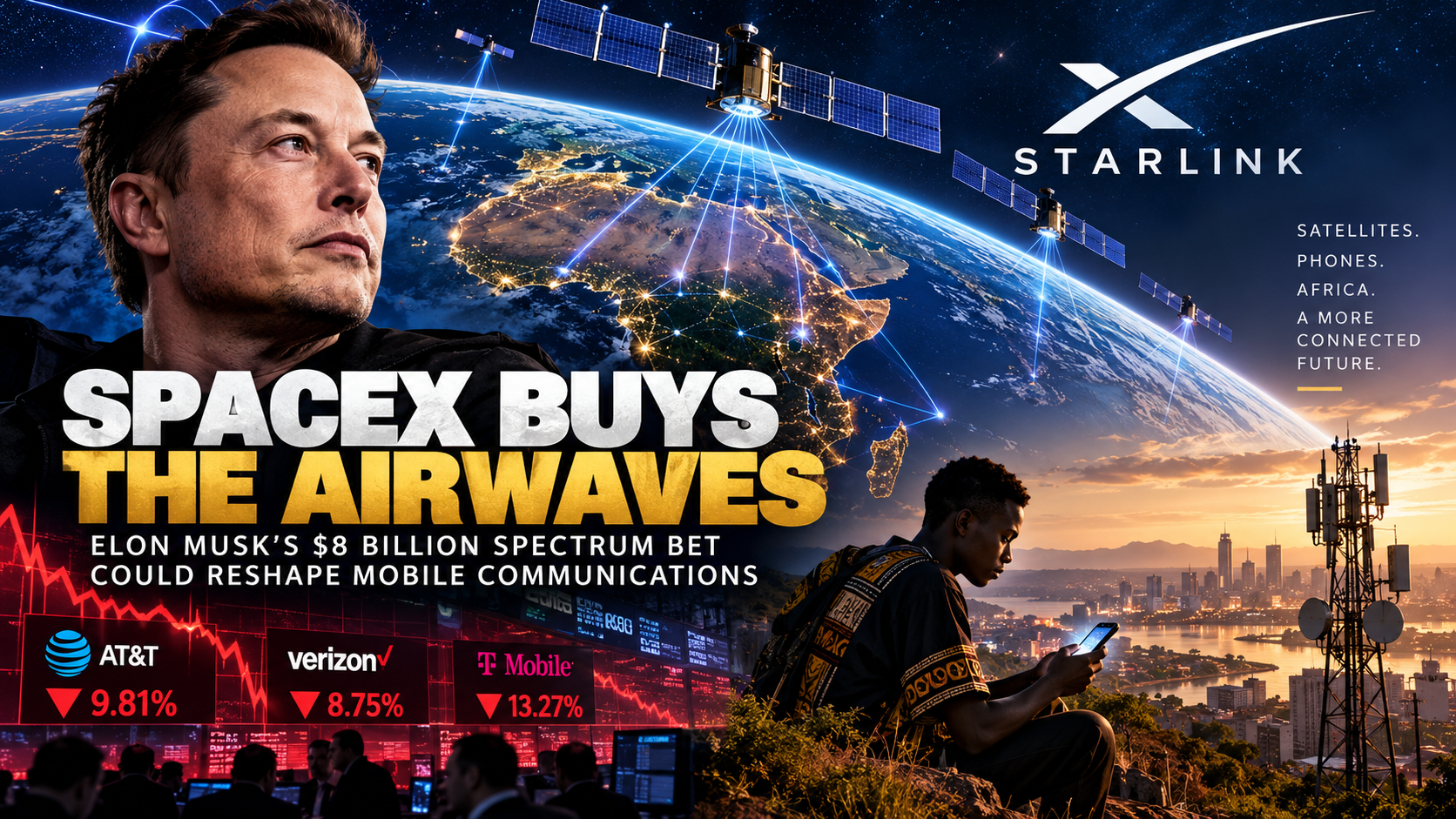
On October 8, 2026, SpaceX agreed to acquire 100% of Grain Management’s nationwide portfolio of 800 MHz spectrum, a low-band portion of the radio spectrum that can travel long distances and penetrate buildings and other obstacles more effectively than higher-frequency spectrum. Grain Management confirmed the transaction, while SpaceX has described the licenses as covering up to 14 MHz of paired spectrum. (Grain Management)
The Wall Street Journal reported the purchase price at approximately $8 billion in cash, although the companies themselves have not publicly disclosed the financial terms. The transaction remains subject to approval by the U.S. Federal Communications Commission and other closing conditions. (Reuters)
That distinction matters.
This isn’t simply SpaceX buying another block of frequencies.
It is SpaceX acquiring a critical piece of the infrastructure required to turn Starlink from a satellite internet company into something much closer to a conventional mobile operator.
And Wall Street immediately understood the implications.
Why the Telecom Industry Panicked
The reaction was dramatic.
On October 9, shares of the three largest U.S. wireless operators suffered extraordinary losses.
Verizon fell 8.75%.
AT&T fell 9.81%.
T-Mobile fell 13.27%.
The moves represented Verizon’s worst single-day decline since 2002, AT&T’s largest one-day decline since 2000, and T-Mobile’s worst session since 2013. (Quartz)
Investors weren’t suddenly questioning whether Americans would stop using smartphones.
They were questioning who would control the network connecting those smartphones.
For years, Starlink’s relationship with mobile carriers was largely complementary.
A satellite could provide connectivity in places where traditional infrastructure was unavailable or uneconomical.
But the new spectrum strategy suggests something much more ambitious.
SpaceX wants Starlink to become a major mobile communications platform in its own right.
That puts it on a collision course with the companies that have spent decades building America’s cellular infrastructure.
What Exactly Is Spectrum?
To understand the significance of the deal, it helps to understand what SpaceX actually purchased.
Spectrum is the invisible infrastructure of wireless communication.
Every phone call, text message, mobile-data session and wireless connection travels through electromagnetic frequencies.
Governments regulate these frequencies because they are a finite public resource.
Telecommunications companies purchase or receive licenses to use particular portions of that spectrum.
Think of spectrum as a highway system.
Your phone isn’t physically connected to a cable.
Instead, it communicates through invisible lanes in the electromagnetic spectrum.
The better the spectrum, the more useful the network can become.
And low-band spectrum is particularly valuable because signals can travel farther and penetrate buildings, walls, vegetation and other obstacles more effectively.
That makes the 800 MHz spectrum SpaceX is acquiring strategically important.
Reuters described the acquisition as a move that could strengthen Starlink Mobile’s ability to compete directly with traditional wireless carriers. (Investing.com)
Starlink’s Missing Piece
Starlink already has something the traditional telecom companies don’t have:
a massive constellation of satellites in low-Earth orbit.
Those satellites can communicate with devices and provide connectivity over enormous geographic areas.
But satellites have historically faced an important limitation.
Getting a strong signal to a device is not the same thing as providing a reliable mobile network inside a building, city or densely populated environment.
That’s where terrestrial spectrum becomes powerful.
SpaceX’s strategy increasingly resembles a hybrid network:
Satellites + terrestrial spectrum + mobile devices.
The company can potentially use satellites to reach areas that towers cannot efficiently cover while using terrestrial spectrum and ground infrastructure where that makes more sense.
The result could be a network that doesn’t think of the distinction between “satellite internet” and “cellular service” in the way the industry traditionally has.
The Towerless Future?
This is where the biggest misconception needs to be addressed.
SpaceX buying spectrum does not mean cell towers are suddenly obsolete.
Nor does it mean Starlink can immediately replace AT&T, Verizon or T-Mobile nationwide.
Analysts have pointed out that spectrum licenses alone do not create a nationwide terrestrial mobile network. SpaceX would still need infrastructure and potentially partnerships or arrangements that allow its service to operate alongside or through existing networks. (MarketWatch)
But the strategic direction is unmistakable.
SpaceX is attempting to reduce the industry’s dependence on the traditional distinction between:
cellular networks on Earth
and
satellite networks in space.
The future may instead be a single communications architecture in which your phone automatically connects through whichever layer provides the best available connection.
A tower.
A satellite.
A ground station.
Or some combination of all three.
The Bigger Threat to the Carriers
The real threat isn’t necessarily that Starlink will immediately steal 200 million customers.
The threat is pricing power.
For decades, major wireless operators have controlled enormous customer relationships because switching networks involved meaningful trade-offs.
Different coverage maps.
Different towers.
Different contracts.
Different infrastructure.
But what happens if a consumer can purchase a communications plan that works through terrestrial networks in cities and satellites almost everywhere else?
The traditional carrier’s geographic advantage becomes less powerful.
A person traveling across rural America could potentially remain connected without worrying about whether the nearest tower belongs to their carrier.
A truck driver crossing remote territory could maintain connectivity.
A ship could remain connected far offshore.
A rural community could receive service without waiting years for a conventional tower rollout.
That changes the economics of telecommunications.
The African Question
For Africa, this story deserves particular attention.
The United States is not Africa.
The spectrum SpaceX is acquiring is part of the U.S. regulatory system and does not automatically give Starlink the right to operate mobile services throughout African countries.
Every African country maintains its own spectrum-management and telecommunications regulations.
But the technology could eventually have enormous consequences for the continent.
Africa contains some of the world’s most difficult connectivity environments.
Large rural populations.
Vast distances.
Remote islands.
Forests.
Deserts.
Mountains.
Communities where building and maintaining conventional cellular infrastructure can be expensive relative to the number of subscribers.
Satellite connectivity has therefore always represented an intriguing alternative.
The difference now is that SpaceX isn’t merely trying to put satellite internet into homes.
It is moving toward direct-to-device connectivity.
That could eventually mean a future in which an ordinary smartphone communicates directly with a satellite without requiring a traditional satellite phone.
From Liberia to Ghana to the Sahel
Consider what this could mean for a country such as Liberia.
A conventional telecom operator may have to evaluate the cost of building a tower, supplying electricity, connecting the tower to a backhaul network and maintaining it.
A satellite network approaches the problem differently.
The satellite is already overhead.
The challenge becomes providing an affordable and technically reliable connection to the user.
For countries with difficult terrain or dispersed populations, that difference could become significant.
The same principle applies across Ghana, Sierra Leone, Guinea, Côte d’Ivoire, Nigeria and the Sahel.
Satellite connectivity could complement terrestrial networks by reaching places where towers are difficult to justify economically.
But there is another important question:
Who controls the infrastructure?
The New Digital Infrastructure Debate
Africa’s telecommunications future has historically involved a mixture of national regulators, local telecom operators, international carriers, infrastructure companies and technology giants.
SpaceX introduces another category:
a global private satellite infrastructure operator.
That raises difficult policy questions.
Who controls access?
Who sets prices?
Where does the data travel?
Who owns the customer relationship?
How are emergency communications handled?
What happens when satellite infrastructure becomes essential to a country’s economy?
And perhaps most importantly:
How should African governments regulate foreign satellite operators without blocking technological innovation?
These questions will become increasingly important as direct-to-device technology matures.
Could Starlink Become a Mobile Carrier?
That is effectively the strategic question behind the market reaction.
SpaceX already possesses the satellite infrastructure.
It now wants more control over spectrum.
That combination could allow the company to move closer to the traditional mobile-carrier model.
SpaceX has also been developing Starlink Mobile through partnerships, including its relationship with T-Mobile.
The new spectrum acquisition represents another step toward reducing the technological limitations of satellite-to-phone communications.
Light Reading reported that the 800 MHz licenses could provide up to 14 MHz of paired spectrum and help SpaceX fill an important low-band gap in its hybrid satellite-terrestrial strategy. (Light Reading)
This is why the market reacted so violently.
Investors weren’t pricing in today’s Starlink.
They were pricing in tomorrow’s Starlink.
The $8 Billion Bet
If the reported $8 billion price is accurate, SpaceX is making an enormous bet on the future of wireless communication.
But the company isn’t simply buying bandwidth.
It is buying optionality.
The spectrum could support multiple strategies:
- Direct-to-device satellite connectivity
- A terrestrial wireless network
- Hybrid satellite-cellular service
- Partnerships with existing operators
- Rural and remote connectivity
- Enterprise communications
- Emergency communications
- Maritime and aviation connectivity
- Potentially bundled communications services
And SpaceX has another advantage.
It controls a rapidly expanding satellite network.
That means the company can potentially integrate the space and terrestrial components rather than treating them as completely separate businesses.
What Happens to Your Phone Bill?
This is the question consumers actually care about.
Will Musk’s satellite network make mobile service cheaper?
Maybe.
But it isn’t guaranteed.
Competition generally creates pressure on incumbent companies to lower prices or improve service.
If Starlink Mobile becomes a credible fourth competitor in the U.S. wireless market, AT&T, Verizon and T-Mobile could be forced to respond with:
lower prices,
better coverage,
more generous data plans,
or
new bundles combining cellular, satellite and broadband services.
But building and operating telecommunications infrastructure is expensive.
Spectrum isn’t free.
Satellites aren’t free.
Ground infrastructure isn’t free.
And maintaining a high-capacity network capable of serving millions of simultaneous users is extraordinarily expensive.
The $8 billion spectrum purchase could therefore be the beginning of a much larger capital-investment program rather than the end of one.
The Real Revolution Is Convergence
The most important part of this story may not be SpaceX versus AT&T.
It may be the disappearance of the boundary between different communications networks.
For most of the history of telecommunications, technologies were separated:
telephone networks
cellular networks
Wi-Fi
fiber
cable
satellite
The emerging architecture is different.
Your device may not care which network it is using.
It may simply ask:
Which connection is available?
And the system chooses.
That’s a profound shift.
The network becomes less visible.
The device becomes more intelligent.
And connectivity becomes increasingly ubiquitous.
Africa Should Be Watching Closely
For African policymakers, entrepreneurs and telecom executives, the lesson isn’t simply “SpaceX is coming.”
The lesson is:
the definition of telecommunications infrastructure is changing.
Countries that once had to choose between expensive terrestrial infrastructure and limited connectivity could increasingly have another option.
But Africa should not simply become a market for imported connectivity.
The continent needs to participate in the infrastructure economy itself.
That means investing in:
- African satellite capacity
- Local data centers
- Spectrum research
- Indigenous telecommunications companies
- Fiber infrastructure
- Ground stations
- Cloud infrastructure
- Digital identity systems
- Local AI infrastructure
- Regional connectivity corridors
Satellite technology can help close connectivity gaps.
But long-term digital sovereignty requires more than buying access from someone else’s network.
The Bottom Line
Elon Musk didn’t buy the entire American mobile-phone industry on October 8.
He didn’t eliminate cell towers.
He didn’t automatically gain the right to operate mobile networks everywhere.
And the reported $8 billion price remains just that—a reported figure, not a publicly disclosed transaction value.
What SpaceX did acquire is potentially more important:
a strategic piece of the wireless infrastructure required to make Starlink Mobile a much more serious competitor to traditional telecom operators.
The market understood the possibility immediately.
Verizon, AT&T and T-Mobile were punished by investors because Wall Street saw a future in which the fourth major challenger to American wireless doesn’t begin by building thousands of towers.
It begins in space.
And if that model succeeds, the consequences won’t stop at America’s borders.
For Africa, where connectivity remains one of the continent’s defining infrastructure challenges, the coming satellite-to-phone revolution could create enormous opportunities—and equally important questions about regulation, sovereignty, affordability and control.
The next great telecommunications battle may no longer be about who owns the most towers.
It may be about who controls the network above them.
And Elon Musk just bought himself a much bigger seat at that table.
Leave a Reply