
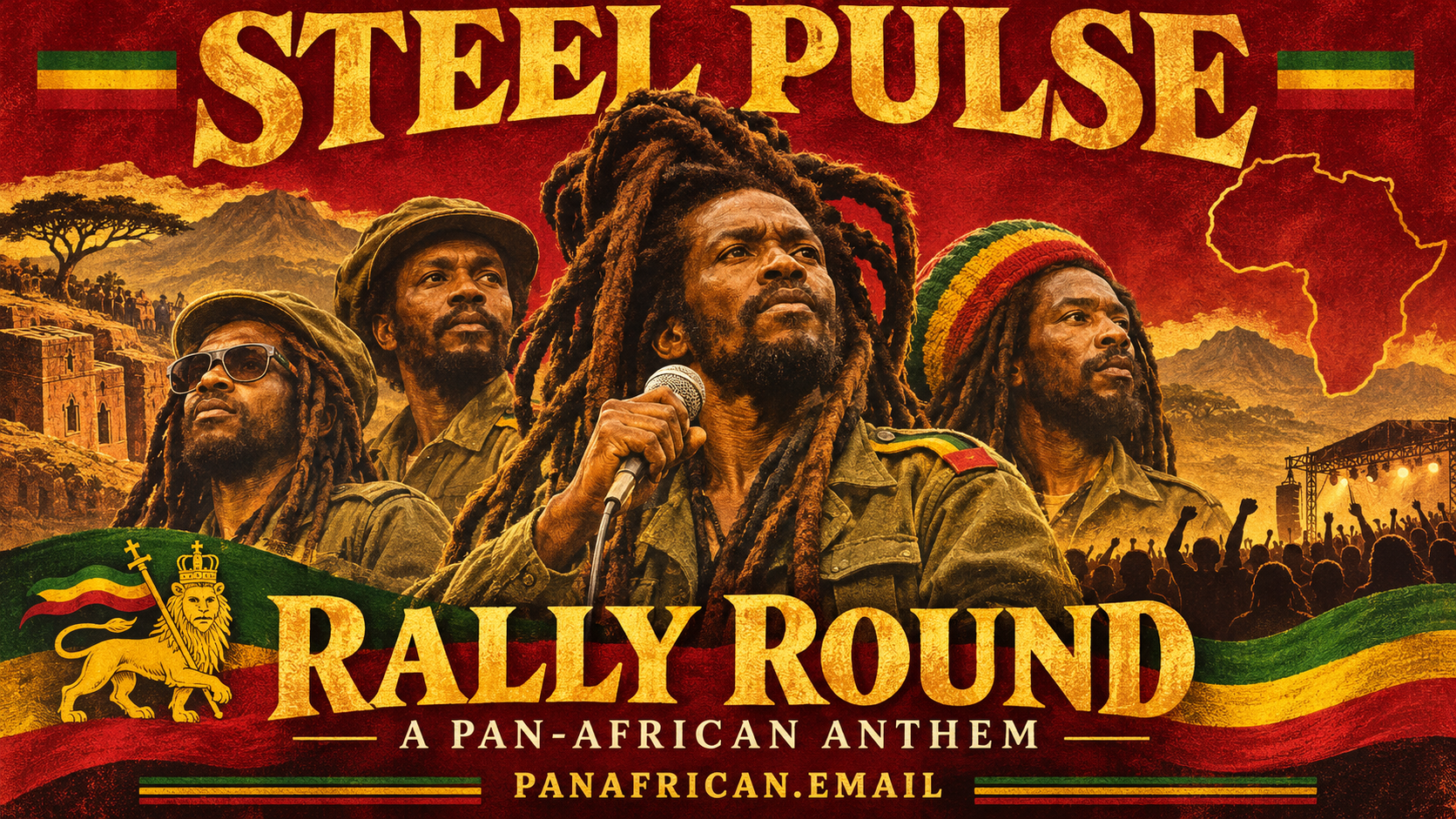
From Birmingham’s Caribbean community to the wider African diaspora, Steel Pulse turned Marcus Garvey’s ideas into a musical call for dignity, historical awareness and collective purpose.
Some songs entertain a generation. Others help a generation understand its place in history. Steel Pulse’s “Rally Round,” also known as “Worth His Weight in Gold (Rally Round),” belongs to the latter tradition.
Released on the band’s 1982 album True Democracy, the song brings Pan-African consciousness into the language of roots reggae. Its central invitation is simple: gather around a shared identity, remember the struggles that shaped it, and recognise the value of African people and their inheritance. (past.jamaica-gleaner.com, jamaicaobserver.com)
From Handsworth to the African diaspora
Steel Pulse formed in Birmingham, England, in 1975. Their music emerged from the experience of a Caribbean community confronting racism while building a life in Britain. Founding figures David Hinds and Selwyn Brown are descendants of the Windrush generation, whose migration helped shape postwar British society.
Songs such as “Handsworth Revolution” and “Ku Klux Klan” established the group’s willingness to confront racial injustice directly. Their involvement in the Rock Against Racism movement also carried that message into spaces where reggae and punk audiences met. (steelpulse.com)
That background gives “Rally Round” its particular force. Africa is approached through the experience of displacement: what does belonging mean when the country where you live repeatedly questions your place within it?
12 studio albums · 2 main live albums · 9 selected compilations Explore the catalogue. Select a sleeve to view it and find the album. Showing 23 albums · select any cover
The Album Atlas
Marcus Garvey’s ideas, carried by music
David Hinds explained the song’s purpose in an interview published in Black Music in April 1982. He had brought together Marcus Garvey’s concepts in a storyline that listeners could encounter through music, including those who had never read Garvey’s writings.
Hinds also resisted a simplistic interpretation of the song as an instruction to relocate immediately to Africa. His emphasis included building stability and understanding wherever a person already lived, while recognising Africa’s spiritual and historical significance. (andybrouwer.co.uk)
Read in that light, “Rally Round” is a form of popular education. Its message asks listeners to connect cultural pride with knowledge, preparation and responsibility.
Red, gold, black and green
The song’s colours bring together related traditions of African liberation and Rastafari symbolism. The red, black and green of Garvey’s Universal Negro Improvement Association sit alongside the gold associated with Rastafari’s Ethiopian colour tradition.
Within the song, those colours become reminders of bloodshed, African land, extracted wealth and the people whose history holds them together. The Jamaica Gleaner identifies this combination as a defining feature of the recording’s Garvey-inspired message. (past.jamaica-gleaner.com)
The flag therefore functions as a compact historical lesson. It invites listeners to see beauty and struggle in the same image—and to consider who benefits from Africa’s wealth.
The recording behind the anthem
True Democracy was recorded in Denmark with producer Karl Pitterson. Recalling the sessions for the Jamaica Observer in 2022, Hinds said Pitterson was dissatisfied with his original vocal delivery on “Rally Round” and encouraged another attempt.
Hinds initially disagreed, but later appreciated the decision. That recollection reveals the care behind a performance whose authority can sound effortless. In the same interview, he described the song as having acquired an anthem-like place among people committed to freedom, democracy and self-pride. (jamaicaobserver.com)
Why “Rally Round” still matters
For a Pan-African audience, the song offers a useful challenge: what should unity produce?
Its themes invite discussion about cultural education, economic independence and the relationship between Africa and its diaspora. Pride becomes more meaningful when it supports institutions, creative work and practical cooperation.
“Rally Round” endures because it gives historical memory a participatory form. The listener can dance, answer the chorus and carry its questions beyond the music: What have we inherited? What do we value? What are we prepared to build together?
Leave a Reply