
By Panafrican.email News Desk
Region: Ghana
Category: Economy / Mining / Commodities
Status: Reported
Confidence: High
Location: Accra, Ghana
Published: November 1, 2026
Ghana Wants More Value From Its Gold
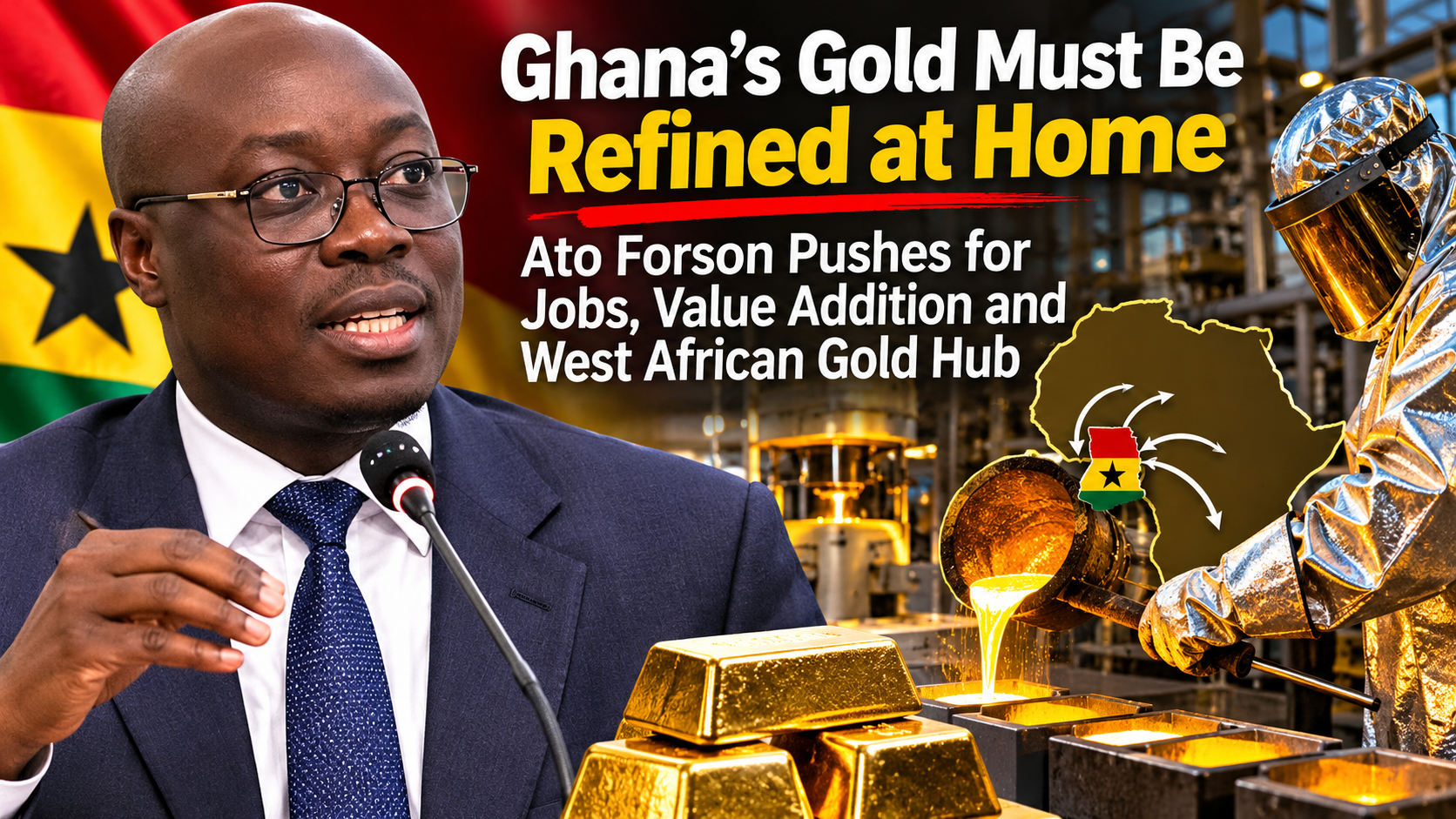
Ghana has spent generations producing one of the world’s most valuable commodities, but Finance Minister Dr. Cassiel Ato Forson says the country has not captured enough of the economic value generated after gold leaves the mine.
Speaking during an engagement with faculty and students at the University of Ghana on October 31, Forson questioned why gold mined in Ghana continues to be sent abroad for refining.
He described a longstanding pattern in which gold is mined in Ghana, transported to South Africa for refining and subsequently moves into European markets.
For Forson, that model represents a missed opportunity.
“The time has come for us to stop it.”
His argument is straightforward: if Ghana possesses the gold, it should increasingly possess the industrial infrastructure required to process it.
The proposal goes beyond constructing refineries. It represents a broader attempt to move Ghana’s mining economy further up the value chain.
From Gold Producer to Gold Processor
Mining creates economic activity, but refining introduces another layer of industrial activity.
A domestic refining ecosystem can require engineers, laboratory specialists, technicians, security personnel, logistics operators, financial services, traders, compliance professionals and other supporting businesses.
Forson acknowledged that the number of direct jobs created by a refinery could initially appear relatively small.
But he argued that the real economic impact should be measured across the broader ecosystem.
He cited Ghana Gold Board, commonly known as GoldBod, as an important source of supply and said the institution purchases approximately three tonnes of gold per month.
Even relatively modest direct employment, he argued, could become the starting point for much larger commercial activity.
The Finance Minister’s broader point was that industrialisation does not necessarily happen in one giant leap. A refinery can become an anchor around which logistics, trading, finance, jewellery manufacturing, laboratory services and other industries develop.
The Gold Souk Vision
One of the more significant elements of Forson’s proposal is the idea of establishing a gold souk — essentially a dedicated marketplace for gold trading and related commercial activity.
That concept would move Ghana beyond simply refining gold and toward creating a financial and commercial ecosystem around the commodity.
Such an ecosystem could potentially connect:
- Gold producers
- Licensed aggregators
- Refineries
- Jewellery manufacturers
- Bullion traders
- Banks and financial institutions
- Assayers and laboratories
- Logistics companies
- Insurance providers
- Exporters
- International buyers
The objective would be to keep more transactions associated with Ghana’s gold economy inside Ghana.
That is an important distinction.
Local refining alone does not automatically create a gold economy. Local refining combined with trading, manufacturing, finance and export infrastructure potentially can.
Ghana Could Process Gold From Across West Africa
Forson also sees an opportunity extending beyond Ghana’s borders.
If Ghana develops sufficient refining capacity, infrastructure and commercial credibility, he believes gold from neighbouring countries could increasingly come to Ghana for processing.
He specifically identified Burkina Faso, Niger, Mali and Côte d’Ivoire as potential sources of regional gold.
His vision would effectively transform Ghana from a major gold producer into a West African gold-processing and trading centre.
That could have implications far beyond Ghana’s mining industry.
A regional processing hub would potentially attract capital, technical expertise, financial institutions, logistics companies and commodity traders.
It would also deepen Ghana’s economic connection with neighbouring gold-producing economies.
The Policy Direction Is Already Moving Toward Local Refining
Forson’s comments are not occurring in isolation.
Ghana’s GoldBod announced in August that gold doré purchased through its system would be subject to mandatory refining in Ghana before export, with the new requirement taking effect September 1, 2026.
That policy direction is therefore already beginning to establish a framework for domestic value addition.
The government has also been discussing incentives intended to make local refining and gold fabrication more competitive.
In October, GoldBod CEO Sammy Gyamfi said proposed measures for the 2027 Budget would include tax incentives for local refineries and jewellery businesses, alongside efforts to improve the availability and cost of electricity. The stated objective is to help Ghana become a regional hub for gold processing and value addition.
Together, these measures suggest that Ghana’s gold strategy is gradually moving from exporting a commodity toward developing an industrial ecosystem around that commodity.
Refining Is Only One Part of the Challenge
The ambition, however, comes with major practical challenges.
A refinery must be commercially competitive.
It requires reliable electricity, secure logistics, sufficient gold supply, sophisticated laboratories, internationally recognized quality standards and access to global bullion markets.
International buyers also need confidence that refined Ghanaian gold meets recognized standards.
This makes accreditation and market acceptance particularly important as Ghana expands its refining ambitions.
Earlier this year, Forson visited Gold Coast Refinery and described its development as an important part of Ghana’s effort to move away from exporting raw gold. At that time, the refinery was described as having capacity of up to two tonnes per week. Government also highlighted plans for a domestic fire-assay laboratory to strengthen Ghana’s ability to scientifically determine gold purity and value.
The infrastructure therefore has to extend beyond the refinery itself.
The Bigger Economic Question: Who Captures the Value?
At the heart of the debate is a fundamental development question:
What portion of the value generated by Ghana’s natural resources remains in Ghana?
Mining companies extract the resource.
International refineries can process it.
International commodity markets determine prices.
Global financial institutions facilitate transactions.
Jewellery manufacturers and downstream industries can capture additional margins.
Forson’s argument is that Ghana should capture more of those stages domestically.
This is the classic value-addition challenge facing resource-rich African economies.
Instead of exporting minerals and importing finished products, governments across the continent have increasingly explored policies designed to process more resources domestically.
For Ghana, gold provides an unusually important opportunity because the country already possesses the underlying resource, an established mining industry and a sophisticated financial sector.
A Potential Regional Gold Corridor
If Ghana successfully develops a competitive refining industry, the implications could extend across the Gulf of Guinea and wider West Africa.
Imagine a regional chain in which:
Gold is mined in Burkina Faso → transported through established commercial corridors → refined in Ghana → traded through Ghanaian financial markets → fabricated into jewellery or bullion → exported into international markets.
That would create opportunities for businesses at every stage.
It could also strengthen Ghana’s position as a regional financial and commodities centre.
But the competitiveness of such a system will ultimately depend on cost, security, speed, transparency and international confidence.
Ghana cannot simply mandate that regional gold come to Ghana.
It must create an ecosystem attractive enough for producers and traders to choose Ghana.
Jobs Beyond the Mine
The employment argument is therefore broader than the number of people physically working inside a refinery.
The potential employment chain could include:
Mining → aggregation → transportation → assaying → refining → bullion trading → jewellery manufacturing → banking → insurance → logistics → export → financial services.
That is where the industrialisation argument becomes more significant.
A country may have substantial mineral wealth while capturing relatively little downstream economic activity.
Building processing capacity changes the structure of that economy.
Instead of the mine being the beginning and end of Ghana’s participation, the country could increasingly participate throughout the commodity chain.
Ghana’s Next Test Is Execution
The policy objective is ambitious, but its success will depend on implementation.
Ghana will need to demonstrate that its refineries can operate reliably and competitively, that gold can be sourced transparently, that producers receive efficient services, and that international buyers trust Ghanaian-refined bullion.
The country will also need to maintain strong controls against illicit gold flows and illegal mining.
That is particularly important because the expansion of the gold economy must occur alongside efforts to formalise small-scale mining and combat illegal mining, rather than creating additional opportunities for illicit gold to enter legitimate supply chains.
The challenge is therefore not simply “refine gold locally.”
It is:
Build a transparent, competitive, internationally trusted Ghanaian gold industry.
From Extraction to Industrialisation
Ato Forson’s intervention points toward a larger economic philosophy.
Ghana has gold.
The question is whether Ghana can turn that gold into industrial capacity, skilled employment, financial services, manufacturing and regional economic influence.
The Finance Minister’s proposed gold souk and regional refining strategy suggest that policymakers are thinking beyond the refinery itself.
The objective is to create an ecosystem.
If successful, Ghana could move closer to becoming not merely one of Africa’s leading gold producers, but one of the continent’s leading gold-processing, trading and value-addition centres.
For a country that has produced gold for centuries, that would represent a significant change in the economic relationship between Ghana and its most famous natural resource.
And for West Africa, it could mark the beginning of a new regional gold economy increasingly built around processing, value addition and African ownership of the value chain.
Panafrican.email Intelligence Note
Assessment: The underlying claim is supported by the October 31, 2026 3News report. The broader regional-hub and value-addition implications are analysis based on Forson’s stated objectives and related GoldBod policy developments, rather than claims that those outcomes have already occurred.
Intelligence Classification: ECONOMIC / MINING / VALUE ADDITION
Country: Ghana
Regional Scope: West Africa
Primary Commodity: Gold
Signal: Local processing / industrialisation
Status: Reported
Confidence: High
Leave a Reply