
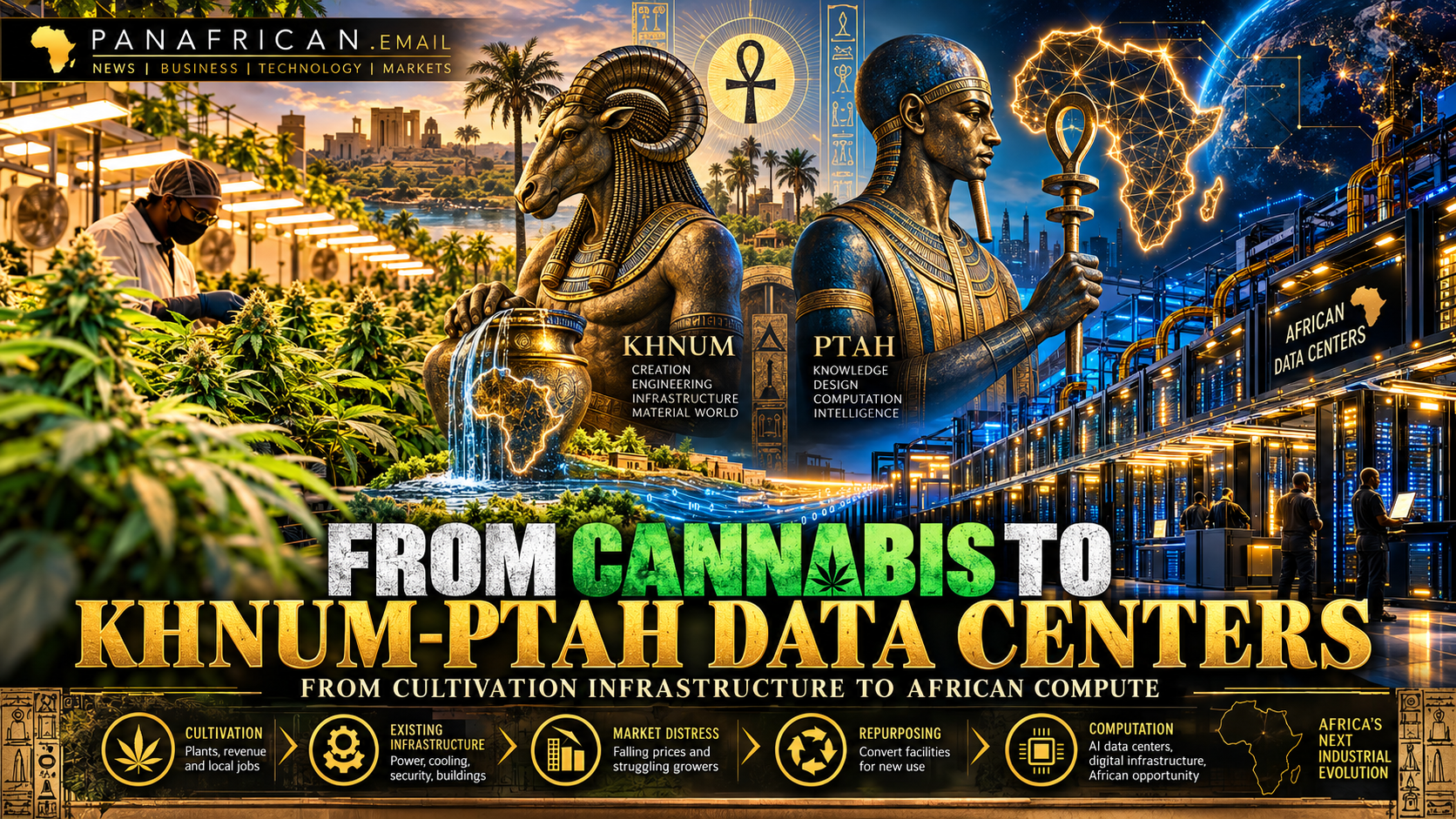
From Cultivation Infrastructure to African Compute
By Panafrican.email — Business | Technology | Markets
The transformation now taking place at the intersection of cannabis, industrial real estate and artificial intelligence may look strange at first: buildings designed to cultivate plants are being examined as potential homes for servers.
But beneath the unusual business proposition is a much larger question.
What happens when an industrial system built for one form of production becomes the physical foundation for another?
In the ancient African imagination represented by Khnum and Ptah, creation was not separated from craftsmanship. The maker shaped material into form; the architect transformed knowledge into structure. In the modern economy, electricity, cooling, water, fiber, buildings and machines have become the materials from which a new form of production is being constructed.
That production is computation.
And as cannabis prices fall and cultivation facilities become distressed assets, some property owners are asking whether the infrastructure built for controlled agriculture can be transformed into infrastructure for artificial intelligence.
The answer, however, is considerably more complicated than simply replacing plants with servers.
THE CANNABIS INDUSTRY’S STRANDED ASSET PROBLEM
Across mature cannabis markets, cultivators are confronting oversupply, falling wholesale prices, taxation, operating costs and changing market conditions.
That pressure is turning expensive cultivation facilities into potential stranded assets.
The buildings can be enormous investments. Indoor cultivation requires substantial electricity for lighting, HVAC and environmental controls, together with water systems, security, insulation and other specialized infrastructure.
Those characteristics have caught the attention of the data-center industry.
Industry reporting has identified cannabis facilities as potential candidates for conversion because some already possess infrastructure associated with energy-intensive industrial operations. (CannIntel)
But the critical word is potential.
A cannabis cultivation facility is not automatically a data center.
The economics depend on power, fiber, cooling, zoning, land, building configuration, water availability and the willingness of utilities and communities to support the conversion.
KHNUM: THE ENGINEERING OF THE MATERIAL WORLD
Khnum is traditionally associated with creation, craftsmanship and the shaping of living forms.
That provides a powerful metaphor for the industrial transition now underway.
The cannabis facility represents one generation of infrastructure.
The data center represents another.
Between them lies engineering.
A cultivation building already has a relationship with:
- electrical distribution;
- temperature management;
- humidity control;
- water;
- security;
- industrial ventilation;
- backup systems;
- physical access controls;
- large-scale mechanical equipment.
Those systems were designed to keep plants alive and productive.
A data center requires a completely different operating environment, but it also depends upon the controlled management of electricity, heat, cooling, connectivity and physical security.
The question is therefore not whether the two industries are identical.
They are not.
The question is whether existing industrial infrastructure can be reshaped for a new economic purpose.
That is where the Khnum metaphor becomes useful: the material already exists, but its form and function can change.
PTAH: FROM CRAFTSMANSHIP TO COMPUTATION
Ptah provides the second half of the conceptual framework.
The ancient Memphis tradition associated Ptah with creation through thought, word and craftsmanship.
Modern computing offers a strikingly different technological expression of the same broad conceptual sequence:
idea → information → computation → output.
AI requires physical infrastructure to make that sequence possible.
Behind every model is a physical machine.
Behind every machine is a data center.
Behind every data center are electrical systems, cooling systems, networks, land, buildings and people.
The cloud is therefore not immaterial.
It is industrial.
And this is one of the most important lessons emerging from the AI infrastructure boom.
THE HARBOR FARMZ EXPERIMENT
One of the clearest examples is Harbor Farmz in Kalamazoo, Michigan.
The company invested approximately $20 million in a 32,850-square-foot cultivation facility in 2020.
The economics of the cannabis market subsequently deteriorated dramatically.
According to Forbes, the facility had approximately 1.5 megawatts of electrical capacity, potential expansion to 2.5 MW within a year and a longer-term pathway toward 15 MW. It also had fiber connectivity and sophisticated HVAC infrastructure. (Forbes)
That made the property interesting to people looking for smaller data-center opportunities.
But the conversion ran directly into one of the fundamental realities of the AI economy:
Infrastructure does not exist in isolation from society.
After community opposition, concerns about electricity, water, noise and grid impacts, Kalamazoo imposed a moratorium on data-center development through August 2027.
Harbor Farmz eventually withdrew its listing.
The facility demonstrates both sides of the thesis.
There may be value in repurposing distressed industrial infrastructure.
But infrastructure must still satisfy the electrical grid, planning authorities, investors and surrounding communities. (Forbes)
THE SCALE PROBLEM
There is another major obstacle.
Cannabis facilities are generally too small for many conventional hyperscale data-center requirements.
Industry reporting has cited cultivation facilities commonly measuring around 20,000–30,000 square feet, while conventional data centers can require substantially larger footprints.
Power is an even bigger difference.
Some cannabis facilities operate with several megawatts of electrical capacity, while modern data centers can require substantially more than 10 MW—and hyperscale AI campuses can reach hundreds of megawatts or more. (MJBizDaily)
That means the future may not be a simple equation of:
Cannabis farm = AI data center.
Instead, the more realistic opportunity could be:
Cannabis infrastructure → smaller regional compute → inference → edge AI → specialized data services.
Forbes reports that developers are increasingly considering smaller 10–50 MW regional and urban/suburban data-center opportunities as power and land become more constrained. (Forbes)
That distinction could become extremely important.
THE AFRICAN OPPORTUNITY
This is where the story becomes larger than cannabis.
Africa is entering an AI infrastructure cycle of its own.
The World Economic Forum reports that African data-center demand could grow from roughly 0.4 GW today to 1.5–2.2 GW by 2030, potentially requiring $10–20 billion in construction investment. (World Economic Forum)
The continent therefore faces a question that is simultaneously technological, economic and industrial:
Where will African computation physically live?
The answer cannot simply be imported cloud infrastructure forever.
African companies, governments, universities and financial institutions increasingly need:
- local computing capacity;
- cloud infrastructure;
- AI inference;
- GPU capacity;
- data sovereignty;
- secure communications;
- fiber connectivity;
- reliable electricity;
- industrial cooling;
- regional data storage.
This creates an opportunity to examine existing industrial properties differently.
FROM CULTIVATION TO COMPUTATION
Imagine an abandoned agricultural complex.
The plants are gone.
The building remains.
The electrical infrastructure remains.
The cooling systems remain.
The security perimeter remains.
The fiber connection may remain.
Instead of demolishing the facility, investors could ask:
What else can this infrastructure become?
That is the central lesson of the cannabis-to-compute phenomenon.
The answer will not always be an AI data center.
Sometimes the property will be too small.
Sometimes the power will be inadequate.
Sometimes fiber will be missing.
Sometimes zoning will prohibit the conversion.
Sometimes the economics simply will not work.
But in carefully selected locations, industrial infrastructure can potentially be given a second economic life.
AFRICA SHOULD NOT SIMPLY COPY THE MODEL
For Africa, the opportunity is not necessarily to replicate the American cannabis industry.
The deeper opportunity is to learn from the asset-conversion principle.
Africa contains underutilized industrial properties, warehouses, agricultural processing facilities, telecommunications infrastructure, energy assets and commercial buildings.
Some may already possess components required for digital infrastructure.
The strategic question is whether governments and investors can identify these assets before constructing entirely new facilities.
That means creating an African industrial-to-digital conversion map.
Such a map could score properties according to:
POWER
Available MW, grid reliability, transmission access and renewable-energy potential.
COOLING
HVAC infrastructure, water availability, ambient climate and opportunities for liquid or advanced cooling.
FIBER
Distance to backbone networks, international cables, internet exchanges and redundant connectivity.
LAND
Available expansion area and suitability for modular data-center construction.
SECURITY
Physical security, access control and critical-infrastructure protection.
ZONING
Whether local authorities permit digital infrastructure.
MARKET
Distance to major population centers, financial institutions, universities, governments and technology companies.
THE KHNUM-Ptah DATA CENTER
This is where the visual language of Khnum and Ptah becomes more than decoration.
Khnum represents the material infrastructure.
Power.
Water.
Cooling.
Buildings.
Machines.
Land.
Ptah represents the transformation of that infrastructure through knowledge and engineering.
Data.
Algorithms.
Servers.
Artificial intelligence.
Robotics.
Networks.
The modern data center becomes the workshop where physical infrastructure and computational intelligence meet.
The ancient imagery therefore becomes a conceptual bridge rather than a claim that ancient Egypt literally possessed modern computer science.
It asks a different question:
What does Africa do with the technological foundations it inherits?
THE NEXT AFRICAN COMPUTE LAYER
The global AI race is increasingly becoming a race for electricity and infrastructure.
Africa cannot compete only by producing AI applications.
It must also develop the physical systems that allow those applications to operate.
That means power.
That means fiber.
That means data centers.
That means cooling.
That means engineers.
That means land.
And increasingly, it means finding creative ways to repurpose existing industrial infrastructure.
The World Economic Forum’s assessment is particularly important: African data-center demand is growing, but the continent still has an opportunity to plan power and digital infrastructure together before demand reaches the scale already stressing more mature markets. (World Economic Forum)
That is an opportunity—not merely a constraint.

THE NEW INDUSTRIAL CYCLE
Every technological era eventually changes the value of physical assets.
Factories become warehouses.
Warehouses become logistics centers.
Retail buildings become fulfillment centers.
Telecommunications infrastructure becomes digital infrastructure.
And now some agricultural facilities are being considered for computation.
The cannabis-to-data-center story may ultimately remain a niche phenomenon.
But the underlying principle is much larger.
Infrastructure has a second life.
The winners will be the investors capable of recognizing what an existing building can become before everyone else sees it.
FROM THE FIELD TO THE SERVER

The transformation can therefore be understood as a five-stage industrial sequence:
CULTIVATION
Land and buildings produce biological commodities.
↓
INFRASTRUCTURE
Electricity, water, cooling, security and networks are installed.
↓
DISTRESS
Market economics make the original business model less viable.
↓
REPURPOSING
Investors search for another use for the physical asset.
↓
COMPUTATION
The infrastructure becomes part of a digital economy.
That final stage is where Africa’s opportunity becomes especially significant.
Africa does not need to wait for every future technology to arrive before building its infrastructure.
It can identify the infrastructure requirements now.
THE AFRICAN COMPUTE THESIS
The cannabis-to-data-center story is therefore not really about cannabis.
It is about industrial evolution.
A building designed for plants can potentially become a building for servers.
A power connection designed for cultivation can potentially support computation.
A cooling system designed for agriculture can potentially become part of a digital facility.
And an underutilized industrial asset can potentially become part of the infrastructure supporting artificial intelligence.
But conversion requires discipline.
Power must be verified.
Fiber must be verified.
Zoning must be verified.
Water must be verified.
Economics must be verified.
Community acceptance must be addressed.
And the computing market must actually support the investment.
That is the difference between an infrastructure thesis and a speculative real-estate story.
KHNUM → PTAH → COMPUTE
The future African technology economy should be built around a simple principle:
Do not merely import technology. Build the infrastructure that makes technology possible.
Khnum gives us the metaphor of shaping material.
Ptah gives us the metaphor of transforming thought into creation.
The data center represents the modern industrial workshop where information becomes computation.
And Africa now has an opportunity to participate in that transformation—not simply as a consumer of artificial intelligence, but as a builder of the physical systems beneath it.
The cannabis industry is discovering that its most valuable asset may not always be the commodity it produces.
Sometimes the hidden value is the infrastructure left behind.
And in the emerging AI economy, power, cooling, fiber, land and industrial buildings are becoming commodities in their own right.
The question for Africa is not whether cannabis farms will become data centers.
The larger question is:
What existing African infrastructure can be transformed into the continent’s next generation of compute?
That is the Khnum-Ptah question.
From creation → to knowledge → to computation.
And the next great African industrial transformation may already be sitting inside buildings that the market has stopped seeing.

Panafrican.email Intelligence Note
The cannabis-to-compute conversion trend remains an emerging and highly selective real-estate strategy rather than a proven mass-market transition. Current reporting shows significant obstacles involving power capacity, facility size, fiber, zoning, community opposition and development timelines. (Forbes)
For Africa, the stronger investment thesis may therefore be broader: identify underutilized industrial assets that can be upgraded into modular digital infrastructure while simultaneously developing reliable power and connectivity.
The future is not simply data. The future is the infrastructure that makes data useful.
Leave a Reply