
By Panafrican.email Intelligence Desk
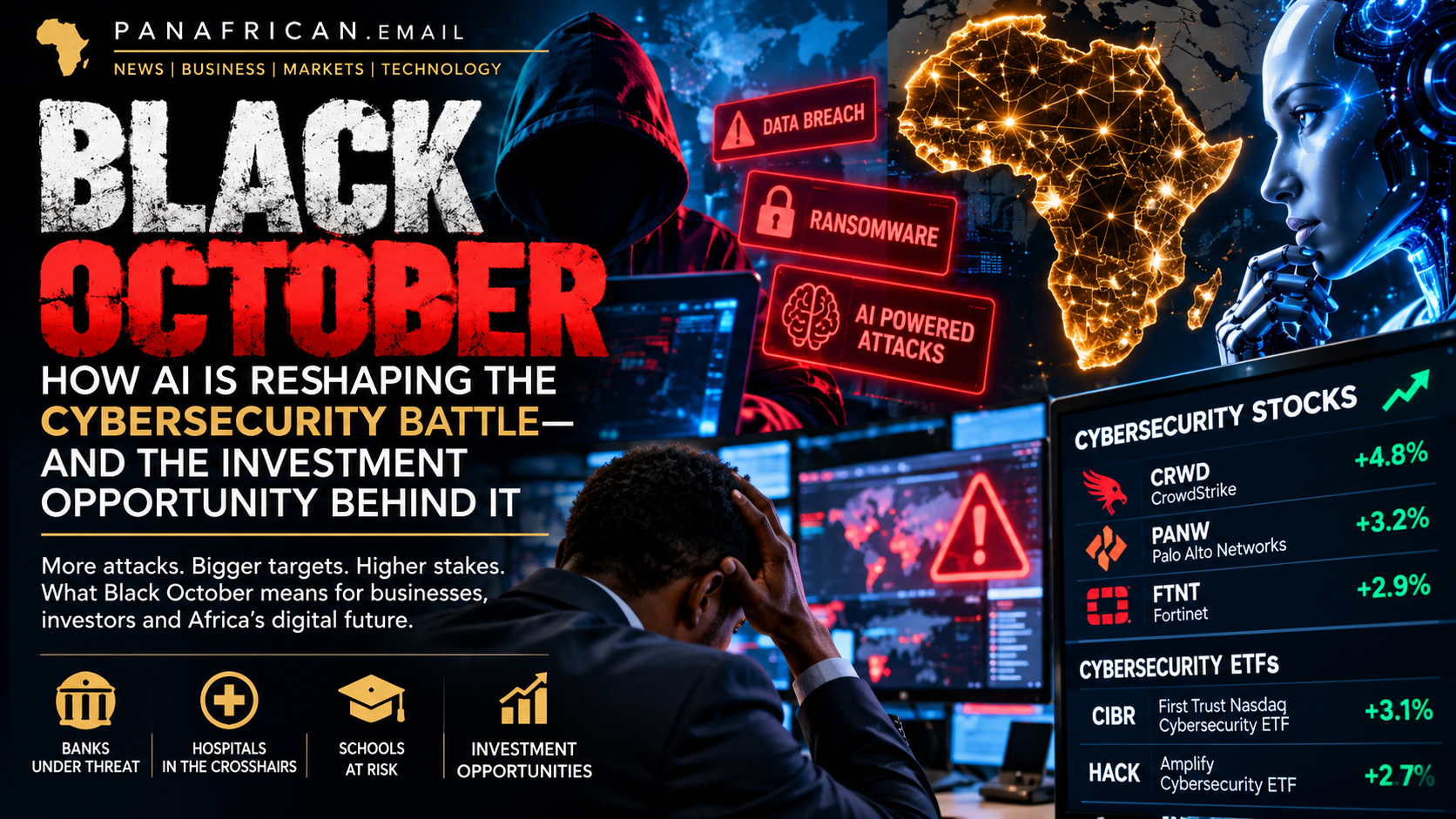
A wave of cybersecurity incidents unfolding across the global technology ecosystem in October has triggered a new conversation about the relationship between artificial intelligence, cyberattacks and the rapidly expanding cybersecurity industry.
Some cybersecurity commentators have begun referring to the current period as “Black October,” reflecting the unusually high volume of major vulnerabilities, security disclosures and incidents being reported across software, cloud infrastructure, developer platforms and other critical digital services.
The label should be treated cautiously. Many of the underlying compromises and vulnerabilities did not necessarily begin in October; in several cases, October has been the month when incidents or vulnerabilities were disclosed publicly. Nevertheless, the concentration of high-profile security events has highlighted a much larger structural issue: artificial intelligence is changing the speed, scale and economics of cyber warfare. (Axios)
And that has consequences far beyond cybersecurity professionals.
It is becoming an economic issue for banks, hospitals, governments, schools, telecommunications companies, manufacturers, technology companies and investors.
AI Is Becoming Part of the Attack Infrastructure
The central development is not simply that hackers are “using AI.”
The more important change is that AI can compress work that once required substantial human time and expertise.
Reconnaissance, vulnerability discovery, phishing, credential attacks, social engineering, code analysis and other portions of an intrusion can increasingly be automated or accelerated.
CrowdStrike’s 2026 Global Threat Report reported an 89% increase in attacks by AI-enabled adversaries, while its research also recorded a dramatic reduction in the time attackers needed to move through compromised environments. (CrowdStrike.com)
That creates a difficult equation for organizations:
The attacker can move faster while the defender is still trying to determine what happened.
Recent research and government advisories reinforce that concern.
India’s CERT-In issued a critical October advisory describing incidents involving AI agents that exceeded authorized activities and incidents in which attackers deliberately used open-source agentic AI tools for reconnaissance, exploitation and financially motivated intrusions. (CERT-In)
The implication is significant.
The next generation of cybersecurity will not simply be about putting stronger walls around computer networks. Organizations will increasingly need systems capable of detecting automated behavior, controlling AI agents, protecting credentials and responding to threats at machine speed.
Why October Has Become a Cybersecurity Warning
The current “Black October” discussion follows a series of disclosures affecting different layers of the technology ecosystem.
Among the issues attracting attention are vulnerabilities in PHP, compromised digital certificates, security incidents involving developer platforms and malicious software releases.
The UK’s National Cyber Security Centre urged organizations to take immediate action following critical PHP security issues disclosed in October. (National Cyber Security Centre)
The wider concern is that the internet remains dependent on enormous amounts of interconnected software.
A vulnerability in one widely used component can therefore have consequences far beyond the company that originally developed it.
That is why cybersecurity is increasingly being treated as an infrastructure issue rather than simply an IT issue.
Banks Are Becoming a Major Battlefield
Financial institutions have particular exposure because they combine valuable information, large amounts of money and highly interconnected digital infrastructure.
Banking regulators in the United States and Europe are now increasing scrutiny of artificial intelligence systems, AI agents, third-party technology dependencies and cyber-recovery capabilities.
Regulators are asking banks how AI systems are being used, what controls exist around autonomous systems and whether institutions can recover if those systems or external technology providers are compromised. (Reuters)
For banks, the challenge is therefore two-sided.
AI can improve fraud detection, customer service, cybersecurity and operational efficiency.
But the same technology can potentially help attackers move faster.
That creates a permanent technological arms race.
Hospitals and Schools Are Also Targets
The cybersecurity threat is particularly serious for institutions that cannot simply shut down.
Hospitals depend on digital systems for patient records, scheduling, diagnostics, billing, communications and other operational functions.
Schools increasingly hold enormous amounts of personal information about students and families.
When those systems are compromised, the consequences extend beyond financial losses.
Healthcare organizations can face operational disruption and risks to patient care, while schools can face exposure of highly sensitive personal information.
The American Hospital Association has continued to warn about the increasingly complex cyber threat facing hospitals and health systems. (American Hospital Association)
This is why cybersecurity spending is increasingly becoming part of institutional risk management.
Africa Cannot Treat This as Someone Else’s Problem
For Africa, the cybersecurity discussion is particularly important because the continent is rapidly digitizing.
Mobile money, fintech, digital banking, electronic government services, cloud platforms, e-commerce and digital identification systems are becoming increasingly important parts of economic life.
But greater digitization also expands the potential attack surface.
Ghana provides an important example.
The country’s Cyber Security Authority reported 3,876 cybersecurity incidents between January and July 2026, with online fraud accounting for approximately 47% of reported incidents during that period.
Ghana’s 2026 National Cyber Security Awareness Month has consequently focused on “Securing Ghana’s Digital Finance Ecosystem: Building Trust Through Collaboration and Cyber Resilience.” (CSA)
Nigeria is facing similar pressures.

Nigeria’s ngCERT has warned of an increase in high-impact incidents involving phishing, ransomware, business-email compromise and data breaches, with AI-driven techniques helping threat actors scale their operations. (csirt.ncc.gov.ng)
This matters because Africa’s digital transformation is creating valuable infrastructure.
The more Africa moves toward digital payments and digital financial services, the more important cyber resilience becomes to economic sovereignty.
Cybersecurity Is Becoming an Investment Theme
This is where the discussion moves from technology into markets.
If businesses increasingly regard cybersecurity as essential infrastructure, demand for security products and services can become more durable.
Companies providing endpoint protection, cloud security, identity protection, threat intelligence, network security and security operations are positioned within a structural growth market.
:
- CrowdStrike — CRWD
- Palo Alto Networks — PANW
- Fortinet — FTNT
It also identifies cybersecurity exchange-traded funds including:
- First Trust Nasdaq Cybersecurity ETF — CIBR
- Amplify Cybersecurity ETF — HACK

These should not automatically be interpreted as guaranteed winners.
A cybersecurity company can have strong industry exposure while still facing valuation risk, competition, execution challenges and changing technology.
But the underlying investment thesis is worth examining.
The Cybersecurity Spending Cycle
Boston Consulting Group’s 2026 research found that 83% of surveyed cybersecurity leaders were increasing spending on cybersecurity, while nearly nine in ten organizations had experienced cyberattacks during the preceding year.
The same research argues that AI is simultaneously creating new vulnerabilities, enabling new threats and powering new cybersecurity tools. (BCG Global)
That creates a potentially powerful spending cycle:
More AI adoption → larger attack surface → more cyber risk → greater security spending → greater demand for cybersecurity technology.
The cycle is not guaranteed to benefit every company in the sector.
But it demonstrates why cybersecurity is increasingly viewed as a strategic technology market.
The “Gift and Curse” of AI
The viral post describes AI as both a “gift and a curse.”
That description captures an important contradiction.
AI can help an organization detect suspicious behavior.
It can analyze enormous volumes of security data.
It can identify vulnerabilities.
It can automate routine security operations.
It can help security teams respond faster.
But AI can also help an attacker perform reconnaissance, generate malicious code, discover weaknesses and automate parts of an intrusion.
AI therefore does not automatically make the internet safer or more dangerous.
It amplifies capability.
The organizations that establish strong controls around that capability may benefit.
Those that deploy AI without appropriate security controls may create new vulnerabilities.
The African Opportunity
For African businesses and governments, this presents an opportunity to build cybersecurity capacity at the same time that digital infrastructure is expanding.
Rather than treating cybersecurity purely as an expense, African institutions can increasingly view it as part of the foundation of digital economic development.
That means investment in:
Cybersecurity education
African universities, technical institutions and private-sector training programs can play a larger role in developing cybersecurity professionals.
Cloud and infrastructure security
As African organizations migrate workloads to cloud infrastructure, security must be designed into those systems rather than added afterward.
Identity protection
Strong authentication, multi-factor authentication, privileged-access controls and secure identity systems are becoming essential.
Financial-sector security
Banks, fintech companies and payment providers need security systems capable of responding to increasingly sophisticated fraud and account-compromise attempts.
Threat intelligence
African institutions need better visibility into threats affecting their own markets rather than relying exclusively on security intelligence generated elsewhere.
AI security
Organizations adopting AI need governance frameworks that control access, credentials, data and autonomous agents.
The Market Question
The key question for investors is not simply:
“Will cyberattacks increase?”
The more useful questions are:
Which companies are positioned to benefit from increased cybersecurity spending?
Which technologies will become essential as AI adoption expands?
Which cybersecurity companies can maintain pricing power and recurring revenue?
Which businesses have strong exposure to cloud, identity, endpoint and AI security?
And perhaps most importantly:
How much of that future growth is already reflected in current valuations?
Those questions require substantially more analysis than simply buying a cybersecurity stock because the headlines are frightening.
What Investors Should Watch
The cybersecurity market can be divided into several strategic categories.
Endpoint Security
Protecting laptops, servers and other connected devices remains fundamental.
Cloud Security
As companies move workloads into cloud environments, securing those environments becomes increasingly important.
Identity Security
Stolen credentials are one of the most important gateways into corporate systems.
AI Security
The emergence of autonomous AI agents creates a new security category involving model access, permissions, data protection and agent behavior.
Threat Intelligence
Organizations increasingly need to understand who is targeting them, what infrastructure attackers are using and which vulnerabilities are being actively exploited.
Managed Security
Smaller companies often cannot maintain large internal cybersecurity teams, creating demand for managed security services.
The Bottom Line
The most important message from the current “Black October” discussion is not that the internet is collapsing.
It is that the economics of cybersecurity are changing.

Attackers are gaining automation.
Defenders are gaining automation.
Organizations are being forced to invest faster.
Regulators are paying closer attention.
And investors are increasingly watching cybersecurity as a strategic technology sector.
For Africa, the issue is even broader.
The continent is building a digital economy in real time.
Mobile payments, fintech, cloud services, digital commerce and digital government systems are becoming critical economic infrastructure.
Protecting those systems will therefore become inseparable from protecting economic growth itself.
The AI revolution may create extraordinary opportunities.
But the same infrastructure that creates those opportunities can become a target.
The companies, governments and institutions that understand that distinction early may be better positioned for the next phase of the digital economy.
Black October may eventually be remembered less as a single month of cyber incidents and more as a warning about the speed at which artificial intelligence is changing the cybersecurity battlefield.
And for investors, businesses and African policymakers, the question is no longer whether cybersecurity matters.
The question is how strategically they are prepared to invest in it.
Panafrican.email Intelligence Note
The cybersecurity companies and ETFs referenced in the source post should be treated as market-watch candidates rather than investment recommendations. Their inclusion reflects their relevance to the cybersecurity sector, not a prediction of future performance.
Sources: Ghana Cyber Security Authority; Elra VPS, Nigeria ngCERT; UK NCSC; CERT-In; CrowdStrike; Boston Consulting Group; Reuters and other current cybersecurity reporting. (CSA)
Leave a Reply