





By Pan-African News Desk
Haiti’s modern crisis did not begin with the rise of today’s armed gangs. It did not begin with the assassination of a president, the collapse of political institutions, or the latest failed international intervention.
Its roots reach much further back — to a revolution that terrified the colonial world, an independence that came at an extraordinary price, and two centuries of foreign pressure, political interference, economic extraction and institutional instability.
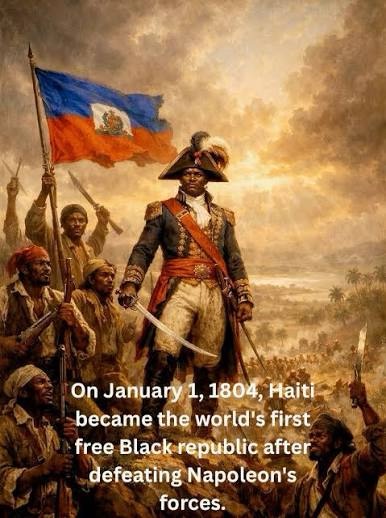
Haiti was born from one of the most remarkable revolutions in modern history. Enslaved Africans in the French colony of Saint-Domingue rose against a brutal plantation system and ultimately defeated one of Europe’s most powerful armies.
In 1804, Haiti declared independence.
It was an extraordinary victory: a people who had been treated as property had defeated slavery, defeated colonial rule and established an independent Black republic.
But the revolutionary victory came with a punishment that would shape Haiti’s economic history for generations.
The Revolution That Changed the World
The Haitian Revolution of 1791–1804 represented something profoundly threatening to the colonial order.
Saint-Domingue had been one of France’s most profitable colonies, built on the forced labor of enslaved Africans. Sugar, coffee and other commodities generated enormous wealth for French merchants and plantation owners.
The enslaved population, however, paid the price.
The revolution shattered that system.
Haitians did not simply demand better treatment within the colonial system. They fought to destroy slavery itself and establish sovereignty.
For slaveholding societies across the Americas, the Haitian Revolution was both an inspiration and a warning.
The existence of an independent Black republic born from a successful slave revolt challenged the ideological foundations of European colonialism.
Yet independence did not bring Haiti the economic freedom that its revolutionaries had fought for.
The Price of Recognition
In 1825, more than two decades after Haiti declared independence, France demanded compensation from the new republic.
King Charles X issued an ordinance requiring Haiti to pay 150 million francs to compensate former French colonists for losses associated with the Haitian Revolution.
French warships were sent to Haiti to enforce the demand.
The choice presented to Haiti was therefore hardly a normal diplomatic negotiation: accept the financial terms or face the threat of renewed military action.
The College de France describes the arrangement as a treaty imposed by France under force, with Haiti borrowing from French banks in order to meet the enormous payment. (Collège de France)
The original amount was eventually reduced to 90 million francs, but the burden remained enormous.
Haiti spent generations servicing the debt. The final payments were not completed until the 20th century.
This history has become central to contemporary debates over reparations and the economic consequences of colonialism.
French President Emmanuel Macron acknowledged in 2025 that forcing Haiti to pay for its independence was an injustice, although France did not agree to Haiti’s broader demands for reparations. (AP News)
The significance of the episode goes beyond the money itself.
The former colony had won its freedom through revolution, only to find that international recognition could come attached to a massive financial penalty.
The “Double Debt”
The burden became even more complicated because Haiti did not simply hand over money that it already possessed.
It had to borrow.
French banks helped finance the payments, meaning Haiti’s indemnity to France was intertwined with additional financial obligations to foreign lenders. Historians often refer to this as Haiti’s “double debt.” (Collège de France)
That distinction matters.
The question is not merely how much Haiti paid France in the 19th century. It is also how the financial burden affected the resources available to the Haitian state as it attempted to build infrastructure, schools, institutions and an economy after a devastating revolution.
The legacy of that debt remains the subject of intense historical debate. Modern estimates of its equivalent economic cost vary widely, with some calculations placing the damage in the tens of billions of dollars.
The frequently cited $21 billion figure should therefore be treated as an estimate of historical economic loss, not as a literal outstanding Haitian government debt today.
Independence Did Not End Foreign Intervention
Financial pressure was only one part of Haiti’s difficult relationship with powerful foreign states.
The United States occupied Haiti from 1915 to 1934.
The occupation reshaped Haiti’s political and economic institutions and remains deeply controversial in Haitian historical memory.
Later, Haiti experienced decades of authoritarian rule, including the Duvalier dictatorship.
François “Papa Doc” Duvalier came to power in 1957 and established a regime marked by political repression. His son, Jean-Claude “Baby Doc” Duvalier, succeeded him and remained in power until 1986.
The collapse of the Duvalier regime did not produce lasting political stability.
Instead, Haiti entered decades of coups, disputed elections, weak institutions, political violence and repeated foreign interventions.
The pattern became painfully familiar: a political crisis would emerge, international actors would intervene, a new government would be supported, elections would be organized, and the underlying institutional weaknesses would remain.
Intervention Without Stability
Haiti has received enormous amounts of international assistance over the decades.
It has also experienced repeated international missions.
Yet humanitarian assistance and military intervention are not the same as building durable institutions.
Foreign powers have often approached Haiti through the lens of immediate crisis management: stabilize the streets, organize elections, deploy troops, distribute aid and prevent mass migration.
But Haiti’s deeper problems — weak public institutions, poverty, corruption, limited economic opportunity, political fragmentation and the lack of an effective national security system — have proved far more difficult to solve.
The result has been a cycle of intervention followed by withdrawal, crisis followed by another intervention, and political transition followed by renewed instability.
The 2010 Earthquake and a Nation Under Pressure
The devastating 2010 earthquake added another catastrophic blow.
Hundreds of thousands of people were killed, millions were affected and enormous parts of the country’s already fragile infrastructure were destroyed.
The international response was massive.
But reconstruction also exposed problems surrounding accountability, coordination and the relationship between international organizations and Haitian institutions.
Haiti repeatedly found itself in the strange position of receiving extraordinary international attention while simultaneously struggling to exercise effective control over its own development.
That contradiction has defined much of the country’s recent history.
The Assassination That Deepened the Crisis
In July 2021, President Jovenel Moïse was assassinated.
The killing plunged Haiti into an even deeper political crisis.
With national institutions already weakened, armed groups expanded their influence.
Political authority became increasingly fragmented, while criminal organizations competed for territory, transportation routes, businesses and control of neighborhoods.
The absence of functioning national elections and the deterioration of state institutions created a vacuum.
And armed groups moved into it.
When Gangs Begin to Replace the State
The gangs operating in Haiti are not simply street criminals.
Many have developed significant territorial control and sophisticated networks involving weapons, extortion, kidnapping and political influence.
United Nations agencies have estimated that criminal groups controlled or influenced roughly 85 percent of Port-au-Prince and its metropolitan area at various points in the recent crisis. Human Rights Watch cited the UN estimate in its 2025 assessment of Haiti. (Human Rights Watch)
That figure should be understood as a measure of territorial influence and control, rather than meaning that every person or institution in 85 percent of the capital is directly governed by gangs.
Nevertheless, the underlying reality is extraordinary.
A national capital is struggling to function because armed organizations control roads, neighborhoods and access to essential services.
The consequences are devastating.
Families have been forced from their homes. Businesses have closed. Schools have been disrupted. Kidnappings and extortion have become part of everyday life in many communities.
The United Nations has also warned of the enormous number of illegal firearms circulating in Haiti, with estimates ranging from 270,000 to 500,000 weapons. (Les Nations Unies en Haïti)
But Haiti Is Not Simply a Story About Gangs
It is tempting to tell Haiti’s story as one of criminality.
That would be a mistake.
Gangs are a symptom of a much deeper institutional collapse.
Where the state cannot reliably provide security, armed organizations can become alternative centers of power.
Where economic opportunities are scarce, criminal economies can become attractive.
Where political institutions are weak, armed groups can become instruments for political and economic interests.
And where citizens lose faith in the state’s ability to protect them, the authority of the state itself begins to erode.
This does not excuse gang violence.
It explains how such violence can become entrenched.
The International Community Has Tried Again
In recent years, the international community has once again turned to multinational security operations.
A Kenya-led Multinational Security Support mission was deployed to assist the Haitian National Police.
But the mission faced significant logistical, financial and personnel challenges. Human Rights Watch noted that the force remained far below its originally expected strength during 2024. (Human Rights Watch)
In September 2025, the United Nations authorized a new Gang Suppression Force intended to replace the earlier mission and work alongside Haitian security institutions. The force was authorized at a planned strength of 5,550 personnel. (United Nations)
The question, however, is bigger than whether another international force can defeat armed groups.
The real question is what happens afterward.
Who rebuilds the police?
Who strengthens the courts?
Who creates legitimate political institutions?
Who provides economic opportunities for young Haitians?
Who restores roads, schools and hospitals?
And who ensures that Haiti’s sovereignty remains at the center of the process?
Haiti and the Pan-African Question
For Africans and people of African descent around the world, Haiti’s history carries a special significance.
The Haitian Revolution demonstrated that enslaved Africans could overthrow a colonial regime and establish an independent state.
It was a revolutionary event with consequences far beyond the Caribbean.
Haiti challenged the idea that European empires possessed an unquestionable right to rule African-descended people.
That is why Haiti’s subsequent treatment by powerful nations deserves to be examined not merely as a Haitian political problem, but within the larger history of colonialism and the African diaspora.
The story also raises uncomfortable questions about sovereignty.
What does independence mean when a newly independent state can be forced to compensate the people who benefited from its enslavement?
What does sovereignty mean when foreign powers repeatedly determine the political conditions under which a country operates?
And what happens when generations of economic and political pressure weaken the institutions that are supposed to protect national independence?
The Crisis Cannot Be Reduced to One Villain
None of this means Haiti’s problems can be explained entirely by France, the United States, the United Nations, political elites or gangs.
Haitian political leaders have made decisions that contributed to the country’s instability. Corruption and political violence have caused enormous damage. Criminal organizations have committed atrocities against civilians.
Haiti’s crisis has multiple causes.
But history matters because present-day conditions do not emerge from nowhere.
A country that began its independent existence under international isolation and a coercive financial burden faced extraordinary obstacles from the beginning.
Decades of authoritarianism, foreign intervention, political instability, natural disasters and institutional weakness compounded those problems.
Today, armed groups are exploiting the resulting vacuum.
The Question of What Comes Next
The international community cannot simply treat Haiti as another security problem to be contained.
Military operations may be necessary to protect civilians and restore basic security, but security cannot be the end of the story.
Haiti needs functioning democratic institutions.
It needs accountable government.
It needs an effective police and justice system.
It needs economic investment that creates genuine opportunities rather than another cycle of dependency.
And it needs a serious international reckoning with the historical forces that have shaped its development.
Two centuries after France imposed the independence indemnity, the debate over that debt has returned to the international spotlight.
At the same time, Haiti’s capital remains under immense pressure from armed groups.
The connection between these events is not a simple straight line. The debt of 1825 did not “cause” today’s gangs.
But Haiti’s history demonstrates something important: economic exploitation, political instability and weakened institutions can accumulate across generations.
The Haiti of today is the product of a long history — revolutionary triumph followed by economic punishment, independence followed by international isolation, foreign intervention followed by fragile institutions, and political crisis followed by the expansion of armed power.
The country that once shocked the colonial world by defeating slavery now faces another historic struggle: reclaiming the authority of the state from forces that have filled the vacuum left by decades of institutional failure.
Haiti’s story should therefore not be told as the story of a failed nation.
It should be told as the story of a revolutionary nation whose sovereignty has repeatedly been tested — and whose people continue to struggle to make the promise of independence real.
The world owes Haiti more than pity.
It owes Haiti an honest reckoning with history.