


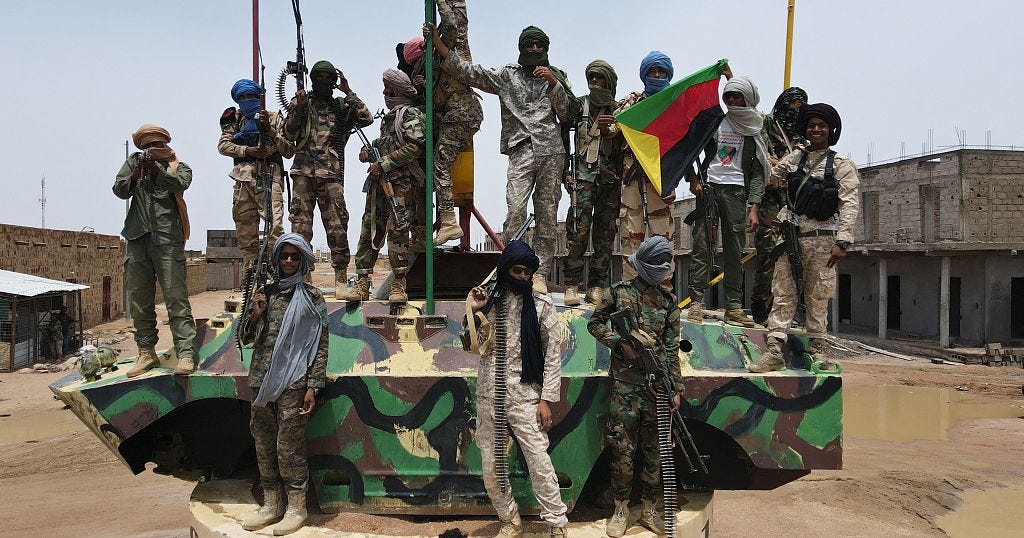
The coordinated attacks across Mali on 25 April 2026 marked a major turning point in the country’s conflict. More importantly, they brought into the open what had long been suspected: the growing military cooperation between the Azawad Liberation Front (FLA) and Jama’at Nusrat al-Islam wal-Muslimin (JNIM). While the two groups had previously been linked through local arrangements and suspected battlefield coordination, the scale, sophistication and synchronisation of the offensive demonstrated a close operational partnership.
The offensive ended with the FLA taking control of the city of Kidal and forcing the withdrawal of Malian forces and Russia’s Africa Corps, marking one of the movement’s most significant military victories in recent years. However, capturing Kidal from government forces may prove easier than governing it under the FLA–JNIM arrangement. The FLA’s political ambitions and JNIM’s jihadist agenda do not fully align, and both groups are likely to face substantial challenges in jointly administering the city while sustaining their partnership. In this context, the central question is no longer who can seize Kidal, but who will ultimately shape its future.
Authority and Governance in Post-Offensive Kidal
Governance in northern Mali remains an understudied question, especially since the Malian army and Wagner, later replaced by Africa Corps, re-entered the region in November 2023, pushed back rebel control, and installed El Hadj Ag Gamou as governor of Kidal. Some reports suggested improvements in basic services under Ag Gamou’s administration. His appointment was politically significant as he is an Imghad leader. Ag Gamou comes from a tribe that has historically been subordinate to the Ifoghas, the tribal confederation from which many rebel leaders and senior JNIM figures originate. Ag Gamou himself has had a complex relationship with Iyad Ag Ghaly, the JNIM Emir, at times fighting alongside him and at other times against him.
The situation is now considerably more complex. While the FLA claims to have retaken Kidal, JNIM already maintained a strong presence in the region through repeated attacks on Malian forces and Russia’s Africa Corps, as well as through influential local commanders such as Abu Abdel Rahman al-Kidali, better known as Sedane Ag Hita.
Beyond its military footprint, JNIM has also developed and sustained forms of local governance in parts of northern Mali, including systems of taxation, security provision, and dispute resolution. These functions not only reinforce its embeddedness in local networks but also place the group in a position to potentially govern or co-govern territory under its influence. Moreover, JNIM has long expressed ambitions to extend its control over Kidal as part of its broader strategy in the Sahel.
As a result, it is unclear how authority will be exercised on the ground under the JNIM–FLA arrangement, how responsibilities will be divided between the two groups in practice, and whether the FLA will be able to effectively govern Kidal without relying on JNIM’s established local networks.
A Pragmatic Power-Sharing Arrangement
According to local sources, the current agreement between JNIM and the FLA was negotiated well before the April 2026 offensive. The groups initially agreed to coordinate military operations before expanding their cooperation into a broader political and governance framework for areas recaptured from Malian and Russian forces. A key figure in these negotiations was Al-Ghabass Ag Intalla, the FLA’s second-in-command and an allegedly close relative of Iyad Ag Ghaly. Having previously served alongside Iyad in Ansar Dine, Alabass reportedly played a central role in bringing the two movements together.
A local source also credits Bilal Ag Acherif, the FLA’s president, with shaping the governance arrangements for Azawad following the withdrawal of Malian and Russian forces. According to the source, negotiations accelerated as both movements came under sustained military pressure from Wagner and FAMa even prior to Wagner’s entry into Kidal in November 2023, creating a shared motivation for cooperation.
Despite this rapprochement, the source stressed that the agreement should be viewed as temporary rather than permanent. The two organisations continue to pursue different long-term objectives. While the FLA seeks to establish an independent Azawad state, JNIM’s objective remains the implementation of Sharia law across West Africa. According to local sources, the FLA accepted the application of Sharia but insisted that religious matters be overseen by local qadis and marabouts rather than dictated directly by JNIM. The FLA would instead retain responsibility for governance and administration outside areas already directly controlled by JNIM. The arrangement therefore reflects a pragmatic compromise designed to preserve cooperation while allowing each movement to pursue its own political project.
The difference in these groups’ political objectives has the potential to undermine even temporary cooperation. Local sources based in Kidal noted that the arrangement has already faced periodic tensions. According to these accounts, JNIM members have on at least two occasions attempted to bypass FLA authority by independently imposing punishments for alleged violations of Islamic law in areas on the outskirts of Kidal that are nominally under FLA administration.
These incidents have, according to the same sources, been resolved through negotiations between the two groups, with reports of disciplinary measures taken against non-compliant JNIM members. However, they raise broader questions about the degree of centralized command and control within JNIM, particularly in areas under FLA administration. Actions by individual fighters or sub-units attempting to enforce Sharia independently have the potential to complicate the agreement between the two groups.
That said, coexistence in Kidal has thus far appeared relatively stable and is in part shaped by an unusual degree of social overlap between the two groups. According to a local source, many senior figures within both the FLA and JNIM originate from Kidal itself and are embedded in the same tribal and family networks. In practice, a significant number of individuals exercising influence over the city come from the same local communities, despite their formal affiliation with different organisations. This shared social and relational fabric has, in turn, made cooperation considerably easier than it might otherwise have been.
Joint Governance in Practice
In an interview, a Kidal resident shared that the FLA has the stronger conventional military presence in Kidal, having concentrated much of its forces, personnel and equipment around Tinzawaten before launching the April offensive. JNIM, however, continues to wield considerable influence through its longstanding local networks and commanders. Rather than competing for authority, the two groups are jointly coordinating security and the day-to-day administration of the city.
This security cooperation appears to be occurring at both senior and tactical levels. FLA and JNIM commanders reportedly coordinate operational planning while overseeing parallel or joint patrols in less secure areas. Fighters from both groups have also been observed operating in the same zones and participating in shared security tasks, suggesting cooperation that extends beyond leadership coordination. Although the groups’ command structures remain formally distinct, battlefield reporting indicates a growing degree of operational convergence, with the nature and extent of cooperation varying according to local conditions.
JNIM-FLA cooperation extends beyond security. Before the April offensive, the International Committee of the Red Cross (ICRC) supported Énergie du Mali (EDM), in supplying electricity to Kidal. Following the capture of the city, the ICRC office was reportedly looted and its staff withdrew. According to the local source, the FLA-JNIM coordination has since assumed responsibility for maintaining electricity supplies and assisting residents with access to water and basic food supplies, effectively filling part of the governance vacuum left by the departure of state institutions and humanitarian organisations. Local sources also indicated that, since taking control of the city, the FLA–JNIM alliance has launched community development initiatives including improving water quality, distributing food and other essential supplies to needy families, and cleaning streets to improve sanitation.
Local sources also point to broader indications that the partnership has gained acceptance within al-Qaeda’s wider network. Following the April offensive, Al-Qaeda in the Arabian Peninsula (AQAP) publicly congratulated JNIM and the local tribes, a statement that sources interpreted as recognition of the alliance between JNIM and the FLA. According to these sources, such recognition may strengthen the prospects for continued cooperation, provided both sides continue to uphold the agreement.
However, the durability of the arrangement remains uncertain, as Kidal represents a unique case rather than a model that can easily be replicated elsewhere. According to the source, coexistence has been facilitated by shared tribal ties and longstanding personal relationships between leaders from both organisations. Extending the same governance framework to regions such as Timbuktu or Gao is therefore expected to prove far more difficult.
JNIM-FLA Cooperation Beyond Kidal
While the arrangement in Kidal has thus far appeared relatively stable, replicating it elsewhere is likely to prove considerably more difficult. According to local sources, Kidal represents a unique case in which many senior figures within both the FLA and JNIM originate from the same tribal and social networks, creating a degree of trust and familiarity that has facilitated cooperation.
Timbuktu presents a markedly different picture. Local sources report that JNIM already plays a central governance role there, mediating tribal disputes, regulating markets, and providing local administration. They also point to the influence of Katiba Al-Furqan, suggesting that governance beyond Kidal will depend in part on Iyad Ag Ghaly’s ability to maintain consensus across JNIM’s various components while preserving cooperation with the FLA. The wali of Timbuktu is also reportedly from an Arab community and may have little interest in advancing the FLA’s political project for an independent Azawad.
Much of JNIM’s influence in Timbuktu is rooted in the governance structures and economic networks it has developed over the past several years. One of the principal ways in which JNIM has consolidated its influence around Timbuktu is through its management of the trade in gold and other strategically important commodities. The group regulates the prices of key goods, mediates commercial disputes, provides security for traders, and performs other administrative functions that facilitate local economic activity. These arrangements not only generate an important source of revenue but also demonstrate JNIM’s capacity to govern, reinforcing its legitimacy as the de facto authority in areas where the state is absent or ineffective. Research on JNIM’s governance model has highlighted how dispute resolution, market regulation, and control over natural resources enable the group to embed itself within local economies while strengthening its political authority.
Given how deeply entrenched these political and economic arrangements have become, it is unlikely that JNIM would be willing to cede or share them with the FLA without securing significant concessions in return. Diluting JNIM’s influence over these revenue-generating and legitimacy-enhancing functions would risk weakening both its financial base and its position as the dominant governing actor in the region.
Assessment
JNIM’s decision to align with the FLA appears primarily pragmatic. It enhances the group’s perceived legitimacy, signals a willingness to negotiate and compromise for strategic gain, and provides an additional arena in which to demonstrate governance capacity. Legitimacy in this context is not merely symbolic; it determines whether armed actors are perceived as political authorities rather than purely coercive forces. Governance thus becomes a vehicle through which political authority can be constructed and consolidated.
The trajectory of Hay’at Tahrir al-Sham (HTS) in Syria illustrates how service provision, territorial administration, and economic management can form part of a broader strategy of political repositioning. In a similar way, JNIM’s cooperation with the FLA can be understood as an attempt to convert battlefield success into governance credibility, and governance performance into longer-term political legitimacy.
However, this dynamic is not unilateral: it also carries important implications for the FLA itself. By entering into an arrangement with a transnational jihadist actor, the FLA gains short-term military capacity and territorial leverage, but it also risks diluting its separatist nationalist legitimacy and becoming associated (directly or indirectly) with Islamist governance practices that may be unpopular with parts of its base and external interlocutors. Shared governance also creates operational ambiguity over enforcement, jurisdiction, and coercive authority in contested zones, potentially weakening the coherence of the FLA administration as it extends its reach.
Ultimately, the alliance illustrates a broader dynamic in which legitimacy is co-produced but also contested: JNIM seeks to convert governance into authority, while the FLA must manage the risks of association and the erosion of exclusive political control.