
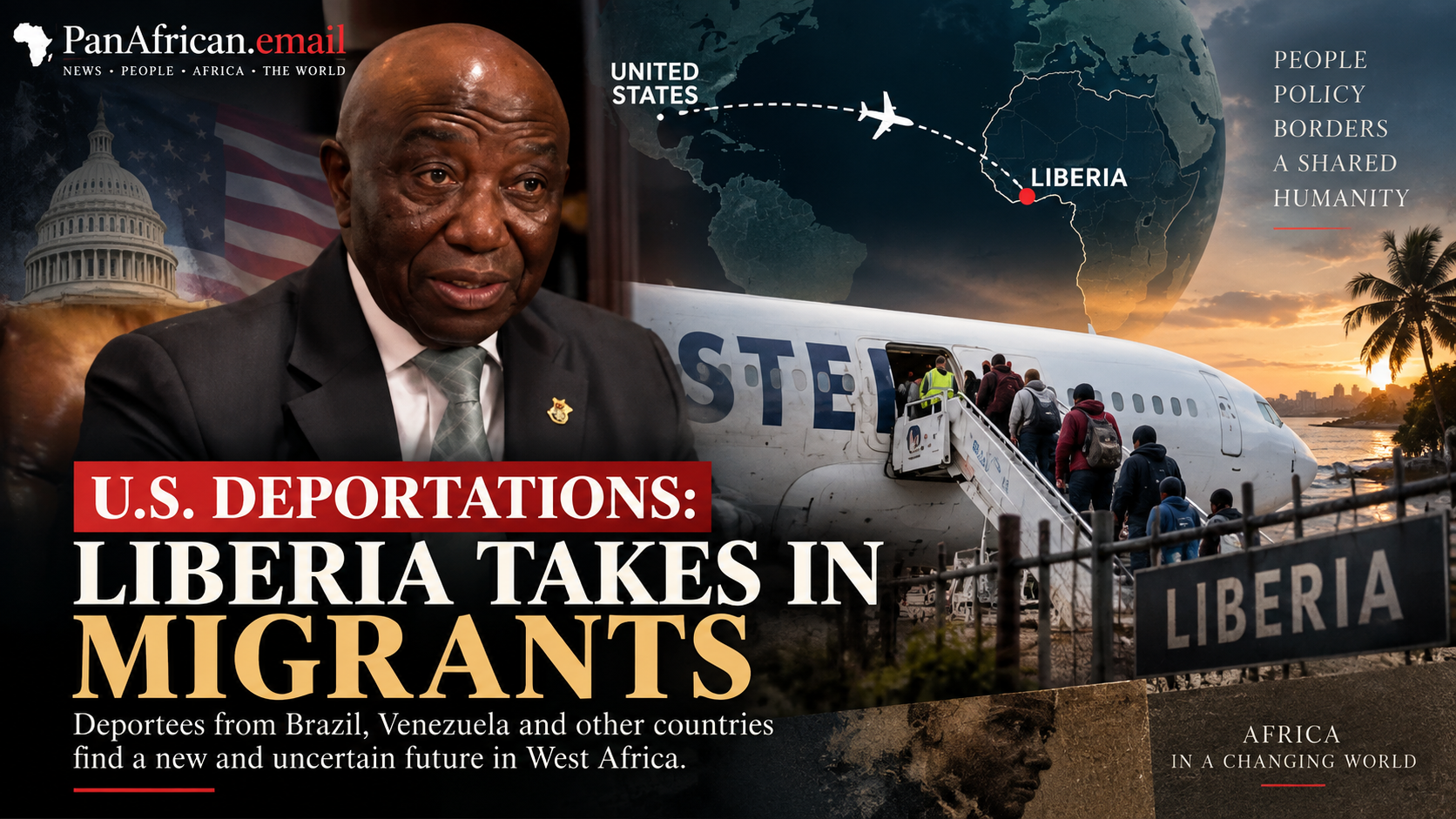
MONROVIA, LIBERIA — A group of people deported from the United States to Liberia has found itself thousands of miles from home, navigating an unfamiliar country and an uncertain future after being removed under the Trump administration’s expanding immigration enforcement policies.
According to reporting by CBS News, the deportees include individuals from countries such as Brazil and Venezuela who were transferred to Liberia rather than returned directly to their countries of origin. CBS News correspondent Camilo Montoya-Galvez and his team tracked down members of the group in a coastal community in Liberia, where the deportees are now attempting to understand what comes next.
The development places Liberia at the center of a broader and increasingly controversial debate over how the United States handles deportations when direct removal to a person’s country of origin is difficult, disputed or otherwise unavailable.
From the United States to West Africa
For the deportees, the journey represents a dramatic change in circumstances.
Rather than returning to Brazil, Venezuela or another country with which they have a direct connection, the individuals were transported to Liberia, a West African nation located along the Atlantic coast.
Liberia has longstanding historical ties with the United States, particularly through the country’s founding in the 19th century by formerly enslaved Black Americans and the establishment of the Republic of Liberia in 1847. Those historic connections have made Liberia an important partner for Washington for generations.
But historical ties do not necessarily mean that foreign deportees have an established community, family network or economic support system waiting for them.
For people arriving from Latin America, the transition to Liberia can therefore be profound — involving a new continent, different languages and cultures, unfamiliar institutions and thousands of miles of separation from relatives and communities.
A Complicated Immigration Question
The transfers have also raised questions about the legal and diplomatic framework surrounding third-country deportations.
Traditionally, deportation involves returning an individual to their country of nationality or another country legally prepared to receive them. The use of a third country introduces additional questions, including what agreements govern the transfer, what legal protections apply after arrival and what happens to people who have no meaningful connection to the receiving country.
These questions are particularly significant when deportees are transported across continents.
The situation also highlights the growing importance of international cooperation to U.S. immigration enforcement. As Washington seeks to increase removals, countries outside the Western Hemisphere can potentially become part of the logistical and diplomatic network supporting those efforts.
Life After Arrival
CBS News’ reporting found members of the deportee group in a town near Liberia’s Atlantic coastline.
Their circumstances illustrate the human dimension of immigration policy that can sometimes become obscured by statistics and political debate.
A deportation does not necessarily end with an aircraft landing. For the person being removed, it can mark the beginning of a new period of uncertainty involving accommodation, employment, transportation, communication with family and access to legal assistance.
For individuals who have never lived in Liberia, establishing a life in the country can present additional challenges.
Liberia itself continues to face significant economic and employment pressures, meaning that newly arrived foreign nationals may have difficulty establishing themselves without financial resources, family connections or institutional assistance.
Liberia’s Position
The development also raises questions for Liberia.
As a sovereign state, Liberia’s participation in international deportation arrangements can have consequences extending beyond the individuals directly involved. The country must balance diplomatic relationships with the United States against domestic considerations surrounding immigration, employment, public services and national sovereignty.
The episode could therefore become part of a larger conversation about the role African countries play in international migration policy.
African nations have increasingly become important partners in global migration management, whether through hosting refugees, accepting deportees, cooperating on border security or participating in international agreements concerning migration.
Liberia’s involvement demonstrates how decisions made in Washington can have consequences far beyond America’s borders.
A Broader Global Debate
The deportations arrive amid an increasingly international debate over migration and the responsibilities of countries receiving people removed from elsewhere.
Supporters of tougher deportation policies argue that governments have a responsibility to enforce immigration laws and remove people who do not have legal permission to remain in their territory.
Critics, however, have raised concerns about due process, family separation, humanitarian protections and the potential consequences of sending people to countries where they have little or no connection.
Third-country deportations add another layer to that debate.
The central question becomes not simply whether someone should be removed, but where they should go and what obligations the receiving country assumes once they arrive.
What Happens Next?
For the deportees now in Liberia, the immediate issue is more personal than geopolitical: determining how to rebuild their lives in a country they may never have expected to call home.
Their presence also puts Liberia under an international spotlight, potentially prompting further discussion about the country’s agreements with foreign governments and its role in global migration policy.
As the United States continues to pursue an aggressive deportation agenda, Liberia and other countries may increasingly find themselves involved in immigration decisions originating thousands of miles away.
The story of the deportees in coastal Liberia is therefore more than an account of one group of people. It is a window into a rapidly changing international migration system — one in which borders, diplomatic agreements and domestic immigration policies increasingly intersect.
Source: CBS News reporting by Camilo Montoya-Galvez and contributors. The details above are presented as a journalistic rewrite of the supplied description; specific legal or diplomatic arrangements should be independently verified before publication.
Leave a Reply