
By panafrican.email | Global Affairs & Defense
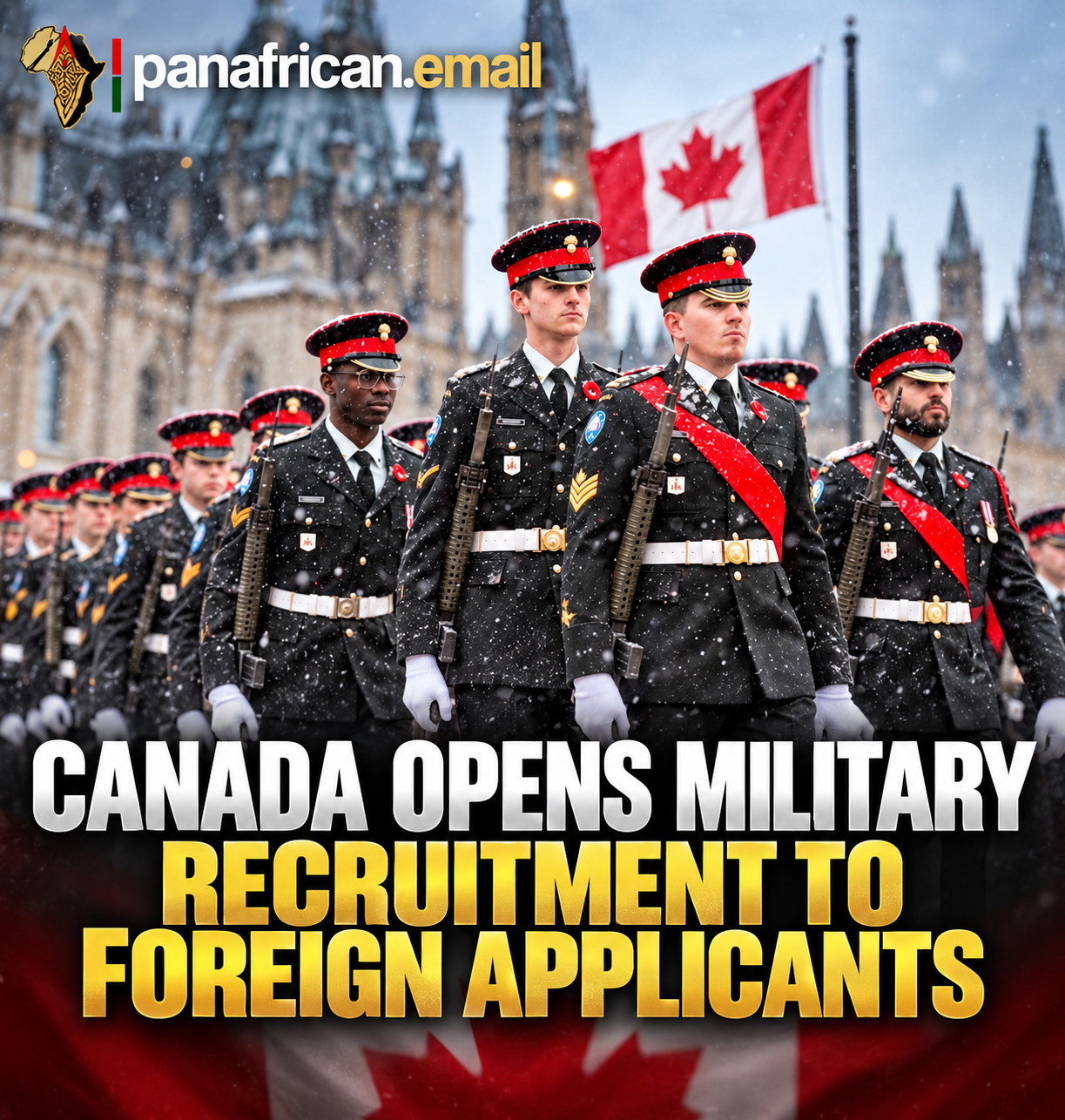
Canada is widening the pool of people eligible to serve in its armed forces, including permanent residents who are not yet Canadian citizens. The policy is part of a broader effort by Ottawa to address military recruitment challenges, strengthen the Canadian Armed Forces (CAF), and attract skilled personnel.
But the expansion is also raising an important public debate: What should citizenship, loyalty and national commitment mean when someone is being entrusted with the defense of a country?
The issue deserves serious discussion—not because foreign-born people are inherently less loyal, but because military service carries responsibilities that are fundamentally different from most civilian employment.
A Changing Canadian Military
The Canadian Armed Forces has been working to rebuild its personnel numbers after years of recruitment and retention challenges.
The scale of that challenge is significant. According to Canada’s Department of National Defence, the CAF enrolled 7,310 Regular Force members during fiscal year 2025–26, exceeding its target of 6,957 and marking its highest number of Regular Force enrolments in more than three decades.
At the same time, the CAF enrolled 1,400 permanent residents during the same fiscal year—the highest number of permanent-resident enrolments since 2022.
Canada’s current authorized strength calls for 71,500 Regular Force personnel and 38,800 Reserve Force personnel. As of July 31, 2026, the Regular Force stood at approximately 68,473 members.
The numbers help explain why Ottawa is looking beyond the traditional recruitment pool.
Who Can Apply?
The policy does not mean that anyone from another country can simply arrive in Canada and enlist.
Canadian rules generally allow Canadian citizens and eligible permanent residents to apply. Current CAF information says permanent residents must have at least three years of physical presence in Canada for eligibility under the updated requirements, and permanent residents are eligible for more than 90 occupations across the Navy, Army and Air Force.
Canada first formally announced the opening of CAF recruitment to permanent residents in December 2022.
The government said the change was intended to broaden the recruitment pool while allowing permanent residents who meet the necessary requirements to serve alongside Canadian citizens.
The policy also recognizes the particular importance of skilled military personnel. Canada has previously accepted trained applicants from foreign militaries who possess permanent resident status, including professionals such as pilots, logistics officers and infantry officers.
The Security Question
This is where the debate becomes more complicated.
Military personnel can have access to sensitive information, weapons, communications systems, military installations and operational capabilities. In some positions, they may eventually participate in missions involving national defense or armed conflict.
That makes security screening essential.
Canada has acknowledged that permanent-resident applicants can present particular screening challenges because of their international backgrounds. In 2025, the Department of National Defence and Immigration, Refugees and Citizenship Canada began sharing information—with appropriate authorization—to facilitate enrolment and security screening for permanent residents interested in joining the CAF.
A 2025 Auditor General report also examined the issue and found that changes to security-screening procedures contributed to a substantial increase in permanent residents being recruited during the latter part of the audit period.
The important point is that foreign birth itself is not evidence of disloyalty.
Millions of immigrants around the world have demonstrated extraordinary commitment to the countries where they live. Canada itself has a long history of immigrants and children of immigrants serving in its military.
The real question is whether the screening process can reliably determine whether an individual is suitable to hold military responsibilities.
Loyalty Is More Than a Passport
Military service is different from ordinary employment.
A soldier, sailor or air force member may eventually be required to risk their life for the country they serve. They may be ordered into dangerous environments, asked to protect civilians, or required to fight alongside fellow service members.
That creates a legitimate question for Canadian society:
What does it mean to be committed to Canada?
A passport provides legal citizenship status. But military service requires something deeper—professional integrity, adherence to lawful orders, respect for democratic institutions and a willingness to place the mission and the safety of fellow service members ahead of personal interests.
That standard should apply equally to Canadian-born citizens and immigrants.
Being born outside Canada should not automatically make someone suspect.
Likewise, being born in Canada should not automatically guarantee loyalty.
The determining factors should be conduct, character, security eligibility and demonstrated commitment to the country.
Canada Has a Recruitment Problem
The recruitment expansion also needs to be viewed through the reality facing the Canadian military.
The CAF has been trying to increase its numbers while competing with Canada’s civilian economy for skilled workers.
Canada’s 2026–27 defense planning specifically identifies continued recruitment efforts, including enrolling permanent residents and improving recognition of foreign education and credentials.
Canada has also introduced immigration pathways connected to military recruitment. In its 2026 immigration categories, the federal government included skilled military recruits with a job offer from the Canadian Armed Forces among its categories for attracting needed talent.
That demonstrates how immigration and military recruitment are increasingly becoming interconnected parts of Canada’s workforce strategy.
The African and Diaspora Dimension
For African and Caribbean communities living in Canada, this development has another dimension.
Canada is home to large and growing African and Caribbean diaspora communities. Many members of these communities are permanent residents who work, study, build businesses and raise families in Canada.
Some may now see military service as another avenue for contributing to their adopted country.
For an African immigrant or other newcomer, joining the Canadian Armed Forces can represent more than employment. It can be a declaration of commitment to the society in which they have chosen to build their future.
At the same time, governments must recognize that international backgrounds can create complicated security considerations.
A person may have family, financial, professional or other connections outside Canada. That does not automatically make those connections problematic. But where national-security responsibilities are involved, authorities must evaluate them carefully and consistently.
Canada’s Challenge: Inclusion Without Complacency
Canada therefore faces a delicate balancing act.
On one side is the need to recruit enough qualified personnel to maintain a capable military.
On the other is the responsibility to protect national security and maintain public confidence in the armed forces.
The answer should not be to treat immigrants as inherently suspicious.
Nor should the answer be to ignore legitimate security concerns in the name of diversity.
Instead, Canada needs a recruitment system that applies the same demanding standards of character, security, competence and commitment to every applicant.
That means transparent eligibility rules, rigorous screening, strong counter-intelligence protections and continuous assessment where appropriate.
It also means recognizing that loyalty is not determined by someone’s birthplace.
A Debate Canada Should Have
Canada’s decision to recruit eligible permanent residents is not entirely new—the policy dates back to 2022—but its growing scale makes the issue increasingly important.
With 1,400 permanent residents joining the Regular Force in fiscal year 2025–26, the role of immigrants and permanent residents within Canada’s military is becoming considerably more visible.
The central question should therefore not be:
“Are foreigners loyal enough to serve Canada?”
A better question is:
“Does Canada’s recruitment and security system effectively identify people—regardless of birthplace—who possess the character, competence and commitment required to serve Canada?”
That is a question worth asking.
Canada needs soldiers it can trust.
It also needs a military that reflects the society it is defending.
Those two objectives do not have to conflict.
The ultimate standard should be neither race nor birthplace, but service, integrity, security and commitment to Canada.
What do you think?
Should Canada continue expanding military recruitment to qualified permanent residents?
Should additional security requirements apply to applicants with extensive overseas connections?
Or should the same standards apply to everyone regardless of citizenship history or country of birth?
Join the conversation with panafrican.email.
Leave a Reply