
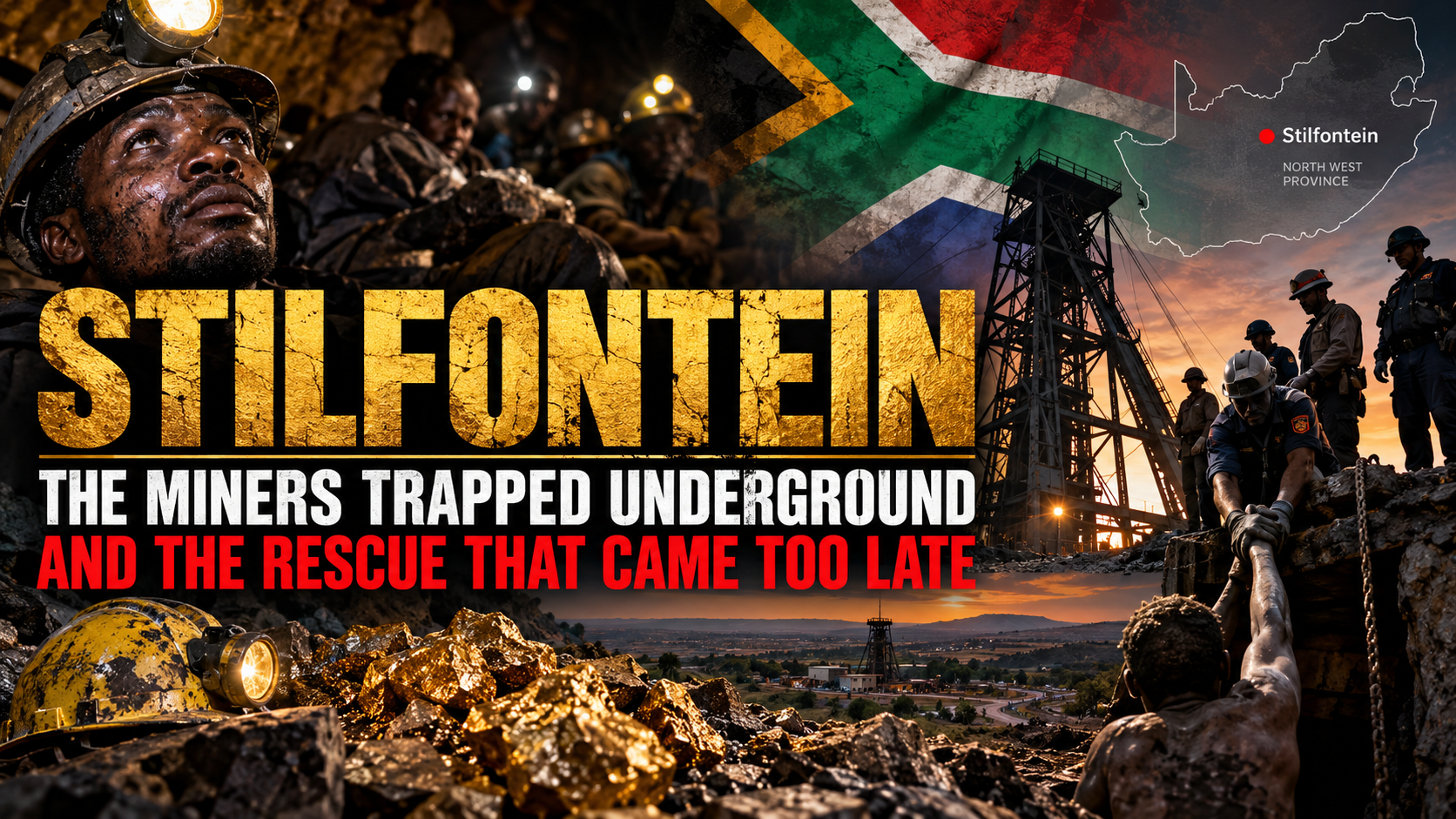
STILFONTEIN, SOUTH AFRICA — In 2024, a government crackdown on illegal mining in South Africa turned a long-running struggle over abandoned gold mines into a deadly humanitarian crisis.
Hundreds of miners became trapped underground in and around Stilfontein, in North West province, as authorities intensified efforts to force illegal miners out of disused shafts. What followed was a prolonged standoff that exposed the dangerous conditions facing people working in abandoned mines—and raised difficult questions about how governments should respond when criminality, poverty, migration and human survival collide.
For the miners underground, the consequences were immediate and brutal.
Some remained below the surface for weeks and months. Food and drinking water became scarce. Those who attempted to leave risked arrest. Others were reportedly prevented from returning underground with supplies as authorities tightened the pressure around the mine workings.
The crisis eventually became one of South Africa’s most closely watched illegal-mining confrontations.
A Dangerous Economy Beneath the Surface
Illegal mining has deep roots in South Africa’s gold-mining regions.
As major commercial mines have closed or become uneconomical, abandoned shafts have remained scattered across communities that were once built around the country’s enormous gold industry. These underground networks can become workplaces for so-called “zama zamas”—informal or illegal miners who enter abandoned workings in search of gold.
The term encompasses a diverse group of people.
Some are South African miners who have lost formal employment. Others are migrants from neighboring African countries who travel to mining regions in search of income. Organized criminal networks have also become involved in the illicit gold economy, creating a complex environment in which vulnerable workers can find themselves operating alongside powerful criminal interests.
The underground economy can be extremely dangerous.
Miners work without the protections normally associated with formal employment. Shafts may be unstable, ventilation can be inadequate and access to food, water and medical assistance is limited.
Yet for people with few economic alternatives, the risks can appear preferable to having no income at all.
The Government Crackdown
South African authorities have spent years attempting to combat illegal mining.
The government argues that illegal mining contributes to criminal activity, environmental destruction, infrastructure damage and lost revenue. Authorities have also linked some illegal mining operations to organized crime, including networks involved in the illegal purchase and processing of gold.
In Stilfontein, the government’s efforts became particularly controversial when authorities sought to pressure miners underground to emerge from the shafts.
The strategy was intended to disrupt illegal mining operations and bring those involved into the hands of law enforcement.
But the longer the confrontation continued, the more serious the humanitarian consequences became.
People underground were increasingly isolated from the outside world. Reports of shortages of food and water intensified concerns among families, community organizations and activists.
Inside the Darkness
For those trapped underground, the mine became a world separated from the one above it.
The darkness was constant.
Food had to be rationed. Water became precious. Physical exhaustion and fear compounded the psychological pressure.
Survivors later described an environment in which miners were forced to make impossible decisions about whether to remain underground or attempt to reach the surface.
Those who stayed faced deteriorating conditions.
Those who emerged risked arrest.
The situation demonstrated one of the central contradictions of illegal mining in South Africa: authorities were attempting to enforce the law against an activity that was simultaneously sustaining people who had few other economic options.
Families Waiting Above
The crisis was not confined to the miners.
Families gathered outside the mining area waiting for news about relatives who had disappeared underground.
For some families, the uncertainty lasted for weeks.
They did not know whether their relatives were alive, whether they had enough food or water, or whether they would ever return home.
The mine became a place of waiting and grief.
Community members and civil-society organizations increasingly demanded humanitarian access and questioned whether pressure on the miners was being applied in a way that endangered their lives.
The debate quickly expanded beyond illegal mining itself.
The central question became whether enforcing the law could justify allowing people to remain in life-threatening conditions underground.
A Rescue That Came Too Late for Many
Eventually, rescue operations began bringing miners to the surface.
But by then, the consequences of the prolonged underground ordeal had already become devastating.
Deaths were reported, while survivors emerged physically weakened and traumatized.
The operation forced South Africa to confront the human cost of a mining economy that has operated largely outside the formal system.
For the survivors, coming back to the surface did not necessarily mean that the crisis was over.
They faced possible arrest, medical problems, psychological trauma and uncertainty about what would happen next.
For families of those who died, the rescue could not undo the months of fear and loss.
The Human Cost of Gold
Stilfontein is ultimately a story about much more than illegal mining.
It is about the enormous value of South Africa’s mineral wealth—and the people who remain at the bottom of the economic chain surrounding it.
South Africa’s gold industry helped build modern cities and generated immense wealth over generations. But as the formal mining industry contracted, abandoned workings became part of a parallel economy.

That economy has its own supply chains, financiers, buyers and criminal intermediaries.
At the bottom are workers willing to descend hundreds or thousands of meters underground because the alternative may be unemployment or extreme poverty.
The gold extracted from these mines eventually enters markets far removed from the dangerous conditions in which it was produced.
This creates a difficult question for policymakers: how can illegal mining be dismantled without treating the miners themselves as disposable?
Beyond Enforcement
The Stilfontein crisis has renewed calls for a broader approach to illegal mining.
Law enforcement remains an important component of the government’s response, particularly where organized criminal networks are involved. But enforcement alone cannot eliminate the economic forces drawing people underground.
A sustainable solution would have to address several interconnected problems.
These include abandoned mine shafts, unemployment, migrant labor, criminal control of mineral supply chains, environmental damage and the lack of legitimate economic opportunities in mining communities.
Formalization could potentially provide another avenue in some circumstances.
Instead of forcing every informal miner into an immediate confrontation with the state, authorities could explore systems that distinguish vulnerable workers from organized criminal operators, while establishing strict safety and environmental standards.
Such an approach would not eliminate the dangers of mining.
But it could reduce the likelihood that desperate people are pushed into abandoned shafts where there are few protections and even fewer options for escape.
A Warning for Africa’s Mining Future
Stilfontein should also be understood within a broader African context.
Across the continent, artisanal and small-scale mining provides livelihoods for millions of people. Gold, diamonds, cobalt and other minerals can create opportunities for communities while simultaneously exposing workers to dangerous conditions and exploitation.
Governments are therefore confronted with a difficult balance.
They must protect mineral resources and public revenue while also protecting the people who depend on those resources for survival.
The tragedy at Stilfontein illustrates what can happen when that balance breaks down.
The miners underground were part of an illegal economy. But illegality does not erase the human consequences of policy decisions.
When people are trapped underground without sufficient food, water or medical assistance, the issue becomes more than a question of criminal enforcement.
It becomes a question of life and death.
Remembering the Stilfontein Survivors
For the survivors, the experience will likely remain with them long after they left the mine.
The darkness, hunger, fear and uncertainty cannot simply be left behind at the shaft entrance.
Their stories provide a rare view into a hidden part of South Africa’s mineral economy—one that exists beneath communities, outside formal employment statistics and largely invisible to consumers who ultimately purchase products containing valuable minerals.
Stilfontein is therefore both a mining story and a human story.
It raises questions about who benefits from Africa’s mineral wealth, who bears the risks and what responsibility governments, mining companies, traders and consumers have toward the people working at the most dangerous end of the supply chain.
The gold beneath South Africa’s soil has generated fortunes.
But the story of Stilfontein reminds the world that there is another cost buried underground—one measured not only in lost revenue, but in human lives.
Panafrican.email will continue examining Africa’s mineral economy, the communities affected by extraction and the political and economic forces shaping the continent’s resource future.
Leave a Reply